Cause And Effect Are Not Siloed, Should Education About Them Be?

Over on The Chronicle of Higher Education, Eric Hayot suggests that humanities subjects have a marketing problem.  Because students are oriented on the utility of degree programs to career development, it is easy to understand what the goals of degrees like accounting, business management, chemistry and physical therapy are but less clear in regard to history and literature outside of teaching those subjects.

Since I often rail against measuring the value of the arts in terms of utility, I was put a little on guard as I started reading further.  Hayot’s idea is to reorganize subject matter and reframe content more in terms of social problems that need consideration and addressing which is often what the performing and visual arts practice expresses.

One way to put such a change in place would be to reorganize the existing curriculum into sets of four-course modules. Such modules could come in two types. Skill modules would focus on practices: language learning, writing and speaking, historical, cultural, and social analysis. Theme modules would focus on topics: social justice, migration studies, the problem of God, translation, journalism, wealth and inequality, conflict, ideas of beauty, television, society and technology, and the like.

[…]

They would also need to convey to students that just because modules on issues like sex and sexuality or Latinx studies or Chinese history exist does not mean that they wouldn’t overlap with, say, material in your discussion of human environments or social justice. (You don’t want a curriculum to imply that the study of sexuality or African Americans happens over here, while the study of history “in general” happens over there.)

There is a lot of detail about his proposal in the article that I obviously can’t depict here without cutting and pasting super extensively. What he suggests bears some consideration because it more directly addresses the oft expressed concept that the skills you gain in humanities degree programs can be applied in myriad professions because of the overlap and interrelations between these topics. Hayot is basically calling for the silos of degree programs to be broken down significantly.

If we want to teach students that human life is not organized into disciplines, then we should not organize our curricula into disciplines. If we want to teach students to see historical connections across differing conditions of global power, we should not organize our literature departments exclusively around modern languages, whose effect is to reproduce over and over again the knowledge and aesthetic work produced in a period of European dominance.

Hayot lists a number of benefits he sees in this approach. Among those that appeared to respond most with the complaints of detractors of humanities degrees have made:

• Appealing immediately to students’ actual interests, or, in other words, meeting students where they are, in current historical conditions, rather than lamenting their lack of interest in traditional humanities majors. .. our job is to teach them, by hook or by crook, not to lament their resistance to being taught.

[…]

• Not forcing students into majors because they need a credential — the modules serve as the credential and communicate far more clearly than major titles a set of interests, skills, and expertise (to employers and parents as well).

[…]

• Encouraging comparison in geographic, linguistic, and historical modes, … You couldn’t teach someone about poverty or justice or technology without using examples that cross space, language, and time. This has the advantage of moving geographic and linguistic breadth away from being an “angle” that one takes on a topic and toward being a necessary precondition of humanist knowledge.

This may seem unrelated to performing and visual arts which can have a clearer path of progression from degree to practice than some humanities, but art doesn’t happen in a vacuum and people whose education has been aligned in these terms are probably going to be more likely to appreciate the value of creative expression across different cultures.

Gershwin As The Soundtrack For Labor Protest

Artsjournal.com linked to a story about Oakland Symphony’s tradition of social justice in the experiences and programs it has offered. One of the things that popped out at me though was in line with my post yesterday about learning more about the emotional associations people had with classical music.

Hatano, the Oakland symphony’s executive director, said that she gets goosebumps thinking about one of Huerta’s choices for the Playlist series, George Gershwin’s Rhapsody in Blue. Huerta recalled listening to the piece on record as a child. Later, when she protested with grape farmers in New York as an adult, she heard the piece playing in the back of her mind, like a heroic soundtrack for her day.

This stuck out to me because most of the time when people talk about why they enjoy classical music, it tends toward relaxing and sublime imagery like the example given yesterday about sitting in a chair by the lake.

However, Huerta talks about “Rhapsody in Blue” in the context of a heroic theme for a labor protest. And really, that is sort the way a large segment of the population has experienced classical music–as the soundtrack for movies. The most recognizable and memorable are likely those that accompany moments of high energy and dramatic tension whether it is Carl Orff’s “O Fortuna,” anything by Wagner and Beethoven “Symphony No. 5” for movies with explosions and high stakes encounters with villains; or everything that Carl Stalling put in Looney Tune cartoons.

While there are often efforts to remind people that they are familiar with all this music already, if only on a subliminal level, thanks to movie and television scores, I don’t know that I have ever heard anyone say it pops into their head as background theme for their daily lives.

It made me think that if you can find people who can talk about having that experience, it might create a stronger positive association with classical music with people.  Since we are all the heroes of our own stories to some extent, recognizing that the music under girding the most dramatic and exciting movie moments could also be appropriate for scoring your personal narrative might improve the perceived accessibility of the genre.

In the last few years of posting, I have often talked about how surveys have revealed that people want to see themselves and their stories depicted on stage. Reflecting the stories of the community on stage may not be the easiest thing for 80 orchestra musicians to accomplish. However, if people begin thinking of classical music concerts as a place where music that has a resonance with the events of their lives, that may make a big difference.

To be clear, people already obviously use music in this way. Pretty much everyone has blasted music that energizes them when they are getting ready to go out and strut their stuff.

But if you have people saying that “Ride of the Valkyries” or “Tales from the Vienna Woods,” depending on the conditions, was running through their minds as they deftly navigated a busy subway station in order to get to work on time, that reframes a daily routine as a bit more magical and special.

Drawing a connection between music with which people are widely, if not unconsciously aware of, and the mundane moments of their lives may help make the genre feel more relatable and accessible than it had before.

Digging Deep To Find What Really Motivates Decision to Engage With Arts

Back in December, Advisory Board for the Arts featured a webinar on marketing the arts emphasizing emotional value to the community. Much to my chagrin, it took me until last week to get a post about the webinar written for ArtsHacker.

Among the interesting tidbits I came away with were the fact that we make choices based on emotional factors and then justify our decision with rational factors like discounts, durability, assumptions about how frequently something might be used, etc.

Importantly for the arts was the finding that for 1/3 our audiences, the arts are part of their core identity so factors like quality and historical significance are enough to convince them of the value of an experience. The other 2/3 need to see connections with other motivators in their lives to see value in participation. I was interested to find that a chart of these motivating factors used in the webinar were parallel to those identified by John Falk in  Identity and the Museum Visitor Experience which I had previously written about in an earlier post here.

The webinar focused on an approach used by Utah Symphony called Zaltman Metaphor Elicitation Technique (ZMET) which involves discovering what emotional values motivate an entity’s biggest fans and then tries to build resonance with the broader community.

Now if you look at the image below on the webinar video your first inclination probably wouldn’t be that there is a huge crossover between orchestra fans and the KISS Army, but the image was still pretty evocative for a lot of people.  My bigger concern would be people considering this a little deceptive because the energy at the symphony and a KISS concert is so different.

In any case, one of the things they did to learn about what was emotionally resonant with fans is ask them bring  10 images to an interview that represent the symphony but do not include any pictures of symphony, musicians or instruments. So for example, someone brought picture of an Adirondack chair explaining they felt the same sense of calm in the symphony as they did in their chair at the lake.

There is a lot more detail in the ArtsHacker post, including time indexes about where things are discussed in the webinar so take a look.  It seems to me that approaches like ZMET and 5 Whys technique Toyota employed are valuable to sussing this information out for the very reason that people do use logic to justify their choices and therefore insulate themselves from their real motivation. Unless you use probing techniques, a simple survey will never reveal this information.


Show Me What You Love About The Arts Without Using Pictures Of The Arts

One Year Later, What Have We Learned About Working From Home?

Vox Recode provided some interesting insights into factors which will exist as people increasingly work from home. Some of the issues I had already anticipated like a move to a less permanent, more freelance/contract worker environment,  and difficulties that may crop up if your supervisor and you live in different time zones but they expect responses aligned to their 9-5 schedule.

There were some surprises for me like the finding that older workers were more open to telecommuting than younger workers whom I assumed would be more comfortable with a digital existence. But apparently it isn’t degree of comfort with technology that was the defining factor:

Employees over the age of 40 were more likely to say they would prefer to continue working remotely, while employees younger than 40 were more likely to want to return to the office, according to one study of teleworkers done by Bucknell University. Young people felt they were missing out on the mentorship and soft skills they would have received working alongside older colleagues in the office, who can help them advance their careers.

“They are impatient to be successful,” Eddy Ng, a professor at Bucknell University and one of the report’s authors, told Recode. “They now know the value of social capital and the need to interact with others.”

The fact that older workers are likely to have living spaces large enough to accommodate office spaces and that are not intruded upon by roommates and younger children were also mentioned as possibly contributing to this finding.

There was also a racial divide and the theories supporting it bear considering if you are planning to do better on diversity and/or letting people work from home:

Nearly all Black knowledge workers currently working from home, some 97 percent, want a hybrid or fully remote work model, compared with 79 percent of their white counterparts, according to data from Slack’s Future Forum survey. The report posited a number of reasons, including remote work reducing the need for “code switching,” or making oneself and one’s speech fit the norms of a majority white office. Being outside the office also reduced instances of microaggressions and discrimination and improved Black employees’ ability to recover from those incidents. With remote work, Black knowledge workers reported a greater sense of belonging, a greater ability to manage work stress, and greater work-life balance than their white colleagues.

The Vox article suggests that productivity will gradually become less focused on the quantitative measures that have persisted since factory assembly lines and more aligned toward quality of work and interactions. However, they caution that using productivity as a measure of an employees worth, regardless of whether it is based on quantity or quality should not be the bottom line.

One of the things they caution against is a situation arts organizations have been urged to move away from –siloing. If you aren’t going into a shared workspace every day you aren’t interacting with everyone that works for your company, only a core group with whom you need to perform your tasks. As a result, there isn’t the sharing of ideas that lead to innovation; creating of empathy for needs of others, (you’re more likely to make things easier for Carol in accounting if you see how hard she works); or the creation of a general organizational culture.

At the same time, the article says that seeing people in their home environments rather than their office cubicle has helped to humanize them.

You don’t come out of seeing your coworkers — and their living rooms and their babies and their pets — in the middle of a global pandemic without getting a little closer to them. And such closeness makes people happier and better at work.

The pandemic did a good job of humanizing people, not only because we saw more of their interior lives but because we worked with them while going through something immense.

[…]

Indeed, one in six people reported crying with a coworker this year, according to Microsoft’s study, and nearly one in three say they are more likely to be their authentic selves at work than last year. About 40 percent said they were less embarrassed when their home life showed up at work compared to how things used to be. All of these interactions correlate with a better sense of well-being, higher productivity, and more positive perceptions of work, according to the study.

Hopefully that isn’t all just the stress of the pandemic and people will continue to feel a closer connection with each other.

Where Are All The Cool Masks?

You know, we talk about the ability the arts have to bring solutions to societal problems. There is one area in which I thought I would see a bigger contribution in the past year but didn’t and that is facemasks.

There is so much obvious potential there, but I haven’t really seen a lot of interesting or clever use of the space. Even if an artist’s purpose isn’t to solve a reluctance to wear masks, there is a motivation to sell masks by designing something people want to show off.

Now granted, the whole point of the last year has been not to come in contact with other people so not only might my experience be limited by the size of the population in my geographic location, but by the need to avoid other people.

However, I am also the person who has been doing temperature checks at the front door of a performing arts venue since July so it has been my business to pay attention to what people are or are not wearing.

I have seen some cool designs that let people show off their personality, but for the most part people show up wearing a monochromatic mask. Sometimes there is a corporate or university logo.

I have seen artistic masks for sale, but haven’t really seen many being worn.

On Hyperalleric, Francesca Magnani, showed off some of the 600 images of New Yorkers wearing masks she has taken and there is some interesting variety among those depicted. I guess I assumed it would become more of a fashion statement than it has.

In my own experience, for Christmas my nephews gave me a mask with a cat face and one with a dog face (though co-workers say it is a bear). What’s fun is that my mouth aligns with the mouth on the mask so it looks like I am speaking with a cat or dog mouth.

Somehow in the last few months I have become identified with those masks. I get more people on the street and in restaurants where I pick-up lunch asking me where the masks are when I am not wearing them than I get compliments on the masks when I am wearing them. People ask my co-workers about the dang masks.

I mean, as you can see, they are kinda fun and the dog one works with my beard even better than the cat one shown below. (I am not a cat, by the way.) But if this is the pinnacle of interesting masks out there, there is a lot more work that can be done.

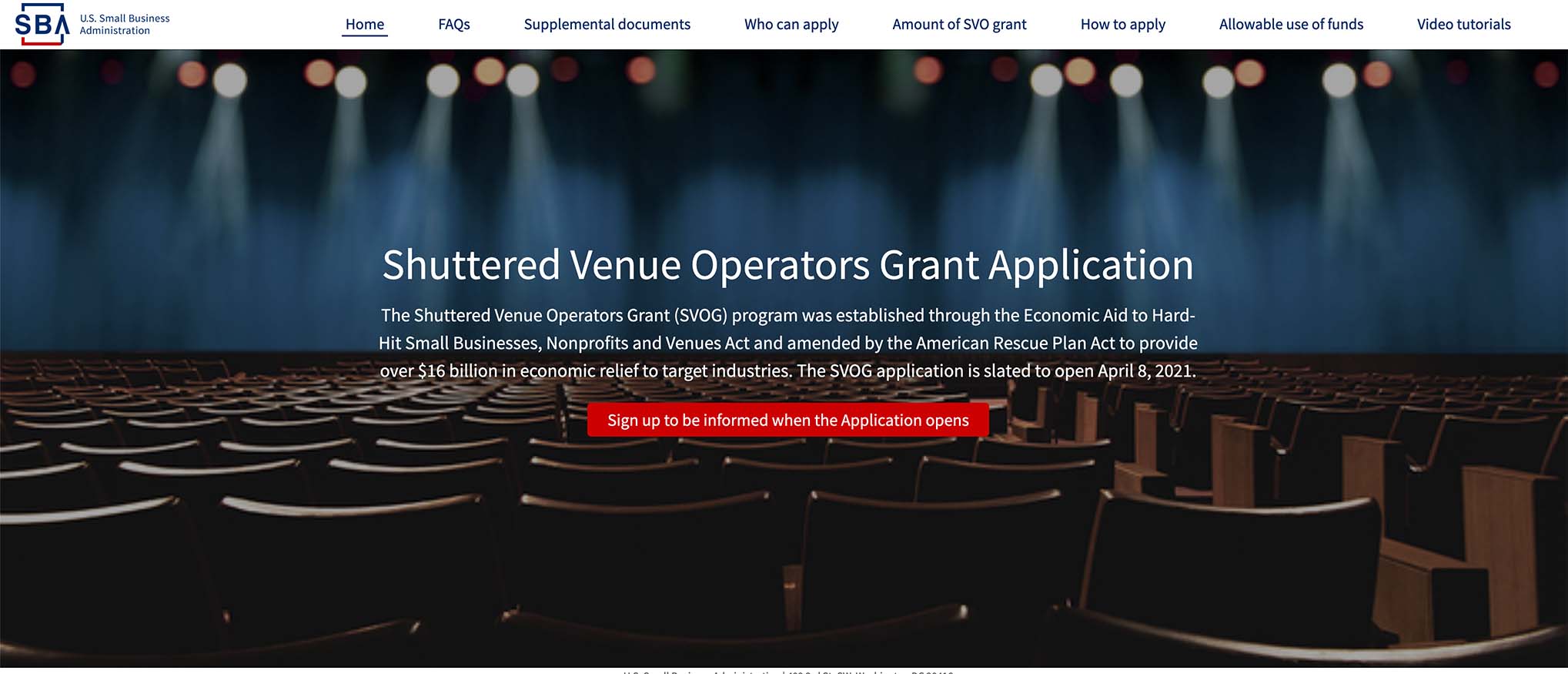
Shuttered Venue Operators Grant Program Opens April 8

If you have been looking at the Shuttered Venue Operators Grant program information page as I have suggested, you may have seen it says the applications will open in early April,

However, there is a new button on that page that takes you to the application portal which informs you things are scheduled to kick off on April 8. You can sign up there to get additional notifications.


If you haven’t done so already, now is the time to register for a DUNS number (or research what your number is), register for SAM.GOV, and check out any webinars your state arts council, state small business administration resource or trade/discipline service organization may be offering.

There are FAQs and Checklists on the Small Business Administration webpage, but you are gonna have questions.

Valuing What Can Be Counted Can Count Against You

Artsjournal.com linked to an article on Australia’s Arts Hub which looks at how the philosophy of “arts as a business” has undermined the arts in that country. The overall theme seemed to be that so much which was perceived as a blessing ended up narrowing the ability to broadly pursue independent creative expression.

Katharine Brisbane writes:

The introduction of the Australian Business Number (ABN) turned artists into ‘small business owners’. No longer objects of patronage, they were free to trade in their own name, and their daily practices became the business activities of budding entrepreneurs.

In the years that followed, artists developed inter-disciplinary practices that merged the interpretive and authorial roles of actors, directors and writers in collaboration. However, as time went on, the adoption of corporate measures such as the key performance indicator (KPI) made funding agencies increasingly more of a hindrance than a help.

Brisbane’s piece summarizes the contents of papers which have come out since 2000. The comments on one of those papers, Art in a Cold Climate: Rethinking the Australia Council by Keith Gallasch contained some interesting insights.

In particular, Sue Beal who was part of Actors’ Equity union and a member of the Australian Council for the Arts’ (OzCo in her letter) Theatre Board back in 1984 expresses regret for some of the decisions she supported having seen the results. Essentially she says that the push to recognize the arts as an industry and OzCo’s desire to consolidate political and economic power under its umbrella placed the major arts organizations in the country in a position to align standards and funding to their benefit.

As an Actors Equity official with the best of intentions, I argued strongly for the recognition of the arts as an industry, believing that this would result in an improvement to artists’ conditions. Well, it did improve the conditions of some, but it also provided the arguments used by the majors in their never-ending demands for increased support from the Theatre Board. It also paved the way for the economic rationalists who soon moved in with their mantra, ‘If it can’t be counted, it has no value’.

Cash flows, attendance projections, sponsorship deals, business plans, burgeoning ‘infrastructure’, marketing consultants, accountants negotiating with accountants-all in the name of ‘best practice’, and often producing bigger deficits-this became the milieu of the majors. Vision, imagination, artistic risk, innovation, experiment, obsession became peripheral. The bottom line was deified. The worst possible skewing one could imagine.

What I found interesting was her belief that there was once an opportunity to shift this power dynamic which Beal had lobbied against and now regrets.

…Pat Galvin, the Secretary of the Department responsible for the arts, suggested to the OzCo that he could take over the funding of the majors and cocoon them in a corner of the department,…. Thus leaving the Council to pursue its real agenda. I shamefacedly confess that I was one of those who argued against this, in hindsight, visionary proposal. The OzCo came up with a thousand reasons why they shouldn’t be handed over. Of these the most honourable-and silly-was the belief that these companies would benefit from a critique of their work from an artistic perspective.

…If the OzCo lost the majors’ huge funding allocation, it would also lose the statutory administrative proportion that came with their funding. Council couldn’t countenance a reduction in staff and believed that it could control the majors. That’s always been nonsense. The Boards of the majors have consistently demonstrated that their political astuteness is infinitely superior to that of the OzCo. They have succeeded where the OzCo has consistently failed: while most of the majors have built direct, confidential and beneficial relations with Canberra, the OzCo has never been able to achieve what should have been its primary goal-decent money for the arts-but instead spent most of its energies trying to survive threats to its own existence.

There is obviously nothing to say that the Arts Council wouldn’t have ended up just as pressed to fend off threats to its own existence had this scheme come to fruition. Government often views arts funding as a zero sum situation so if the major organizations were receiving funding already, it is just as likely the existence of the council would be seen as unnecessary. Beal might instead be arguing that it was a mistake to place the majors within the direct purview of the department secretary because it allowed them to amass so much political influence.

While the arts in the US have fared no better in relation to the NEA, it is always interesting to see how government funding of arts and culture has fared in other countries.

SVOG Program Updates Coming Fast Now

While I am pretty sure people are following the developments of the Shuttered Venue Operators Grant program pretty closely and are probably getting regular updates from their state and industry service organizations, I figure it doesn’t hurt to put reminders and updates out there myself.

Especially since all the updates I have been getting from service organizations haven’t pointed out some important distinctions between the FAQs the Small Business Administration is putting out on a weekly basis now. (Likewise, assume I am not pointing out the distinctions that are important to you and read through them!)

For example, about a week or two ago they started posting check lists of materials you should be collecting in advance of the opening of the application period which appears to be on track to happen in early April. The latest version of the check list can be found here, but since they are updating between Thursdays-Sundays, if you are reading this after March 18 you are better off going to the main page.

The same goes with the regular FAQ document. The passage of the American Rescue Plan has caused sections of the FAQ to be removed in the March 12 version.

For example, the March 5 version had this question:

6.Can an entity apply for a PPP loan now and decide later on the loan if it did not receive an SVOG? At what stage is a PPP loan considered “received”?

but it is now replaced with:

6.*No longer relevant / deleted per the American Rescue Plan being signed into law.

Though if you scroll down, you will see a couple new points of information have been added to that section which address PPP loans and SVOG funding:

21.*How will receiving a PPP loan affect an eligible entity’s SVOG award?

22.*If a portion of my PPP loan was forgiven, will that affect how much of the loan amount is deducted from my SVOG?

As before, anything that has been updated since the last FAQ has an asterisk. But you should through everything thoroughly in case you missed an update.

Among the latest updates are answers to questions about whether the payout will be lump sum or multiple payments. Answer – it depends on a number of factors. See page 16

Should you use fiscal year 2019 or calendar year 2019? – You can use either, but if you apply for the supplemental funding phase you need to use the same time frame.

There was also a new entry answering questions about whether sponsorships should be counted as earned revenue since donations are not counted as such. The answer is different for commercial and non-profit performing arts entities:

Because it represents payment made in exchange for a service (i.e., recognition or advertising), sponsorship payments (such as naming rights) received by for-profit entities will be considered earned revenue. Like the treatment afforded memberships and fundraising events, sponsorship payments received by non-profits will be considered part earned revenue and part gross revenue. In such cases, the sponsorship payment amount a non-profit receives that represents a fair market value for services in exchange (i.e. promotion, free admission, use of facilities) will be deemed earned revenue and the portion of the sponsorship payment that exceeds that amount will be deemed a contribution and thus gross revenue…

Well Done Rare Medium

It is pretty widely acknowledged that people who work for non-profits do so for intangible benefits like a feeling of contributing to the betterment of society and self-actualization rather than rewarding levels of remuneration.

Of all the benefits non-profit workers feel they get from the work they do, compliments are probably not one of them. A story in Harvard Business Review noted that two research efforts found that while people felt that compliments were beneficial and should be given more often, many people refrained from expressing compliments to others.

…we consistently found that people underestimated how good their compliment would make the recipient feel. Compliment-givers tend to believe the other person won’t enjoy their interaction as much as they actually do; in fact, they often believe that their exchange will probably make the person a little uncomfortable. Yet, consistently, receiving a compliment brightens people’s day much more than anticipated, leaving them feeling better, and less uncomfortable, than givers expect.

[…]

In fact, only 50% of people in one experiment who wrote down a compliment for a friend actually sent the compliment along when given the chance, even though they’d already done the hardest part — coming up with something nice and thoughtful to say. That is, despite the widely shared desire to give more compliments, when faced with the decision people still often forgo low-cost opportunities to make others feel appreciated and valued.

Among the concerns people had were that their delivery of the compliment would be awkward and that repeatedly giving compliments on consecutive days would diminish the value of the praise and be perceived as increasingly insincere.

The authors conclude by noting that gratitude and praise is especially important now more than ever and advocate for creating a culture of gratitude:

As Aron Ain, CEO of Ultimate Kronos Group has said, “Gratitude is not about a one-time holiday party, day off, or spot bonus…It is about creating a culture of gratitude.”

(Title of this post is based on a recollection of a clue in a Hardy Boys book from ~40 years ago where the antagonist writes a note congratulating a fortune teller.)

Would You Start Taking Piano Lessons From A 14 Year Old?

A few weeks ago economist Tyler Cowen discussed how he had taught chess when he was 14-15 years old. His regular clientele were two adults in their 50s and 20s and a child prodigy around 10-11. He said he would have likely had more students if it weren’t for transportation issues.

My first thought was to wonder if anyone, especially and adult, would ever pay a teenager to instruct them in an artistic discipline. I don’t know about acting or visual arts, but by 14-16 there are some pretty skilled dancers and musicians out there.

Yes, I know there are summer camps, etc where teenagers are placed in a position of teaching younger kids, but I was thinking more along the lines of hiring someone in your hometown to provide lessons.

Cowen does admit that his situation was something of an outlier, but only because he felt most teenagers would assume no one would take them up on the offer rather than just offering their services. It also doesn’t appear that Cowen was necessarily exceptionally skilled. He said he stopped teaching when he stopped playing chess and characterizes it as something of a transactional decision. But that might be adult Tyler imposing his economist bias on his memories.

It has long been recognized that teaching your skill to someone else improves the teacher’s understanding of that skill so there is a benefit to teens hanging up a shingle and offering to help people get started.

Looking at some of Tyler’s reflections on his experience, there seem to be applicable parallels to teaching an artistic discipline.

2. Chess teaching isn’t mainly about chess. A chess teacher has to have a certain mystique above all, while at the same time being approachable. Even at 14 this is possible. Your students are hiring you at least as much for your mystique as for the content of your lessons.

3. Not everyone taking chess lessons wanted to be a better chess player. For some, taking the lesson was a substitute for hard work on chess, not a complement to it… Some of the students wanted to show you their chess games, so that someone else would be sharing in their triumphs and tragedies. That is an OK enough way to proceed with a chess lesson, but often the students were more interested in “showing” than in listening and learning and hearing the hard truths about their play.

4. Students are too interested in asking your opinion of particular openings. At lower-tier amateur levels of chess, the opening just doesn’t matter that much, provided you don’t get into an untenable position too quickly. Nonetheless openings are a fun thing to learn about, and discussing openings can give people the illusion of learning something important, if only because you can share opening moves with the top players and thereby affiliate with them.

As I read these, (Cowen offers seven insights in total), it seemed that paying attention to why people took lessons had a lot in common with why people attend performances. Some people want to improve, but others’ goals are to obtain a lesser degree of knowledge, mastery and affiliation with the people and practice of those skill sets.

Gaining an understanding of these motivations from the point of view of a teacher, even if it is in retrospect as an adult, might help artists do a better job of relating with audiences as an adult.  There is a difference between understanding what audiences want having learned it from teachers and mentors who are providing their worldview and reflecting on direct experiences you had before your perceptions were colored by years of formal training.

I think about the tasks I resented having to do and the difficult experiences I had when I was a young kid and a teenager that I would later realize gave me a competitive advantage when interviewing for a job. Now I resent that the foul medicine turned out to actually be good for me.

Is This “Yes, And…” Problem Solving?

A couple weeks ago I caught Thomas Wolf’s blog post about why Concert Companion, the hand-held device that offered commentary synchronized to the performance content, had failed to gain wide distribution. I really appreciated the information. I have written about Concert Companion’s lack of traction among orchestras but Wolf provides far more detail than I was ever aware of.

Wolf suggested reviving the practice with modern technology and setting it during rehearsals instead of performances.

Rehearsals offer one of the best ways to learn about music. You not only get to hear a work being played, but you can gain insights into how musicians think about a piece as they work on it. However, observing an actual rehearsal, without some help about what is going on, can be downright frustrating if not boring. Musicians talk to one another in ways that are difficult to hear and even if they are miked (which many of them find distracting), they often talk in musical shorthand that a non-musician doesn’t understand.

[…]

Now imagine that you are sitting in a real rehearsal (or watching it on a screen) and a trained musician who is not playing is offering commentary in real time that you can read on a screen. For example:

The musicians just stopped and are discussing whether a repeated passage should have an echo effect the second time it is played. They are going to try it that way. Listen to the effect when they play that thematic material boldly the first time and quietly the second time.

or

The basses and cellos are in unison here and they are trying to make sure they are in tune with one another. That is why they are playing those notes so slowly. Each player is adjusting his or her pitch until they get the intonation just right.

I didn’t think this really would solve some of the problems that Concert Companion faced. One of the things Wolf identified as a problem was that it needed a trained person present to advance the notes in synch with the music and that was an additional expense orchestras couldn’t afford. Wolf’s suggestion of having someone writing live commentary requires someone even more highly trained to provide high quality insight on a moment’s notice AND type quickly enough that the viewers receive the information in a timely manner.

I can tell you from experience that people underestimate the amount of time it takes just to type in supertitles for an opera and then get that to synch up correctly. While the commentary wouldn’t have to synch quite as well, that is still a tall order. It seemed to me there would be a greater cost in time, energy and funding.

I was prepared to write a post about it when Drew McManus beat me to it, and worse, he liked the idea.

It wasn’t until the end of his post that Drew provided the obvious answer. He mentioned that 20 years ago he had been organizing outings to live rehearsals where they would sit far enough from the stage to avoid interrupting things. Today you can put people in the audience with their cellphones and earbuds, set up an audio only Zoom meeting, and have an interactive conversation with one or more guides to learn more about what was going on.

This still requires a trained staff member, or as Drew suggests, a super fan, but would present far less of a scramble to provide content.

The obvious extension of this is that you can do the same thing at a final rehearsal for a live performance of any genre. Live streaming a rehearsal with commentary to even a small group of people watching from home might be problematic until things can be worked out with rights holders. However this could enhance the value of seeing a performance live and expand the core audiences for an organization.

As I wrote this, I recognized I am the third person in a chain adding an idea about how to solve a problem. Is this “yes, and..” problem solving?

What Does It Mean To Have Influence

I saw an article containing an interview with choreographer Robert Moses that basically opens with Moses saying the conversations occurring regarding equity are addressing the wrong questions.

How to increase equity? “Ask different questions,” is the reply from Moses. Or preferably, don’t ask the same tiresome questions.

“The notion of change is sophomoric,” Moses says. “The idea is to give people honest opportunity to be part of whatever they’re intending to be a part of. The questions get tiresome because they come from the same place. It’s not interesting if it doesn’t have anything to do with what needs to happen.”

Moses poses a question of his own: “Should we have more representation? No, we should have more influence. More actual ability to exercise that influence and power. All those things will be happening for the better of everyone,” he says, heavily emphasizing the “everyone” in his declaration. “It has to be in as many hands as possible… It’s about talk that’s useful. An organization that powers those things is what I care about. The conversations then can take place that move us all. We’re not spinning our wheels and using portions of a cultural experience to affix something to the moment.

I’m not exactly sure I completely understand what he means. Which is good I guess, because if I thought I knew what he meant, I might stop considering the larger implications of the statement.

If influence and power in as many hands as possible isn’t more representation, what is it? It is obvious that representation can be employed superficially, but so too can pursuing talk and conversations that is useful. Often both can feel like progress when they are just the appearance of progress. So isn’t productive work in representation and/or conversation valuable?

The distinguishing element that sticks out to me is the mention of “…using portions of a cultural experience to affix something to the moment.” That seems to reproach focusing on creating standards based on conditions at a specific time versus embracing broader, long term goals. For example, the idea that you are done when the composition of your board reflects the demographics of the community versus the broader goal of seeking to create an environment where power and influence are shared in the broadest terms possible.

Anyone else want to share their thoughts?

Latest Shuttered Venue Grant FAQ Provides Increased Detail

While I am sure a lot of performing arts venues have been closely paying attention to news about Shuttered Venue Operators Grant (SVOG) program designed to help arts organizations impacted by Covid shutdowns, you probably wouldn’t have expected a major update to a government department’s FAQ document to be rolled out on a Sunday.

There was a major update to the SVOG FAQ on Sunday.

It isn’t difficult to identify what information is new because anything that didn’t appear in the February 12 update has a * next to it.

This version answers a lot of questions I have heard asked in webinars, including specific information about the eligibility of performing arts venues run by university, state and local governments. Similarly, there is detailed information which apply to museums.

The February 28 version also provides new definitions for a lot of terms like museum, promoter, regular programming, theatrical producer, performing arts organization operator, cover charge, mixing equipment, lighting rig, sound engineer, etc.

The question of what constituted fixed seating came up a lot in webinars I attended because it is a significant requirement to receive funding in some instances. In this version they added the following information:

*Would heavy bleachers pushed back against the wall when not in use but never removed from a theater qualify as fixed seating?

Yes. Any cumbersome seating not easily or regularly removed from a theater will be considered fixed.

While there is a requirement that people be paid fairly in the legislation, earlier versions of the FAQ explained that volunteer labor did not exclude a venue from apply if the staff managing the venue were paid. This means that many community theatre organizations may also be eligible for SVOG funding.

The FAQ that illustrates this best is probably the following, which also appeared in earlier versions:

If a venue’s box office is staffed by volunteers is it eligible to apply? Yes. Among the criteria included in the live venue operator or promoter definition is a requirement that a qualifying venue must engage at least one individual to perform at least two of the following roles: sound engineer, booker, promoter, stage manager security personnel, and box office manager. The Economic Aid Act does not reference any hired box office staff other than a box office manager and does not absolutely require even that position. As such, the use of volunteers to staff a venue’s box office would not preclude it from being eligible to apply for an SVOG.

There is also some oddly specific questions that makes me think the legislation was intentionally written to provide eligibility to a corporate entity.

Does a live venue operator who qualifies as an “eligible person or entity” remain eligible for an SVOG if that live venue operator has a minority investor (less than 51% ownership) that has more than 500 employees, locations in 11 or more states, and locations in 2 or more countries? Is that the only ownership/control-related grounds for disqualifying someone?

Yes. The Economic Aid Act speaks only of majority ownership and control in the context of the disqualifying conditions related to being listed on a stock exchange or to the geographic scope of operations and number of employees. There are no other control requirements in the statute.

If you hadn’t researched SVOG funding or didn’t think you qualified, the latest version of the FAQ should provide a greater degree of clarity than any previous version. (Though the additional detail may dash the hopes generated by the previous vagueness.)

What Does My Phone See?

I visited a new exhibition presented by my local art museum this weekend. While I was wandering the galleries, I overheard a small group talking about their interpretation of the meaning of different pieces. Looking at those same pieces, I had no idea where they were drawing those conclusions from, though based on the common theme in the comments I thought they might be medical professionals.

I caught up with them in one of the rooms and they asked what I thought the image in two of the pieces might be. I took a picture of one of them, but based on the museum’s policy on reproduction of images outside of personal use, I am uncertain about posting it here.

The artist had bent a grid of white lines on a black background to create a silhouetted image on a canvas. I couldn’t find the exact works on his site, but an example of the technique is seen here. Except the forms of the works in the museum were not quite as distinctly identifiable as the house in that website.

At first glance at one of the pieces, I thought the image was an elephant’s head but a few seconds later I saw it could also be an angel in flowing robes and long stole.

The other image was even less clear and I was not at all sure what the jumble was. One woman decided to point her phone camera at it and was pleased to find that the image became more distinct on the canvas….but she still wasn’t sure what the heck it was.

After a few moments, to me it sort of looked like the frontal view of horses galloping toward the viewer, similar to the statue of three mustangs on the Southern Methodist University campus seen from head on.

When we were all pondering what we were looking at, I commented that the interaction we were having would never be possible if we took a digital tour of the museum. Not only that, we probably wouldn’t have been delighted by the mystery of the works caused by the vagaries of human vision, because the unflinching eye of the camera would have stripped that away as we had already seen.

Privately, I also thought that while I am generally against people using their phones to mediate how they experienced art, in this case it added to the experience. Part of that was due to the fact they didn’t default to pointing the camera at the wall before they had a chance to consider what they were looking at. After waiting and sharing theories about what we were seeing, then they raised their phones and recognized that the camera clarified things…though still didn’t provide definitive answers.

I am not trying to distill a central moral lesson out of any of this, though I certainly feel the in-person experience provides the most benefit. If there is a central lesson we have learned in the last year of Covid times, it is that we need to moderate and re-evaluate our expectations about what interactions with art and culture are supposed to be.