Got A Good Beat, You Can Dance To It…And It’s Taking Our Jobs

I was listening to an episode of the Code Switch podcast this weekend while I was out walking. The topic was about how merengue was the basis for a culture war in Puerto Rico.  What, at first on the surface seemed to be a resistance to the introduction of a new type of pop music to compete with salsa gets entangled with cultural identity.

Merengue was essentially carried to Puerto Rico by waves of immigration from the Dominican Republic. The music had a different energy and was easier to dance to than salsa. One of the hosts mentioned her mother was embarrassed by how poorly her husband danced, but that he was able to do a passable job dancing to merengue rhythms.

However, in time there were violent protests and demands that merengue be outlawed because it was putting salsa musicians out of work. One merengue musician had his car set on fire. There was a lot of suspicion that it was salsa musicians, but the owner had no proof and so never filed a complaint.

The podcast hosts admit there may have been some nationalism and classism associated with the resistance since merengue was initially being introduced and performed by immigrants who may not arrived in Puerto Rico legally. Many of them seeking to use the island as a way to continue on to the U.S.  There may have been a sense that these folks from the Dominican Republic were interlopers who were not invested in advancing the future of the island.

The most interesting element is that in time Puerto Rican musicians made merengue their own.  The merengue song, “Suavemente,” which became ubiquitous in the late nineties was performed by a Puerto Rican musician. The guy whose car was burned was invited to the home of one of the prime suspects for the arson who admitted merengue ultimately made it possible to own the house he had.

I have been trying to think if there have been similar stories with other music forms. I know there have been plenty of protests about music being obscene or diverging from standard expectations, but has there been other instances where performers of an emerging music style have been accused of robbing other musicians of their livelihood by virtue of being more popular?
 

Unexpected Headline – Black Sabbath The Ballet Premieres In September

In a case of “not something I had imagined”, the Birmingham Royal Ballet recently decided to create a ballet set to the music of Black Sabbath, who got their start in the city. Lead guitarist Tony Iommi described the show as a “rags to riches” tale will attract “both our fans and ballet fans”.

Say what you want about whether a ballet set to heavy metal music is appropriate, my first thought was that from what I know of Birmingham the concept is suited to the history and socio-economic dynamics of the city and it is population. Obviously, these are the very forces that gave rise to the band in the first place. It may be an unorthodox pairing, but it is aligned to the community rather than an attempt at shoehorning something presumed to be good for the audiences or that they will learn to like.

I don’t doubt there will be cries of sacrilege. I am just suggesting Black Sabbath is more closely aligned to Birmingham than something like Aaron Copland & Agnes DeMille’s “Rodeo,” which has more resonance with American cowboy culture.

My thoughts about the continued timeliness of the song “War Pigs” preceded me reading Ballet director Carlos Acosta’s parallel thoughts on the song:

“”War Pigs is so relevant today, how sometimes politicians and governments hide behind words. And all the wars happening at the moment… it’s timeless.”

Congratulations On Your Failure! (Make Sure To Show Your Work)

This Facebook post about the Failure Award Scholarship immediately caught my eye this morning.  Museum of Contemporary Art Denver is looking for creative Colorado seniors to apply to their Failure Award Scholarship program. Winners will join past failures awarded the $20,000 scholarship.

I am sure you realize there is more nuance to this than it first appears. Some may even be able to guess what the scholarship is recognizing.

While so much of student life is focused on achievement, MCA Denver believes that in order to create something original and authentic, it is necessary to risk failure. The Failure Award is given not on the basis of academic merit or athletic prowess, but rather on a student’s demonstration of a willingness to take these risks.

[…]

The Failure Award is based on documentation of a project the student created or produced while in high school that demonstrates originality and creativity. This can be a creative project, like a novel, a play, an opera; a technology-based project like a design for a new car, or a spaceship, or a robot; or something that falls outside of these criteria altogether. Some projects may present solutions to problems in the world, however, all projects will be considered, no matter how harebrained, impractical, or absurd.

[…]

All types of projects will be considered, including, but not limited to: visual arts, drawing, painting, photography, sculpture, dance, theatre, performing arts, instrument or voice composition, design, fashion, culinary arts, technology, gaming, robotics, business ventures, social innovation, or other creative practice.

There has long been a conversation about the lack of risk taking in the arts being reinforced by audiences and funders both so it is pretty clear the museum is trying to step up and reward students who make an effort to try something new.

Adult me was thinking it would have been better if they announced the scholarship toward the beginning of the year instead of around January-February because I would have likely tossed out many of the early stages of my work so I didn’t accidentally mix the versions up and had enough room. As a result, I wouldn’t have the documentation to show my process.

But knowing the high school aged me, I probably wouldn’t have even started my project until a few weeks before the deadline so the timing is probably right.

Videogame Inspired Tourism

I saw this tweet the beginning of the month and was engaged by the idea of video game inspired tourism.

I tried to see if there was a recording made of her talk, but haven’t been able to find it. Given that people have trekked to see the locations appearing in Star Wars films and episodes of shows like Game of Thrones, it isn’t surprising that people want to see these places in real life. What is a bit more interesting is that a video game about a post-apocalyptic world would take the pains to accurately depict real life locations.

Does this reflect a tension between the pursuit of creating fictional worlds and scenarios and a desire for authenticity? What drives the desire for authenticity, the gaming company, the players, a combination of both? With the emergence of AI created art, which can presumably integrate elements of real locations as well as generate completely new environments, will the drive for authenticity continue or will gaming studios and players be satisfied with AI generated worlds?

Not to mention, will those artist jobs continue to exist?

The fact that people are traveling to these locations suggests people have an interest/curiosity in extending their virtual explorations into the physical realm. This bodes well on many levels if game designers continue to actively seek new interesting places in the real world to translate into the games.

When Audiences Take “Best Party In Town” Marketing At Their Word

The last few months I have been seeing a number of stories about audiences in UK theaters being abusive toward staff and other patrons. A week or so ago, The Stage reported that Edinburgh Playhouse staff had been punched and spat upon, moving the director to call out the bad behavior on Twitter, saying the abuse was affecting the mental health of staff.

“Where in the past we had very isolated incidents, we now have a greater number of incidents. But when people are asked to modify their behaviour, the most common answers are: ‘I don’t care.’ And when we tell them they are disturbing people behind them, they say: ‘I don’t care, I have paid for my ticket, I will do what I want.’ That seems to be the most common thing.”

[…]

“It is really horrible for them and staff can be scared to come to work. And what I hear from other theatre directors is that we are dealing with a mental-health crisis in our staff as well, and this is part of it, a part of what fuels it,” he said.

The bad behavior has become such a problem, theater management are reportedly changing their marketing messaging, asking that phrases like “best party in town” and “dancing in the aisles” not be used.

On Tuesday, Colin Marr, director of the Edinburgh Playhouse theatre, told the Stage that audience behaviour was the worst he had known in his five years in charge. “One of the main things we are trying to do is around messaging and working closely with producers,” he said. “We are talking to them about marketing. So, when we market shows let’s not have phrases such as ‘best party in town’ or ‘dancing in the aisles’ – the show has something much stronger than that to sell.”

[…]

An ATG spokesperson confirmed the company was working with producers on marketing. “We’re taking a multidisciplinary approach to tackling challenging audience behaviour, covering all points of the customer journey, including how we market shows. We want everyone to fully enjoy the experience of a show and we work closely with producers to create appropriate marketing material,” they said.

These stories raise an interesting point. There has been a lot of conversation about how many performing arts experiences used to be bawdy, raucous affairs and the current sedate, staid attendance experience has been artificially imposed relatively recently. But given that there is physical and emotional violence being directed at staff and other audience members, is a return to a less restricted environment the best course? Should theater staff step back and not try to impose a specific type of behavior on attendees who want to sing and dance along the show, thereby removing the point of tension and potentially leaving them in a safer place?

Creating Conversations Around Arts Reality Shows

You may have recently seen that MTV and the Hirshhorn Museum are teaming up to create a TV series to find the next great visual artist. As soon as I saw this, I recalled that there had been similar reality TV visual arts contests before. The bottom of the article references Bravo’s Work of Art: The Next Great Artist which ran for two seasons around 2010-2011.

But I had actually written about the show ArtStar back in 2006. Most of the links in that post don’t work, but the Slate article and Wikipedia entry both still exist.  There was a fair bit of criticism about both shows. The Arts world hated both, while Work of Art was generally popular with audiences. ArtStar was widely accused of being an extended self-promotional video for the gallery owner/host.

Art critic Jerry Staltz, who was a judge on Work of Art wrote a piece for Art News reflecting on the experience.  He notes that the show was never really about finding the best artist, despite the title.

I agree with the many viewers who said it didn’t reflect the “real art world” — although it was never meant to. It was intended as a game-show version of undergraduate art school where assignments are given, studios supplied, and people kicked out (without, of course, owing $100,000 in school loans). A lot of the challenges were inane …. People on my Facebook page invented far better challenges,…

[…]

If I could change anything about Work of Art, it would be how the contestants are selected. Clearly Bravo’s criteria were more numerous than mere talent, because the contestants simply weren’t good enough. I wish the judges had picked the competing artists, the way they do on American Idol.

Staltz seemed to feel like the biggest benefit of the show was the conversations it generated.

Over the ten weeks it aired, hundreds of strangers stopped me on the street to talk about it. In the middle of nowhere, I’d be having passionate discussions about art with laypeople. It happened in the hundreds, then thousands of comments that appeared below the recaps I wrote for nymag.com. Many of these came from people who said they’d never written about art before. Most were as articulate as any critic. I responded frequently, admitted when I was wrong, and asked others to expand on ideas.

It made me think that his approach to reality TV arts competitions is a constructive one. Essentially use a conversation about the process being employed not being a realistic method for identifying a great artistic talent as a jumping off point that helps arts professional connect with audiences, validating their instincts and capacity to judge while gaining a better understanding of what about artistic practice engages people.

Boy, This Seems To Be The Month For Ticket Pricing Conversations

You may have seen that the AMC movie chain decided to implement tiered pricing for their theaters with higher prices for preferred seating and lower pricing for less desirable front row seating and wheelchair spaces.

“The mega-exhibitor, which has already introduced sightline seating in select markets, is betting movie-goers will pay more for a better view of their favorite Hollywood titles, as do patrons of music and sporting events.”

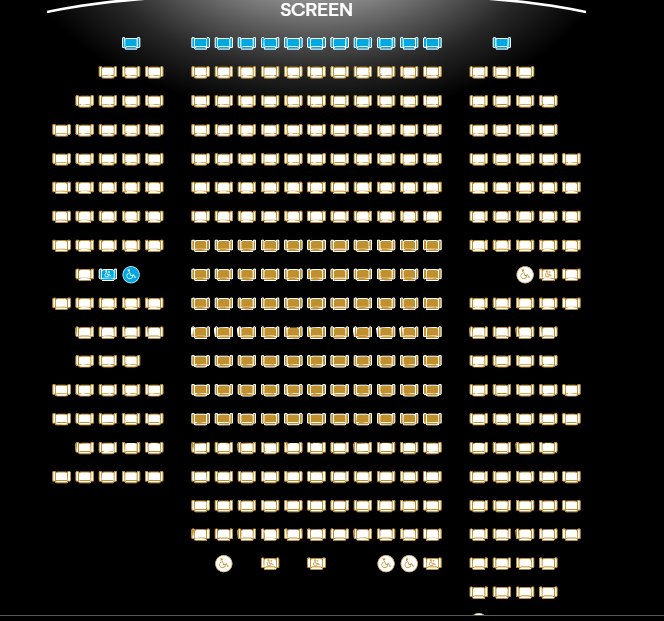
They are testing this pricing out in select markets so I popped over to the site Lincoln Square 13 in NYC to see what the chart looked like. Below are the recliner and regular seating arrangements for the new Magic Mike movies. The tan seats are the premium priced seats, the blue are the discounted seats and the white are regular price.

I should note that the recliner seating chart is for the 7:45 showing and the regular seating chart is for the 9:15 showing. I looked at the 6:15 screening chart for the regular seating and there are only a handful of seats sold. It may be that time is not really convenient, but it seems like a lot of folks in NYC are willing to pay extra for recliner seating plus a premium on a Monday night. And I assume AMC realizes 7:45 is probably more convenient and makes sure the screening with the recliners is available so they can make a little extra money.

That said, another Hollywood Reporter article on the same subject noted that Paramount worked with theaters, including AMC to lower the ticket price for the movie 80 for Brady, just days before AMC unveiled this new premium seating plan.

” For years, some distribution executives have argued in favor of variable pricing, whereby tickets are lowered depending upon a movie’s target audience. In this case, Paramount presented evidence showing that older demos are more sensitive about ticket prices.

But no sooner had 80 for Brady opened over the Feb. 4-6 weekend to a pleasing $12.7 million then did AMC reveal Feb. 7 that it is implementing a hefty $1 and $2 price increase for many seats…The news quickly put the 80 for Brady initiative on the back burner since AMC’s plan goes in the opposite direction by introducing higher costs.

This has created a bit of a philosophical tension between the two approaches-varying price based on target audience vs. vary prices based on seating location. Paramount says it won’t have final numbers for another week or so, but preliminary data shows that admissions were higher for 80 For Brady than its other release, Knock at the Cabin. The latter ended up making more revenue than the former the first weekend of February, but by Monday Brady exceeded it in revenue.

There has been some criticism from some like actor Elijah Wood who says that these pricing schemes will exclude lower income families from an activity that has been relatively democratic.  Others are concerned that complicated pricing will provide an incentive to stay home and stream.

Hollywood studio executives, however, are concerned about the moviegoers who aren’t as eager to pay more, or who already have doubts about resuming their moviegoing habits. Notes one distribution source, “my biggest worry is that all of this pricing becomes too complicated.”

What Profits A Man To Gain Riches, But Lose His Ardent Fans

I was not keeping close tabs on the topics President Biden was expected to cover in the State of the Union so it was a coincidence that yesterday’s post was about exorbitant add on fees on the same day he was addressing that issue.

It is probably less of a coincidence that another article from TicketNews came across my feed today reporting what I alluded to in the last lines of yesterday’s post. A Bruce Springsteen fanzine decided to call it quits after 43 years due to Springsteen’s decision to engage in dynamic pricing and slow release of inventory practices.

But for Springsteen, who built much of his reputation on the appearance of being a man of the people rather than interested in exploiting his fans for as high a value as he can capture, the reputational damage has been significant. The Backstreets closure is merely the latest, and highest profile, chapter of it.

“There’s no denying that the new ticket price range has in and of itself been a determining factor in our outlook as the 2023 tour approached — certainly in terms of the experience that hardcore fans have been accustomed to for, as Springsteen noted, 49 years,” reads one part of Phillips’ message to readers. “Six months after the onsales, we still faced this three-part predicament: These are concerts that we can hardly afford; that many of our readers cannot afford; and that a good portion of our readership has lost interest in as a result.”

Part of the issue is that some of Springsteen’s public statements seem to dismiss the concerns of his fans. The fact that ticket prices have dropped from $4000 in the initial roll out to $450-$1000+ with $61 seats available for some shows, does seem to indicate demand pricing theoretically works.

However, the article suggests that the damage is done and younger artists need to be cognizant of the current environment.

What will be interesting is whether or not younger artists – many of whom don’t have decades of good will from their fans to squander – will see what dynamic ticket pricing and openly fleecing your biggest fans can do to their future interest in your work and think twice about embracing the Ticketmaster/Live Nation model of “slow ticketing” going forward.

Keep An Eye On The Ticketing Uproar

With people feeling more comfortable going to public events again, the travails consumers suffer when trying to purchase tickets are coming front and center. Last week TicketNews reported that President Biden is urging Congress to pass legislation limiting excessive fees and mandating transparency about hold back practices.

The issue of high fees that are often hidden until you are well into the purchasing process is pretty well-known and complained about. Hold backs on the other hand, are less obvious and more in the realm of a suspected, but not confirmed practice.

While companies like Ticketmaster and Live Nation regularly blame ticket resale or “bots” for the enormous spike in ticket prices consumers are paying, many believe that price inflation by hiding the true available supply through holdbacks is the biggest factor in that price surge, with the industry hoping to sell consumers and lawmakers on resale being the issue rather than their own deceptive practices.

[…]

Support for President Biden’s plan was also put forward by the National Association of Ticket Brokers, a trade group supporting ticket resale rights and consumer-friendly policy. Its statement specifically called out the “scheme called slow ticketing” used by Ticketmaster and Live Nation to hold back huge portions of tickets for most events without disclosure when tickets go on sale. Once the public is convinced that tickets are sold out, additional tickets are slowly released to the market, leading to a perceived yet artificial scarcity that convinces consumers to pay surged prices – referring to the process as a deceptive marketing practice.

Transparency and fair pricing may be a bigger issue in the attendance decision than we may realize. Among recent online reviews of my venue, comments about fair pricing and low fees appear multiple times.

It bears paying attention to public sentiment and how lawmakers move to resolve these growing concerns.

Perception of practices by some of the larger operators are so poor that suspicions may be raised about the entire event industry, painting everyone with the same brush. Engaging in relatively straightforward demand based or dynamic pricing practices may easily get lumped in with attempts at artificial manipulation, shunting tickets directly to resale markets and excessive fees.

What Is The Value Of A Press Release When News Stories Are Written By AI?

Many readers know that I recently moved from Macon, GA to take up a job in Colorado. Even before I moved, I was astounded by the number of articles that were being written about Macon, encouraging people to visit.  I kept asking what Visit Macon, the convention and visitors bureau was doing to encourage all this coverage which included Frommers, Southern Living, Yahoo! Conde Nast Traveler, AFAR, Bloomberg, Men’s Journal, INSIDER, CBS This Morning, and The New York Times. For a time I thought it was the ghost of the effusive vice president of sales and services for Visit Macon who died in September smiling down on the city.

As you might suspect all this success was the result of the work of a PR firm, TK PR. The folks from Visit Macon recently posted a newsletter piece from TK PR trumpeting their success promoting Macon. One thing that grabbed my attention was that they had gotten eight stories for Macon in 2022 resulting in 678 million impressions and $6.2 million in value at the cost of $0, plus 29 other stories for additional clients without once using a press release.

In the newsletter, TK PR founder, Taryn Scher, challenges readers to do away with press releases in 2023.

And while I can’t tell you in just a few sentences what we did to land each story, the one absolute thing we didn’t do to land any of these stories? Send a press release.

Y’all I hate to tell some of you this: but press releases died with the fax machine. If you are one of those few people who still relies on either, I’m sorry but I’m here to tell you it’s time to come on over into 2023. It’s nice out here. A little tech-heavy but we’re all adjusting.

Seriously though, you have to stop thinking that a press release is going to land you any sort of real quality media coverage.

Noting that CNET and others are publishing stories written by AI, she implies that living beings may no longer even be looking at press releases any more.   In this context, she suggests that waiting on someone to approve a quote that will appear in a press release is likely going to be a waste of your time.

Among the things to do instead is pitch the story directly:

That’s not to say the information isn’t important- but you need to take that who, what, when, and where and make it relevant to WHY NOW- why is this part of a bigger trend or relevant for the current news cycle? Why should a journalist care? And more importantly why will their readers care?


Australia’s Last Poet Laureate Was A Convict?

Big news out of Australia where the first national arts policy since 2013 was announced.  In addition to commitments of funding to specific entities and organizations, arguably the most significant element of the policy is a commitment  “….to protect First Nations knowledge and cultural expressions, with a particular brief on cracking down on fake art that plagues the $250m-a-year Australian Indigenous art market.”

Other elements of the plan include the establishment of a poet laureate position which last existed during the country’s convict era,  a state of the arts report to be issued every three years, and the establishment of  “a quota for expenditure on Australian content by multinational streaming platforms such as Netflix and Stan..” The amount of this quota is rumored to be about 20% and The Guardian article quotes people who are concerned streaming platforms may pull out of the country if they are required to produce Australia based content.

It happens that I saw a piece on Vice last night before I saw The Guardian article. Vice asked Australian artists what they thought about the plan.  Many felt the money was going to the usual suspects and advocated for a universal basic income plan for artists.

Others felt that the arts were unfunded in proportion to their footprint:

“The arts sector will get $286M over four years, or $72M a year. The fossil fuel industry gets $11.6B a year in government subsidies. Australia’s arts sector employs about six times as many people as the fossil fuel sector.

The requirement for locally generated content was cause for hope for some:

“I started to lose hope in local content knowing that reality TV filled up much of our “Australian” quota on broadcast networks. The possibility of streaming services now being made to spend 20% of their budget on original, local content honestly makes me feel hopeful and excited to pursue my career on my home turf.”