Big Boards In Big D, But Probably Not For Thee

There was a piece on the Dallas Morning News website about how the boards of various Dallas arts organizations were beginning to focus on greater diversity in their membership and accountability of their staffs.

The article opens by noting that Dallas Summer Musicals parted ways with their managing director months before his contract expired and the Dallas Museum of Art appeared to have a tense parting with their director.

“In the old Dallas,” says Veletta Forsythe Lill, a former City Council member and past executive director of the Dallas Arts District, “a board would have let a guy finish his term,” as in, why not let Jenkins stay eight more months, until his contract expired?

“But we’re living in a new Dallas,” Lill says, “and the new Dallas naturally carries with it a new breed of board member. The new boards want more control and more accountability.”

[…]

Today’s artistic boards veer younger and more corporate, and although older white men continue to dominate, their once-fierce hold — some would say stranglehold — is beginning to wane. Today’s artistic boards are increasingly more diverse, with women commanding a more powerful presence than ever before.

I was happy to see that boards are starting to take their governance responsibilities seriously and are attempting to make board and staff composition more diverse and reflective of the communities they are serving.

As I was reading through the article, I wondered if the boards would possess the will to evaluate how effective they are at executing their responsibilities.

When I see that Dallas Summer Musicals has 146 board members and 40 members on their executive committee, I can’t help but be skeptical about how effective such an unwieldy arrangement can be.

Reading the following, I suspected the membership numbers are largely courtesy appointments for the purpose of fundraising:

Board giving and participation guidelines: $1,000 down payment to be a general board member, coupled with raising at least $2,000 from outside donors. Must be a season-ticket holder. Executive committee members: Must make a $2,500 down payment, raise at least $5,000 from outside sources and be season-ticket holders.

Similarly large numbers appear on the boards of AT&T Performing Arts Center whose bylaws allow up to 70 members, but currently has 55; Dallas Museum of Art which has 73 board members; and Dallas Symphony Orchestra which has 68 members, 20 of which are on the executive committee.

In January I wrote about San Diego Opera which was revived after a stakeholder revolt fought the board’s decision to cease operations. The board membership went from 53 to 24. One of the key issues they identified as having contributed to their inability to adapt to the changing economic and social environment in San Diego was the “Get, Give or Get Off” board membership policy.

The San Diego Opera was one of those organizations where having a large number of people on the board was a function of fundraising. You pay x amount of money and you’re on the board, and no one wants to alienate any of those folk with contentious conversations that cause discomfort. But that is certainly not a good modus operandi for an organization facing the whitewater of the twenty-first-century cultural organization. And, it was not only the business model that had to change but the governance model, too.

Yes, yes, I know everything is bigger in Texas. With a funding model that includes 40 executive board members bringing in $7,500 each and the other 146 board members bringing in $3000 each, Dallas Summer Musicals may not experience issues that require them to be more nimble and responsive.

For everyone else, everywhere else, it is worth considering if a move toward a leaner, more nimble board might be the best course to meet the organizations long term challenges.

For  your listening pleasure, “Big D” from The Most Happy Fella.

Pretension Is Just A Hoity-Toity Word For Pretendin’

A book with an intriguingly different view on pretentiousness was recently the subject in the LA Review of Books. According to reviewer Barrett Swanson, Dan Fox, author of Pretentiousness: Why It Matters, thinks pretentiousness gets a bad rap.

Early in his disquisition, Fox wonders why children who investigate the world through “pretend” and “make believe” are seldom accused of pretentiousness, whereas adults who experiment with the liberties of masquerade are inevitably charged with duplicity.

[…]

“So you thought the film you just saw was pretentious, and so was the date you took with you. You thought the food and service at the restaurant where you had a bite to eat after was also pretentious. But pretending to be … what, precisely?” Fox asks. Because there is no Platonic ideal,… “When a person decides that a restaurant is pretentious,” he concludes, “the ‘authentic’ restaurant to which it’s being compared and the values that provide The One True Restaurant with its bona fides are seldom revealed.”

There are some interesting things in there to ponder.  Though before I get into the main part of my post, I wanted to note (without having read Fox’s book), that often pretension is based on an authenticity comparison that is anything but idealized — San Diego being the only place to get authentic Mexican food, for example. (Whereas NY is indisputably the only place that makes pizza and bagels worth eating.)

My initial thoughts about why kids can pretend without being dismissed as pretentious and adults can’t get away with it as easily, is due to the fact we don’t feel empowered to call people out as quickly when we get older.

Between being bound by a sense of polite behavior and a growing understanding that there are subjects in which other people are more expert at than ourselves, we don’t feel we have the ability to force people to acknowledge they are pretending something is what it isn’t. Still, because we feel ashamed of our lack of knowledge or ability to deny the reality being asserted, we label it pretentious.

For example, we had no problem as kids recognizing that someone is pretending to be Superman or a dinosaur. We had no compunction about saying pretend bombs, swords and Kamehameha waves missed us or got deflected by our energy shields.

It is more difficult to know if someone is wrong when they make a statement about a performance or visual art work if we don’t have experience in that field. If something tastes awful to us, we don’t know if it is really poorly made or if our palate just isn’t refined. Because we acknowledge the possibility of not having enough knowledge or experience, we don’t have the confidence to yell “Na-uh!” that we did when we were children.

Even if we did and we were right, there may be sufficient number of other people who have agreed to pretend otherwise causing us to feel uncomfortable. We may laugh about wine experts who think the same wine tastes better when it is in a more expensive bottle, but we still feel anxiety about picking out a bottle to bring to a dinner party.

It may actually relieve one’s anxiety to a degree to look at a situation that appears intimidating and decide everyone who thinks a certain way is pretending. It can be liberating to walk among people whom you have decided have subscribed to a certain fiction whereas you have subscribed to a slightly different fiction. Or perhaps, you have decided it would be fun to see how far you can get pretending the same thing everyone else does.

While I think this might be a helpful intermediary step to assuage anxieties, deciding everything is equally meaningless and lacking of value does an injustice to objects and achievements that have actual value.

This isn’t an argument for determining what is objectively more valuable and important than something else. Rather, eventually one needs to acknowledge that there are some things one recognizes as more important and valuable than other things. Others may not agree and that doesn’t bother you. The you five years in the future may not agree with the you of today and you need to be okay with that possibility as well.

Friends Don’t Let Friend’s Orgs Get Clickbaited

Non-Profit Quarterly had a piece last week about an effort to “help” non-profits that is flawed on so many levels.

An advertising company has created a site, Clickbait For Good which is creating clickbait campaigns for charities, apparently without being asked. Setting aside the fact that clickbait has pretty much peaked and worn out its welcome, the images they are using with their campaigns are pretty inappropriate for the associated charities.

It is unclear if the charities consented to the clickbait headlines being created for them on the Clickbait For Good website. One hopes not.

  • For Love 146 (human trafficking): “She fell for Mr. Perfect. You won’t believe what happened next” (with an accompanying image of a seated young girl in a frilly red dress).
  • For Girls Not Brides (child marriage in places like Bangladesh): “OMG! She is just 16 and she has done things the Kardashians haven’t even thought about” (with an accompanying image of an elite wealthy woman wearing a white dress hiked as high as it will go before being pornographic, exiting the backseat of a luxury car carrying a bag containing her latest expensive purchase).
  • For #Milk4Syria: “The ONE thing you need to know about drinking milk.”
  • For American Foundation for Suicide Prevention: “Exclusive: See what happened only a week after Robin Williams’ suicide.”

I checked the webpage out and indeed the images are as cringe worthy as described-

child bride

Non-Profit Quarterly lays it out pretty clearly why these sort of campaigns do more harm than good when it comes to generating investment and trust.

The problem is that this ill-conceived initiative is likely to aggravate more than inspire. The website should offer charities the option to sign up to decline the offer.

Clickbait is sometimes clever, often misleading, always distracting, and by definition overpromises and under-delivers. Clickbait patronizes the donor and at best trivializes the charity’s mission. Nonprofits seek engagement and relationships, not mere clicks. View “counts” may pay the bills in the marketing world, but tricking people into clicking on charity content kills trust, which is the coin of the realm in the voluntary sector.

[…]

Charities cannot game trust. Lying kills donor retention. The headlines above are morally indefensible. Clickbait is like learning to smile from a manual. Philanthropy is not grown in a petri dish. Charity is the result of honest human interaction and concern. Charity needs to be honored, not disgraced.

There is definitely fun to be had with click-baity ads, especially if you are spoofing the format to get people to attend a fun event. But to draw attention and support to serious crises, if there are appropriate, effective uses of the format, I have to imagine they can be counted on one hand.

There may not be a high likelihood that your arts organization will be targeted by one of these ads and the potential impact may not be as bad as for some of these humanitarian organizations. If these campaigns are indeed being created unsolicited, a neighboring organization might be grateful if you alert them to an ad that casts them in a questionable context.

Problems With Non-Profit Work Environment Pushed Into Greater View

This morning, The Atlantic published a story about The Plight of the Overworked Nonprofit Employee that addresses the conflict non-profits face between paying employees well and devoting funds to services.

While this is not a new conversation at all for those of us in the non-profit sector, it isn’t one that is often discussed in the general media. It is good to see the topic getting out there.

The main impetus for this story seems to be the concern many non-profits feel over the new Department of Labor wage rules which won’t allow companies, including non-profits, to classify employees as exempt from overtime payment rules.

Anyone making less than $47,476 salary a year will be eligible for overtime if they work more than 40 hours a week.

The article notes that many non-profit organizations depend heavily on staff classified as exempt to work overtime in order to achieve their missions. They point out the dichotomy “…between the values that many nonprofits hold and the way they treat their own staffs.”

I felt like the article did a good job of illustrating the tension between wanting to do good in communities with limited funding that often has strings attached and the fact that low salaries and long hours often mean employees are only slightly less stressed than the people they serve.

It is one thing to feel indignant upon reading about the double-standard that exists (my emphasis):

Strangely, though nonprofits are increasingly expected to perform like businesses, they do not get the same leeway in funding that government-contracted businesses do. They don’t have nearly the bargaining power of big corporations, or the ability to raise costs for their products and services, because of tight controls on grant funding. “D.C. is full of millionaires who contract with government in the defense field, and they make a killing, and yet if you’re a nonprofit, chances are you aren’t getting the full amount of funding to cover the cost of the services required,” Iliff said. “Can you imagine Lockheed Martin or Boeing putting up with a government contract that didn’t allow for overhead?”

But when you read about how people who assist those experiencing trauma can’t afford to get help dealing with their own trauma, there is a greater sense of urgency that the environment needs to change:

When Roberts arrived, the battered woman clung to her and asked her to listen to a recording of the sounds of fighting and of the woman screaming and crying. Roberts joined her in prayer, helped her move her things to a new apartment, went back to the agency, locked herself in the bathroom, and sobbed. On days like that, Roberts wanted to get therapy, but knew that she couldn’t afford it. “If I had gotten paid for all the hours I was working, even at my base rate, I would have jumped at the opportunity to seek care to make sense of what I’ve experienced on the job,” Roberts says. “But I wasn’t making enough to pay for anything more than my basic needs.”

It should be noted that the Ms. Roberts’ employer forbids people to work overtime, but there was an organizational culture that dissuaded people to take time off or flex their time when the demands of the job went past 5 pm.

As I read the article, there seemed to be a slight subtext suggesting that the new labor laws may force a lot of the issues into the light and lead to reformation. Once non-profits tell government agencies and other funders they can no longer legally accomplish the same things for the old levels of funding, then long overdue decisions will have to be made.

The new salary rules eliminate the margins that allowed non-profits to try to do more with less. While it may be a relief when non-profit employees finally begin to get paid and scheduled appropriately, the communities those non-profit organizations serve may suffer a great deal more before the reality of the situation is acknowledged and appropriate steps are taken.

Failing To Your Back Up Plan

Harvard Business Review had a short piece about a study that found that having a back-up plan often undermines one’s motivation to succeed.  The interviewer specifically uses an example of having a back-up plan to an arts career in one her questions. (not to mention the first image you see is a dancer en pointe in one sneaker)

So, to use another cliché, we need to always act as if failure is not an option?
The punch line of this research could certainly be this: If you prepare for failure, you may be more likely to fail. But the practical advice we would give is more nuanced than that. We’re not suggesting that you always avoid making backup plans. But maybe you could hold off on doing so until you’ve put as much effort as possible into your primary goal. If you’re a manager of a team working toward a certain objective, consider asking a second group, consisting of different people, to come up with the backup plan rather than your A team. If you’re an entrepreneur, think about committing to one start-up idea for a period of time, instead of planning for and being ready to jump to another project as soon as things go south.

My aunt always told my cousin, an aspiring dancer, that she should get a teaching degree to fall back on. Was she wrong?
Success and performance depend on many factors. For some people, not making a backup plan might indeed be beneficial in helping them put their best effort forward. Some parents assume that having a backup plan is always a good thing, yielding nothing but positive outcomes. Given our findings, we’d suggest that they at least consider the possible negative effects.

Before I go any further, lets remind ourselves that achieving a high level of performance in any endeavor is not necessarily rewarded with remuneration or acclaim. Often there is no direct relationship between financial success and ability.  Jihae Shin who authored the study states that plainly – success and performance depend on many factors.  When it comes to arts careers, it often seems like those factor are stacked against you.

Since we are at the start of a new school year, this is probably a good time to resurrect (if it has ever been buried) subject of whether those pursuing an arts careers should be advised to think about a back up plan.

If you tell a person who is highly skilled and possessed of the potential to be a world class actor/dancer/ musician/visual artist to have a back up plan, are you undermining their potential?

If they achieve their potential and can’t find a means of support for themselves through their practice and have no other skills, have you contributed to their misery?

This conversation intersects with the one about artists needing to be more entrepreneurial vs. diluting a conservatory experience to provide instruction in that direction.  Where is the cut off line of talent and skill between those who should be counseled to pursue a discipline relentlessly and those who should start making back up plans?

Who is the best judge of this? Many would say the budding artist can’t be trusted to know themselves. Either they overestimate their talent and ability or are squandering it.

Carter Gillies outright says there was evidence that he should not be an artist…then he stuck his fingers in clay, got an MFA and is supporting himself as a potter.

To a large degree, success in an artistic career is more attributable to an intersection of luck and good connections than the accurate prognostications of mentors, professors, friends and family.

My personal bias is toward picking up as many skills as you can and being open to opportunities that come along. My own career path is not what I envisioned it would be and some of it was a result of getting out of my own way. (Though I suspect I could be a bit more open.)

I am going to go out on a limb and say that when Drew McManus was working his butt off to attend Interlochen Arts Camp, he may have had an inkling that he would be an orchestra consultant one day.  But probably didn’t think he would be running a blogging exchange, arts job board, designing websites for arts organizations and rolling out a scheduling management service.

There are more opportunities to apply our skills than we are lead to believe. When I say this, I don’t just mean artists, I mean that we have been largely socialized to believe that success is found at the end of a college degree in a STEM or Business field and all else results in a job in a fastfood restaurant.

Does keeping your eyes and options open constitute a back up plan that will keep you from reaching your potential? Assuming you are motivated to find something that works for you and apply yourself to pursuing it, I would say it isn’t. Given that many people tend to have multiple careers over the course of their lives, it may be unwise to be too much of a specialist.

Jihae Shin suggests there are different ranges of time in which refusal to entertain other options is useful.  Eschewing any alternative for a lifetime can be destructive.

Aside from your job search, have these findings changed how you operate at work?

Yes, I now sometimes try to delay making a backup plan until after I’ve really done everything I can to accomplish my first goal. For example, when Katy and I were working on this research project, I didn’t think about other projects we could do if this one failed.

Just because you opt for your back up plan doesn’t mean you can never dance again.

But lets face it, the whole subject and conversation is complex and full of nuance. Not the least of which is that as an artist, even the suggestion that you may “never dance again” if you choose a back up plan is emotionally and spiritually painful.

Why Would We Not Want More?

I frequently write about why arguing the benefits of the arts based on their instrumental value (e.g. improves economy or test scores) is a bad approach because it depends on an absence of a substitute which is effective at accomplishing the same ends.

The alternative is to talk about the intrinsic value of art, or art for arts sake. The problem with this approach is that it lacks that concrete data that everyone says they base their decisions on.

Or rather, it lacks the concrete data that everyone insists they are faithfully basing their decisions upon. If you have paid any attention to the way decisions are made in the political or educational arenas, you know that isn’t true. Still, if you want to make your case, you have to do it in a convincing manner in terms which people can relate.

Teacher Peter Greene had an entry on Huffington Post about a year ago which performs this task pretty effectively in regard to defending music education. It probably isn’t the exact approach to take if you are called to provide testimony at your state legislature, but he provides a general ground plan.  (my emphasis)

Music is universal. It’s a gabillion dollar industry, and it is omnipresent. How many hours in a row do you ever go without listening to music? Everywhere you go, everything you watch— music. Always music. We are surrounded in it, bathe in it, soak in it. Why would we not want to know more about something constantly present in our lives? Would you want to live in a world without music? Then why would you want to have a school without music?

[…]

Making music is even more so. With all that music can do just for us as listeners, why would we not want to unlock the secrets of expressing ourselves through it? We human beings are driven to make music as surely as we are driven to speak, to touch, to come closer to other humans. Why would we not want to give students the chance to learn how to express themselves in this manner?

Music is freakin’ magical. In 40-some years I have never gotten over it — you take some seemingly random marks on a page, you blow air through a carefully constructed tube, and what comes out the other side is a sound that can convey things that words cannot. And you just blow air through a tube. Or pull on a string. Or whack something. And while we can do a million random things with a million random objects, somehow, when we just blow some air through a tube, we create sounds that can move other human beings, can reach right into our brains and our hearts. That is freakin’ magical.

Even though the “Why would we not…” questions are not completely based on logic, it shares many of the same motivations that drive scientific inquiry.

We are surrounded by sun, air, earth and water, why would we not want to study them to better understand how they impact things like agriculture and help us prepare for drought, fires, floods, tornadoes and hurricanes?

As I said, while Greene’s reasoning doesn’t provide quantitative measurements to support it, it does provide what Carter Gillies says is often lacking in such rationale – it begins to teach people why we value the arts – and it does it with language that captures attention and starts to fire the imagination.

Concentrating On What Is There Not On What You Wish Was There

Maria Popova made a BrainPickings post about Elliott Schwartz’s book, Music: Ways of Listening, about four years ago. The link to it just came to my attention recently.

Popova notes, “you can substitute “reading” for “listening” and “writing” for “music,” and the list would be just as valuable and insightful, and just as needed an antidote to the dulling of our modern modes of information consumption.”

Reading Schwartz’s thoughts, I think you could probably make a similar substitution for most arts disciplines.

As I mentioned last week, I have been trying to be more active about answering Arts related questions on Quora. Yesterday, I received a request to answer a question about what things should one think about if they wanted to become a better dancer. I started thinking what my answer might be if no one else stepped forward to answer. To my slight surprise, many of the general approaches I was thinking of suggesting are included in Schwartz’s list from 1982.

I wouldn’t necessarily include all these in a Quora answer, but among the things Schwartz wrote that jumped out at me were the following:

Develop your sensitivity to music. Try to respond esthetically to all sounds, from the hum of the refrigerator motor or the paddling of oars on a lake, to the tones of a cello or muted trumpet. When we really hear sounds, we may find them all quite expressive, magical and even ‘beautiful.’ On a more complex level, try to relate sounds to each other in patterns: the successive notes in a melody, or the interrelationships between an ice cream truck jingle and nearby children’s games.

I liked this one especially because it isn’t necessary to do a substitution at all to make it applicable to other arts disciplines. It can be just as valuable to an actor, dancer, writer, visual artist, etc to pay attention to mundane sounds around them and be sensitive to how that might manifest in the work they produce.

The same is true regardless of whatever discipline you might insert. Actors frequently people watch to gain deeper insight into the way they can depict characters and relationships. Dancers, musicians, writers and visual artists can all use people watching to inform their work. And then so on with each discipline.

Try to develop musical concentration, …It may be easy to concentrate on a selection lasting a few minutes, but virtually impossible to maintain attention when confronted with a half-hour Beethoven symphony or a three-hour Verdi opera.

Composers are well aware of this problem. They provide so many musical landmarks and guidelines during the course of a long piece that, even if listening ‘focus’ wanders, you can tell where you are.

The idea that is it okay and normal to lose focus and become bored when participating in an arts experience goes back to the early days of this blog. (obligatory nod to Drew McManus) It is important for people who are relatively inexperienced to be aware that such guideposts exist for them.

Try to listen objectively and dispassionately. Concentrate upon ‘what’s there,’ and not what you hope or wish would be there. At the early stages of directed listening, when a working vocabulary for music is being introduced, it is important that you respond using that vocabulary as often as possible. In this way you can relate and compare pieces that present different styles, cultures and centuries. Try to focus upon ‘what’s there,’ in an objective sense, and don’t be dismayed if a limited vocabulary restricts your earliest responses.

I thought the idea of concentrating on “what’s there” and not what you wish would be there is especially relevant these days when you can get the exact form of gratification you desire upon demand by pulling your smartphone from your pocket. (Though I suppose there were similar issues people were bemoaning in 1982. Can’t think of what since cable and VCRs weren’t ubiquitous presences.)

Popova excerpts seven tips from the book and I have pared down the ideas expressed even further. At the very least it is worthwhile to view the Brainpickings post and ponder what Elliott Schwartz had to say.

Dances With Seedlings

Via Non-Profit Quarterly is a brief story about the Farm to Ballet Project which is taking agricultural themed ballet to about nine farms throughout Vermont this summer. (Their second season, I should mention.)

When I first started reading about this project, The Wormfarm Institute and their various programs like the Fermentation Fest and Roadside Culture Stands immediately came to mind. There has been a concentrated effort over the last decade or so to call more attention to arts programs in rural settings.

The Farm to Ballet Project partners closely with the farms and reinvest profits either into the farm or other agricultural non-profits.

But he also has a passion for local farming, and the Farm to Ballet Project has allowed him to connect the not-so-obvious dots between dance and agriculture. The project supports the farming community because 75 percent of ticket sales from each performance go to the host farm or to agriculture-related nonprofits. Local farm products are highlighted in other ways, too. For example, at a recent performance, “many in the 300-plus audience of adults and children also enjoyed dinner beforehand made from locally grown ingredients.”

They perform a story ballet that follows farm plants, animals and soil over the course of a year. The dancers in the first video below talk about being lettuce, cucumbers, goats, bees and various other creatures in the performance which occurs outside in the farm fields.

In the second video below, two of the dancers talk about how much they have come to appreciate impact of different grass types (and cow patties) on what sort of movements they can safely execute.

In addition to bringing ballet to communities in a context the audiences have never seen before, they are also providing an opportunity for people to renew an artistic practice that had been interrupted by other life events.

In the interview below, a woman talks about how she never expected to be able to perform classical ballet again after having started a family. This season their youngest company member is 17 and the oldest is 73.

This comment reminded me of a post I made last year about a woman who started two dance companies in different cities for people who had trained in dance to a high level, hadn’t pursued dance as a career, but wanted to continue dancing and choreographing.

This interview is additional evidence that there is an unmet need for an outlet of creative expression in dance and probably other disciplines.

They mention a benefit of performing in a farm field they hadn’t initially anticipated is that kids can follow their impulse to get up and start dancing off to the side without really interrupting the performance.

Telling The Story Of Your Overhead

Our friends at the Non-Profit Happy Hour Facebook group shared the Furniture Bank’s Charity Overhead Manifesto. In the post, the Furniture Bank talks about how much damage resistance to covering overhead can do to their programs.

We have heard many of these arguments before, but Furniture Bank takes the next necessary step of humanizing and discussing the impact of the work “overhead employees” perform.

The reason this is important is because it takes an abstract concept of overhead and specifically shows how overhead costs are manifested in the organization’s operations. Absent this specificity, it is easy to envision overhead going to senior administrator salaries or unsexy equipment and supplies like filing cabinets and copy paper. While this is inevitably the case to some degree, it isn’t the whole story.

This reminds us how important a compelling story can be. Furniture Bank lists what their overhead helps them accomplish:

  • Maintain, insure and run a fleet of 11 trucks, and a team of movers, picking up furniture from donors and delivering them to clients every day;
  • Employ 25-30 individuals each year who would otherwise face barriers to employment;
  • Pay market rent on a 30,000 Sq Ft client showroom;
  • Sustain an organization with 40 hardworking and big hearted employees who:
    • take orders,
    • track inventory,
    • book client appointments,
    • schedule and complete pickups & deliveries,
    • answer donor inquiries,
    • process donations,
    • ensure we have the right technology to run our operations, and
    • undertake the numerous other tasks that must occur every day to ensure that the community’s unwanted furniture goes directly to a family transitioning out of homelessness or displacement.

That format can be a little boring though. They also participate in the Charity Defense Council’s “I’m Overhead” campaign that has created images with Furniture Bank employees discussing what they do which end with a line about the impact they make, (you can see examples of the full ads on the Furniture Bank site.)

“My name is Miro Janes-Richardson. I make sure families have a place they can finally call home, and I’m overhead.”

My name is Yuri Hernandez. I make sure clients have the dignity of choice and don’t have to sleep on the floor, and I’m overhead.”

Miro is a truck crew leader and Yuri is a client services coordinator.

It may be difficult for arts organizations that don’t have a strong human services aspect to their operations to tell as compelling a story as these, but there are still opportunities to illustrate that staff help the organization be good stewards of donations.

For example:

“Do you recognize this flat? It has been in some of your favorite performances over the last five years including Dangerous Liaisons, Amadeus, A Raisin in the Sun and Christmas Carol. Here at the theater, we are great recyclers, repainting and repairing set piece dozens of times, extending their useful lives for years. This reduces our need to purchase lumber, which is good for the environment. But to make it happen, we need to store flats like this one and be clever about changing its appearance so you don’t recognize it when it appears again.

I am Steve and I work magic to make fake trees look real so that real trees can live, and I am overhead.

That five minutes of typing may not have resulted in the most compelling argument for theater operations, but you get the idea.

It isn’t just enough to tell people that they shouldn’t use overhead ratio as a measure of effectiveness, it is also necessary to communicate specific examples that illustrate that what they may envision the raw numbers represent isn’t necessarily the reality.

I don’t doubt that there will still be people who want 95-100% of their donation to be devoted exclusively to program beneficiaries, but linking overhead activities with impact outcomes can help combat decision making strictly by the numbers.

The Classic Or Contemporary?

When it comes to Shakespeare, I feel like it is worth taking the time to sit and allow yourself to adjust to the language and rhythms rather than dismissing it outright as too impenetrable. There is a lot in there that can’t be accurately replicated by updating the language.

I would say the same thing about classical music and visual art. Allowing yourself time to transition your perspective from 21 century life to whatever period a piece of music was written in is worth the time.

If you are wandering a museum, you definitely need to be prepared shift between digital graphics of daily existence to Vermeer to Mark Rothko.

So I was interested to read back in April that Shakespeare enjoys a greater degree of appreciation in non-English speaking countries.

A survey of 18,000 people in 15 countries reveals, for example, that 88% of surveyed Mexicans like Shakespeare, compared with only 59% of British people; 84% of Brazilians said they found him relevant to today’s world, compared with 57% in the UK; and 83% of Indians said they understood him, far more than the 58% of Britons.

Overall, Shakespeare’s popularity abroad stands at 65%, compared with 59% in the UK.

[…]

The research suggests it is experience of Shakespeare at school which plays the biggest part – studying the original text can put people off for life.

Hilhorst said most Britons were taught Shakespeare in his original English while abroad there were often translations which used a more contemporary, accessible language.

That conclusion would explain why the “do you like Shakespeare” figures are roughly the same among English-speaking countries – USA (63%), Australia (60%) and the UK (59%). In the top five are India (89%), Mexico (88%), Brazil (87%), Turkey (79%) and South Africa (73%)

Only French and Germans like Shakespeare less than English speakers.

There is an implication in the article that Shakespeare is better enjoyed in general when the language is updated to be accessible to contemporary audiences.

I am of two minds about this. First, it is irking no one is really advocating for classical music to be updated to make it more accessible. Certainly, you can put it in different contexts to make it more familiar and accessible like Bugs Bunny cartoons or playing it in bars, but will it increase appreciation and understanding of Bach to hear is played on electric bass, guitar, keyboard and a drum kit?

What about electric violins and turn table?

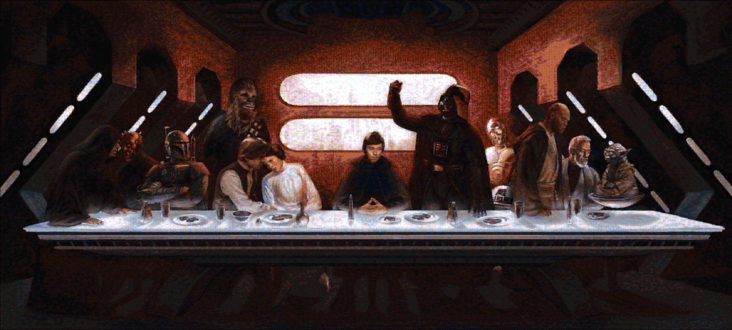
Does it help people understand The Last Supper if it is digitized or parodied?

star-wars-last-supper-mosaic-72dpi

If I am being honest, maybe Black Violin’s version of Bach’s Brandenburg Concert will help people become more comfortable with the original. But I imagine it is also easy to claim that while it may make you more comfortable, it doesn’t really help you understand Bach’s original composition.

I would also argue this is more akin to a shift in context than an actual adaptation into a contemporary “language.” I would place the common practice of  setting Shakespeare in different time periods while retaining the language in this category.

Which brings me to my second mind. The one advantage Shakespeare has is that the works can be adapted to contemporary times and the adaptations can help you understand the original works. I would say West Side Story may do this better for Romeo and Juliet and Throne of Blood for MacBeth than Forbidden Planet does it for The Tempest (granted, Forbidden Planet wasn’t intended as an adaptation of Tempest).

Whether adaptations like these help inspire people to explore the originals, I don’t know. My sense is that the theatrical format by its very nature lends itself to adaptation in ways that allow people to connect with the original works in ways other arts disciplines don’t.

To a certain degree, there is an argument for making Shakespeare’s language more contemporary because you can do effectively.

But it is still absolutely worth experiencing Shakespeare in the original language.

What Is Required To Create Works That Matter?

Can a creative person afford not to attend to the business details and promotion/branding of their practice these days?

Cal Newport, perhaps unwittingly, wades into the longstanding debate about pure practice of ones craft vs. being more business savvy and oriented with his post “Want to Create Things That Matter? Be Lazy.”

In this instance, the “laziness” is not doing anything that distracts you from deeply investing in your core pursuit. So no engaging with fans on social media or email; accepting speaking engagements; show casing work, etc.

While Newport doesn’t explicitly say this includes ignoring personal finances and legal arrangements, his definition that:

“…shallow work is an activity that can impede more important deep efforts and therefore cause more net harm than good. It might slightly help your writing career in the moment to be retweeted, but the long term impact of a distracting Twitter habit could be the difference between a struggling novelist and an award-winning star like Stephenson.”

could easily be used to support a rationalization for avoiding the less pleasant aspects of a creative career.

Paying attention to the contracts you enter in and analyzing if you are effectively pricing your work provide a net benefit to one’s career, but this is also time consuming if you don’t have the resources to pay someone else to do it for you.

While you would be on solid ground to claim these are definitely worthy pursuits, according to Newport activities like public speaking engagements are on shakier ground. Still, public appearances, especially ones you are paid for, aren’t really on the same level as busyness that you engage in to avoid doing substantive work.

Emails and social media can be a time suck and you can rationalize that you are getting things done and advancing your career, but Newport has a point that the trade off of spending an hour on tweets vs. an hour of productive creation in unequal. At a certain level of notoriety, public appearances can become a huge time and energy suck of themselves.

At the same time, we can point to examples of people who have had their careers start based on the effort they have put into a social media presence. Whether you think that success is deserved or not or whether you believe the career will endure or not is another issue.

Even though I am pretty much firmly on the side of balancing your checkbook and reading your contracts, I think the conversation about how best to pursue a career as a creative isn’t one that can be definitively settled.

That said, it doesn’t serve creative artist well to lecture them on being mindful of all aspects of their lives without some good practice guidelines (if not best practice guidelines).

Most creative oriented folks would say it is important to them to create work that matters. But if no one is aware of the work’s existence, if no effort has been made to make people aware of it, does it matter? Or rather, does it matter to the extent that others feel it has impact in their lives.

There can also be the question about whether it matters enough to support the creator financially, but that touches upon an immense conversation so I will just leave the question as one of impact.

So how do you know when you are neglecting the practical requirements of a creative career? How do you know when you are favoring shallow pursuit of your creative goals over deeper pursuit of them?

These statues were in a side alley people park their bikes in. Does this work matter?

Can You Answer This Question About The Arts?

I am a little embarrassed that it hasn’t occurred to me to post about this sooner.

Here on the old blogosphere, general Internet, at conferences, in coffee houses and on the street where you live, we often talk about educating people, reaching out to them, removing the sense of mystery about the arts. Yet it seems so difficult to figure out an effective way to do this.

While I am not going to claim it would have a high ROI, it just occurred to me, (despite participating for years), that getting more arts people answering questions on Quora would help promote and educate people about the subject. In addition, it would give those involved with the arts a sense of what people were asking and give them practice answering the questions.

I have been reading and participating on Quora for a few years and only just recently realized that the arts have pretty light representation in terms of questions and responses. I get a digest of recent responses everyday which often address questions about history (real and speculative), politics, and guns, lots of guns. I have no idea why I get so many topics on guns since that isn’t one of my stated interests.

It just occurred to me this weekend that I don’t really see much about the arts. When I do seek out questions on the topic, the most recent answers can be between 3-5 years old.

Today I got a request to answer – “Why do they tiptoe in ballet?” I have a general idea of how to respond, but many of you with a dance focus can do a better job answering than me.

Here is a brief example of the types of questions in the subject area – What makes acting believable?; How can I improve my live performance as a musician?; Theatre: Why aren’t plays recorded for commercial sale?; What are some interesting tricks that are used in theatrical set design? (this one only has two answers); Is it socially acceptable to go to the theater by myself?

Of course, there are also questions about studying an arts discipline (barely any answers on multiple theatre related ones) and dating someone who is involved in the arts.

Quora can be a great source of information on areas of interest you may have. You may often discover answers to questions you weren’t aware you had. The range of people answering questions can be surprising. Celebrities, prominent business people, Nobel Prize winners and prominent experts often offer their insight. Over time you will also start to recognize and even seek out answers by less noted people who have earned your trust by exhibiting a high level of expertise and thoughtfulness in their responses.

While you will find articles providing advice on how to use Quora for marketing and promotion, the environment of the forum doesn’t really tolerate blatant promotion.

Enquiring Stakeholders Want To Know

Last week I made a post about “rebranding” overhead costs in other terms in order to get away from the associated stigma. Included in the post, I mentioned that a non-profit was being sued by donors for dipping into its restricted funds to invest in the organization’s exploding growth.

On the Non-Profit Quarterly website today was an interview with Cindy M. Lott about the changing non-profit regulatory and enforcement environment that suggested similar scrutiny of non-profits may only increase.

The interview with Lott discusses a lot about the history of non-profit regulation on the state and federal level. One of the things they note is that the IRS’s decision to digitize 990 filings is going to bring the opportunity for a lot more transparency for non-profit charities. Access to financial documents and other information will hopefully provide a greater capacity to detect misappropriation and embezzlement of funds.

What caused me a bit of concern wasn’t the prospect that governments might use this information to apply undue scrutiny to non-profits, but that donors and funders might.

According to Lott, state attorneys general have always had legal standing to bring a suit against a non-profit entity or board of directors. In recent years, she says, other groups have argued that they have standing to bring suit as well.

Occasionally, we see beneficiaries who say, “Wait a minute—I represent an interest that is not being brought by AGs for whatever reason.” And we see marginalized members of the board and donors who say this as well.

While this is contrary to laws regarding who has standing, the fact that there are shareholder actions and class actions in the private sector may be cited to pressure for the same rights in the non-profit sector. Lott notes that secretary of state offices which oversee non-profits in each state are heavily involved with enforcing consumer protection and might easily equate donor dollars with consumer dollars.

I am merely noting what may be a natural outcome of the current trajectory of an underresourced enforcement community intersecting with a wealth of publicly available data. We may very well find in the near future that donors and beneficiaries who have access to information about where these billions of dollars are going may, in fact, decide that they would like a say when they believe something goes off the rails.

The interview cites the action taken by a wide segment of stakeholders in the case of Sweet Briar College’s planned closing. The footnotes for the interview provide a number of other examples of stakeholder actions, including a class action by donors who discovered 100% of their donation didn’t go toward programs as they intended and a suit by two sons who want to review the cause of losses suffered by a foundation their father established.

At this point I don’t see anything to be immediately alarmed about. It will definitely be worthwhile to keep an eye out for how things develop in the areas of governmental oversight and legal standing of donors and other possible stakeholders.

“…The Art That Is In You Has Only Faintly Touched The Lives Of Your People.”

Last month, Americans for the Arts blog was printing excerpts from the writing of Robert E. Gard who primary focused on manifesting the Wisconsin Idea through theater and creative writing starting around 1945.

I first became enamored of the concept of the Wisconsin Idea about 10 years ago. The idea that a state government and university system would be focused on a holistic improvement of the lives of the state’s citizenry is pretty inspiring.  Even though political opposition began work to undermine and unravel elements of it almost immediately, people have hewn to the Wisconsin Idea for over a century.

There was an excerpt on Americans for the Arts’ blog of a piece Gard wrote in 1952 that illustrates just how long some themes and debates about the arts in the U.S. have endured.

Your struggle, America, has matured so rapidly that the quaint folkishness of your village has been swept into an almost common molding, and the economic fruit of your struggle has been so plentiful that we, your people, have tended to shun the responsibility of art, sometimes to scorn it, and to look at it askance as a manifestation unworthy of our virile American manhood. You have put down deep taproots, America, that have given us the stuff of wondrous plenty, but these same roots have starved off the expressiveness of yourself. For those of us who have loved you best have not completely understood your struggle, and the art that is in you has only faintly touched the lives of your people.

[…]

It became suddenly and completely apparent to me that we could no longer pretend that theater, to have its true vital meaning, could be fabricated and foisted upon the people as entertainment alone, or as sociology, or as an art form practiced by the few for the satisfaction of individual egos. But that theater must grow spontaneously from the lives and the necessities of the people, so that the great dream of a few men and women who saw true visions might come true: the dream of an America accepting the idea of great popular art expression without question, as a thing inherently American.

So there you go, in 1952 Gard expressed concern that: 1 – America has a slightly hostile streak when it comes to the arts or creative self-expression; 2 – Arts needed to be viewed as more than just simple entertainment; 3- Yet not viewed as the province of an elite few, but as place where people saw their own lives reflected.

In 60+ years since Gard wrote that, little has changed. These topics still dominate conversation and are cause for hand wringing.

I am optimistic that things are headed in a constructive direction. Given all the attention focused on programming, casting and employment choices being made in theater and movies, there is a greater opportunity to see oneself and one’s stories.

The same with the effort to build public will for arts and culture I have been writing about recently which has creative self-expression at its core.

I am sure Gard was pretty optimistic back then too, and with good reason if you look at all that was created and still endures in the name of the Wisconsin Idea. It is also pretty clear that the effort has to constantly be sustained against both external forces that seek to oppose and erode it, as well as simple internal neglect and entropy.

To some degree, I see the effort to build public will for arts and culture as a spiritual successor of the Wisconsin Idea. The Idea was always meant to become a national influence. While its spread hasn’t been as prevalent as initially hoped, the folks in Wisconsin have been really good about actively keeping the torch lit and the light has indirectly had a positive influence on others.

If you are looking for a guiding principle to help you speak about arts and culture to those who have negative associations with the concepts, you could do worse than to meditate upon and internalize the empathy and ambition of the last line in the first paragraph I quoted:

For those of us who have loved you best have not completely understood your struggle, and the art that is in you has only faintly touched the lives of your people.

Is There Rising Market For Silence?

The journal Nautilus had an interesting piece about the value of silence.

The article starts out talking about how 100 Finnish marketing experts met to discuss how to promote the country for tourism. Someone half jokingly suggested promoting the silence of the country. The group decided it actually wasn’t a bad idea.

One key theme was brand new: silence. As the report explained, modern society often seems intolerably loud and busy. “Silence is a resource,” it said. It could be marketed just like clean water or wild mushrooms. “In the future, people will be prepared to pay for the experience of silence.”

People already do. In a loud world, silence sells. Noise-canceling headphones retail for hundreds of dollars; the cost of some weeklong silent meditation courses can run into the thousands. Finland saw that it was possible to quite literally make something out of nothing.

In 2011, the Finnish Tourist Board released a series of photographs of lone figures in the wilderness, with the caption “Silence, Please.” An international “country branding” consultant, Simon Anholt, proposed the playful tagline “No talking, but action.” And a Finnish watch company, Rönkkö, launched its own new slogan: “Handmade in Finnish silence.”

The “Silence, Please” campaign has apparently become one of the most popular aspects of the branding effort.

Despite the current theory that an arts experience shouldn’t require participants to be passive receivers in a dark, quiet room, silence is healthy for our mental and physical well-being and may be an asset worth promoting for some arts and cultural entities.

The Nautilus piece mentions research that shows how exposure to noise while we sleep can have emotional and mental impacts that may also manifest into physical problems.   Silence, on the other hand, can have positive impact on our development.

Yet to her great surprise, Kirste found that two hours of silence per day prompted cell development in the hippocampus, the brain region related to the formation of memory, involving the senses. This was deeply puzzling: The total absence of input was having a more pronounced effect than any sort of input tested.

It should be noted that these observations were made with mice, but they are researching the implications for dementia and depression in humans.

There is also mention of a 1997 Washington University study (with humans) that noticed there were interesting increases in some brain activity when subjects were quietly doing nothing that get suppressed when people are engaged in an activity.

Artists of all disciplines have known about the power of empty space and silence in their work. Still, I was surprised to learn of following result that occurred when monitoring the vitals of humans listening to music:

In fact, two-minute silent pauses proved far more relaxing than either “relaxing” music or a longer silence played before the experiment started.

So perhaps concert goers do have cause to be upset at those who clap between movements. It isn’t ruining the composition, the noise from clapping is robbing them of a positive physiological effect!

Many creatives, including one cited in the Nautilus article, are very much aware that silence is often the best method for generating creativity and inspiration.

If the arts community is going to encourage people to become more actively engaged in their own creative expressions, it is probably important that the value of silence not be overlooked. It is easy to forget that when there is so much to say about technique, history, artistic value, monetary worth, personal practice etc., etc.

For those who are seeking to unplug themselves from their regular lives, the opportunity and implied requirement of silence may be the most valuable aspect.