Forgive Your Mistakes

As the year ended, it was announced that Spiderman: Turn Off The Dark, was closing this January. Given the interminable previews, technical problems and public discussion of Julie Taymor’s dismissal as they moved to revamp the production, wry comments were never far from people’s lips when the show was mentioned.

The show served as a reminder that having successful big names attached to a show like The Edge, Bono and Julie Taymor, doesn’t guarantee success.

I was going to write a post on another topic today, but I got to reading about the difficulties faced by the original production of West Side Story in 1957. Despite also having big names like Arthur Laurents, Jerome Robbins and Leonard Bernstein attached to it, the show was a hard sell and faced a number of problems.

Stephen Sondheim, who hadn’t really become a household name at the time, didn’t want to work in the project for fear of being pigeonholed as a lyricist instead of a composer. His mentor, Oscar Hammerstein, had to convince him that working in such talented company would be invaluable for his career.

No one wanted to produce the show because its gritty story of street gangs ran counter to the happy, bright vision of musicals of the 1950s. (Remember, this is based on the tragic story of Romeo and Juliet, two of the main character are dead on stage by intermission and the two leads by the end of the story.) Even when two producers did sign on, one was unable to raise money and backed out soon after. Some theater owners refused to let their buildings be used for the show.

Finally, Hal Prince, who had previously turned the show down, was convinced to come on as a producer by Stephen Sondheim.

There were high tensions between the four collaborators over many of the artistic decisions, especially between the domineering Jerome Robbins and everyone else. Reportedly by opening night, none of the other three were on speaking terms with Robbins.

But the result was a show that was absolutely groundbreaking at the time, moving contrary to so many conventions. Now, more than 50 years later, West Side Story is one of the most enduring musicals on Broadway. It doesn’t seem quite so innovative today because so many others followed its lead.

In retrospect, it is easy to compare West Side Story to Spiderman and identify why one succeeded and the other failed, but had you been involved in the process of mounting the first production of either one, it would have been difficult to predict the eventual outcome correctly.

By some measures, Spiderman with the built in name recognition of the property, director and producers, along with all the funding behind it should have succeeded where West Side Story with its edgy story that no one wanted fund should have failed.

Today Drew McManus made a wish list for arts and culture in 2014 and asked what his readers wished for.

It wasn’t until I read about West Side Story and thought about Spiderman that I realized my wish is for artists and arts and cultural organizations to be able to forgive themselves for their failures and to realize that success is not always easy or immediately apparent.

Excepting Spiderman for a moment, there are huge, well funded corporations who perform extensive research and data analysis who still fail miserably in their endeavors. (See JCPenny’s assumption that consumers wanted honest pricing.)

While differences in economic realities may allow them to weather the consequences of their mistakes better than you can, at least recognize that having one hundred times your funding doesn’t make them even 10 times a better decision maker than you.

Conversely, your lack of funding does not indicate you lack brains and ability.

Know Who You Are Dealing With

In about two weeks I will be attending the Association of Performing Arts Presenters conference in NYC. I will be hosting a discussion panel, but my primary objective is to learn about different artists that might potentially perform in my space and make contacts with different artists’ agents.

It occurs to me to toss out a cautionary tale about being very, very careful about verifying that the people with whom you are working to arrange a performance are, in fact, the actual artist’s representative.

When I was working in Hawaii, the University of Hawaii at Manoa Athletics department decided they wanted to present a fund raiser featuring Stevie Wonder. They sent $200,000 to people who were not Stevie Wonder’s agent who subsequently took the money and ran off. The FBI ended up getting involved.

Given the scrutiny we faced to even get a $2,000 check cut, those of us working for the university in the performing arts wondered how so much money ended up getting transferred in the first place. Second, even if they didn’t think to ask those of us who handled performing arts contracts for the university, we wondered why none of the other prominent promoters in the state weren’t consulted. Any of us could have told them they were dealing with the wrong person.

However, I will admit that for someone who is inexperienced, it is difficult to discern who Stevie Wonder’s agent is. Many artists have their agent listed on their website, but Stevie Wonder doesn’t. My suspicion is that this keeps people who aren’t seriously prepared and qualified to present him from deluging the agent with requests. Anyone who is serious about presenting him will know how to identify his agent, Creative Artists Agency. (CAA)

That lack of information provides an opening which allows other people to take advantage. Even though I don’t engage artists who command $400-$500,000, I know CAA is one of the few agencies large enough to handle the business of someone like Stevie Wonder. But if you search the internet for “Stevie Wonder agent,” you will find 6-10 listings of people offering to arrange a concert for you. If you didn’t know CAA was his agent, which would you choose? CAA is the first search result, but there are two paid placements that come in above them.

Most of the other companies listed will likely turn around and contact CAA on your behalf to arrange for Stevie Wonder’s performance, taking a cut themselves. This isn’t to say these middlemen are just skimming a piece of the action. There are many that will add value to the exchange and handle the details you don’t have the resources to deal with yourself.

Some might take the money and run.

There are organizations that work to apply a code of ethics to artist booking like North American Performing Arts Managers and Agents (NAPAMA), but plenty of wholly legitimate agents are not members. And the general layperson never knows if these trade organizations are legitimate themselves or just created to provide a semblance of legitimacy.

Probably the best guard against getting cheated is good research and relationships. As I said, many artists will have their agent listed on their website. If they don’t some careful research is in order.

This is especially true if you are partnering with another entity who is going to help you mount your event. The more expensive the artist is going to be, the more you want to work with someone trustworthy who has experience presenting artists of that caliber.

The problem is, if you don’t have a close relationship with such a person, you are basically left assuming that the person you do trust to vouch for them actually knows enough to make that judgement.

The wisest course is get experience presenting events, working your way up to larger and larger names to get the experience. But many people don’t plan to present shows frequently enough to acquire this experience.

Deciding you want to invite someone who regularly commands $50-100,000+ for your fundraiser or anniversary event, having never presented such a performance before and not working with an entity that has, is a recipe for disaster. There are going to be basic expectations about the experience that you are entirely unaware of and unprepared for.

And really, the same is true for artists with $10,000 fees. There will just be exponentially more people involved at the higher fee and the problems will be that much more public.

You Think You Know Scrooge?

Like I assume most of you, I thought I pretty much knew everything there was to know about A Christmas Carol. I had seen dozens of adaptations, (not including the Klingon version) and revisited the same movies multiple times. (My first recollection of the story was actually Mr. Magoo.)

Since we were producing a production of the show this year, I wanted to do a bit of research for a press release. To my surprise, I learned that pretty much everything we take for granted about Christmas was in a large part the result of Charles Dickens’ attempt to use his story as propaganda.

So many of the tradition we have today were just starting to be invented or revived during the Victorian era. I suspect this is why a Victorian Christmas is something of an ideal.

Caroling was just starting to come into its own. The practice of erecting a Christmas tree had been brought to England from Germany by Prince Albert.

England had had many Christmas traditions, but they had been outlawed by the Puritan Parliment during the Cromwell era in 1647. This ban was carried over to the United States, specifically Boston. It would be nearly 200 years before they saw their revival. (Christmas Carol was published in 1843.)

I think most surprising to me was that Bob Cratchit asking off for Christmas was very much the exception rather than being the rule. Fourteen years after Dickens completed A Christmas Carol, a Boston factory owner was so moved, he decided to give his workers the day off and sent each a turkey.

It amazed me to think that giving workers the day off wasn’t a common practice. Basically, if you are getting off on Christmas or receiving holiday pay, you owe some thanks to Charles Dickens.

Of course, Dickens’ primary motivation wasn’t to gain a day off for everyone, but to engender a sense of charity and goodwill toward one another during Christmas. He had a pretty crummy childhood with his father locked away in debtors prison requiring Dickens to work in a factory to earn money. He developed an empathy for the impoverished and those who suffered social injustice.

When you read or watch A Christmas Carol in the context of it being a somewhat groundbreaking plea for the Christmas spirit and a prime example for traditional Christmas practices yet to come, you gain a new appreciation for the work.

I talked about these elements in my curtain speech prior to our performance of A Christmas Carol and I have actually had quite a number of people thank me for providing the information.

So a Merry Christmas to you all. Revel in your traditions, family and friends.

Please j’onn, Don’t Eat Me

Not to be outdone by Drew McManus’ generous referral last week of donations toward Jon Silpayamanant’s Mae Mai blog, I went to see him perform this week.

It was a dangerous trek across the backroads of rural Ohio. But none of that compared to the peril of meeting Jon himself, as you can see in this picture. (He is the warrior in the back.)

Fierce Klingon cellist and his brother in blood

I assure you, if he hadn’t started to engage a cloaking field which blurred his features, you would appreciate the full terror inspired by his mighty form. In his hand behind me, he is holding a D’k tahg dagger as he muses that the blood of humans, tainted by their cowardice, tastes worse than targ blood.

In other words, I had a great time.

I made the trip to Cincinnati to see A Christmas Carol in the original Klingon. I had seen the show listed before and hadn’t realized this was the first time the production had been mounted in Cincinnati. All the previous productions were (and still are) performed in Chicago and Minnesota. (Video of a Chicago cast here.)

Much honor was earned this month in Cincinnati!

As much as I say that tongue in cheek, even with all the Star Trek fans out there, it isn’t the easiest thing to go to a new city and audition actors who can speak Klingon, or find actors willing to learn.

Jon composed the score for the show and made a special appearance yesterday with members of Il Troubadore to perform during intermission. There were pieces of Klingon opera as well as “Terran folk songs.”

Probably not what you imagined if you read that Jon often focuses his blog writings on “ethnic orchestras,” but like a good writer and musician, he doesn’t discount any potential avenue of exploration.

It makes Western orchestras look silly worrying about what is appropriate to wear onstage. He has to fret over Klingon armour and a Wookie costume (he aims to have one like this by 2015) and face the scrutiny of truly pitiless critics –sci fi enthusiasts.

Info You Can Use: Speed Dating For Volunteers

Last month Non-Profit Quarterly (NPQ) had a small piece on a “Speed Dating” event that 15 Sacramento non-profits organized to recruit volunteers. In addition to it being a great idea for volunteer recruitment, it also seemed like a (relatively) low-stakes way to practice and evaluate the most effective methods of speaking about your organization for fundraising and promotion purposes.

On the merits of recruiting volunteers, I thought it was a better option than just listing opportunities on websites and newspapers because it is more active and takes advantage of the cachet of other organizations to engage with people who might not immediately be attracted to your organization.

By this I mean, had you advertised a volunteer recruitment open house for your theater, it may pass the notice of people who don’t already have an affinity for your discipline or organization.

If you are part of an event that also includes the local Red Cross, schools, hospitals and other non-profits, you have an almost guaranteed opportunity pitch your organization to everyone there. Since everyone is expected to interact with everyone else, it removes the awkwardness of volunteer fairs where you attempt to engage with people who pass your booth. Ultimately you have the opportunity to gain the participation of a person who was only vaguely familiar with your organization, was unaware you went into elementary schools, but is absolutely invested in helping with those activities.

This approach may be well suited to recruiting young volunteers because it is so direct and interactive rather than depending on them to find and research you at some point in their busy day. (Which is not at all to say that older retirees wouldn’t find it great fun as well.)

In the NPQ comments section, Abigail Denecke echoed my thoughts wondering what questions/statements/approach might have been most effective at cultivating additional action. And I liked commenter Laura Halley’s idea about using a speed dating structure as a general orientation tool.

Allow Yourself The Same Patience You Would A Baby

I don’t recall who it was that provided the link. I want to credit Maria Popova at Brain Pickings because this is the sort of thing that appears there.

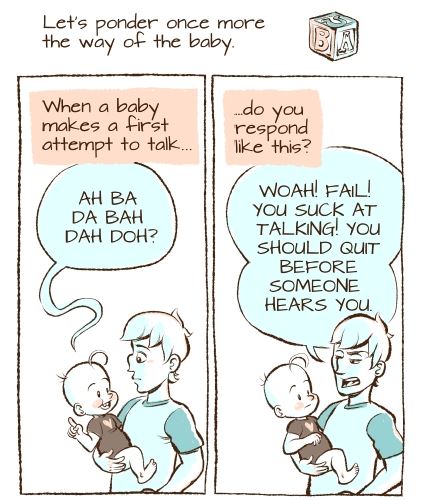
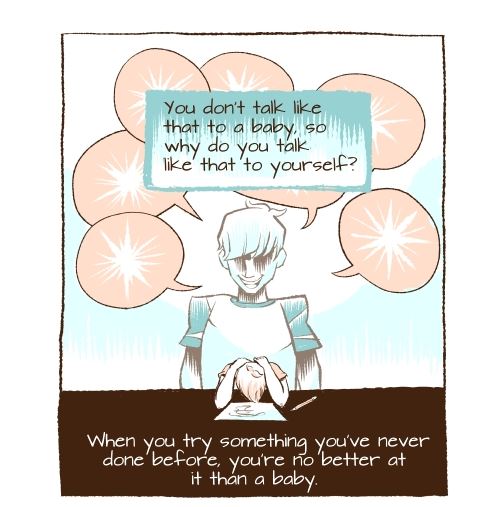
But someone directed me to Stephen McCraine’s Doodle Alley web comic. Specifically his Be Friends With Failure comic that urges beginning artists to have patience with their self and to realize that the process of developing their skill is going to be fraught with mistakes and missteps.

In many ways, it is similar to Ira Glass’ talk about the gap between your creative taste and your ability to execute it I wrote on last year.

I really liked the whole  Be Friends With Failure strip, but the frames that got me were these:

you faildont treat self like baby

McCraine has his strips indexed by general topics of advice for artists like setting goals, improving and motivating yourself. It appears he finished his series last month. There are about 25 strips so it is easy to get through them all in a relatively short time. He tackles some interesting concepts like “Practice Does Not Make Perfect” , “Know Your Artistic Lineage,” “Diversify Your Study,” and “You vs. You.

The answers to all your problems aren’t going to be encapsulated in a short web strip, but I think the medium and execution are an effective shorthand reminder to help steer yourself back on track. You may not have the time or inclination to pick up a text that discusses these concepts, but I think the format is such that you would more quickly return to it for a little boost of motivation.

Wherein I Hallucinate About Internships

I recently misread the title of a post on Museum 2.0. But in that second of misapprehension, my brain flooded with assumptions about the subject of the post. I misread “A Shared Ethics for Museum Internships” to be something like “Ethics for Shared Museum Internships.” In that moment, I thought shared internships was a great idea and had a vision for how it would work.

Some of these assumptions were made in the context of the growing discussion of problems with unpaid internships, most recently an quoting former Sleep No More interns as saying there wasn’t any educational benefit to the experience.

One thing articles about unpaid internships have focused on is the idea that the experience is supposed to be educational and of no direct benefit for whomever the intern is working. Now the best information I have right now is that these guidelines don’t apply to non-profit and public sectors. But there are rumblings that this may be changed. And there is also the issue of just because you can use an intern in the place of a staff person, doesn’t mean you should.

What I thought the Museum 2.0 post was going to suggest was trading interns between companies, particularly between for- and non-profits. I had this immediate vision of interns at a bank working in a museum and the museum intern working in a bank for a few weeks. The benefit being that the future banker would have an understanding of arts non-profits and the future museum director/curator would gain insight into what motivated banks to support arts organizations (or what motivates individuals to give as part of their bequest if the intern worked in the the trusts department.)

While it may not be entirely appropriate for a non-profit to “act like a business,” this type of experience can contribute to a better understanding of the points of view of board members who are business leaders by future non-profit leaders, and those of non-profits by future business leaders and board members. Miracles probably won’t result from a few weeks spent interning in a different company, but it shouldn’t impede things too badly either.

Moments later, I realized what the real title of the piece was, but my initial impression still seemed like an interesting idea. Even if you didn’t do an internship trade, placing an intern to work for a week at the company that did your brochure printing or the hotel that put your performers up, would give an intern a better understanding of the work done by the close partners of the organization.

A few years down the road, the intern might be in a position to propose an arrangement that is mutually beneficial to both the non-profit and the commercial partner that ends up bringing them closer together. A closer bond would also be the hopeful long term benefit of the intern swap I initially mentioned. Once the interns had reported on their experience and moved on, hopefully the cooperating businesses and non-profit would feel a continuing respect and understanding of each other.

Of course, it can be hard work to arrange all these details. It is hard enough to ensure that the experience at your organization is meaningful and doesn’t relegate the intern to copying and answering the phone, much less to provide the same experience at other work sites. But then, the intern isn’t really supposed to be making a lot of copies during this period anyway.

Any thoughts about this, its viability and how it might be accomplished? I mean, essentially what I am asking is, since I already hallucinated the post into existence, does anyone want to write about Ethics of Shared Internships?

Hard To Pronounce Show? There Is An App For That!

We all know that an online ticket platform can make it more convenient for people to purchase tickets at their leisure, but a recent article on Slate suggests that it may also help sell tickets by avoiding opportunities for anxiety.

…1980s change in Swedish liquor retailing that led to stores being moved from an “ask a clerk to retrieve a bottle” model to a “self-service” format. It turned out that, not only did removing a layer of human interaction spike sales (by 20 percent) but it also led to a shift in those sales toward a large number of difficult-to-pronounce drinks. According to Swedes independently surveyed by the researchers, it is apparently harder to say Stolichnaya than Absolut in Swedish, and there were real challenges with French wine pronunciation as well.* So take away having to say anything out loud and the sales of the tongue-tied bottles increased by 7 percent.

Another example they gave was that online ordering for pizza increased the spending on each order. People didn’t order more pizzas, but they did order more toppings on each pizza. The theory was that people were more comfortable doubling up on meats or making a complicated order (like for a Starbucks coffee) when they could do so online rather than having to express it to a person.

Of course, that may not always be in the best interest of the consumer…

..the website induced more “double bacon” than “double veggies” orders. The picture painted is one of people avoiding the awkwardness of complex—and fattening—orders online and making simpler—and healthier—ones when they had to deal with a real, live person.

I oriented more on the concept that ordering online helped people avoid potential mispronunciations on shows like Antigone and Coriolanus or artists with foreign pronunciations like Stephen Colbert.

I wondered given non-profit arts organizations are in the business of educating, is it better to gently correct or even correctly pronounce the name when reviewing the order, or to just ignore the mistake and avoid embarrassing the customer at all.

I don’t have any research to show that this sort of anxiety factors into the method people choose when they order tickets, but the research showed that people deferred their real desires even when the opportunity for embarrassment seemed low.

Though anxiety over the ticketing ordering process probably ranks lower than most barriers to participation for arts audiences, it does seem like another reason for having the alternative available and easy navigate.

I am not trying to contradict my blogging confrere Drew McManus with the title of this post and encourage people to develop new apps, but many of the commenters on the Slate article mentioned how much they loved being able to place their order when they entered Starbucks or a deli and have it waiting by the time they got to the register.

It may be beneficial to use a ticketing service that offers those sort of apps so people can order in advance or while they wait on line.

Perhaps I am overly sensitive to constantly being up-sold during my Christmas shopping excursions, but the last paragraph of the article especially resonated with me. The author, Joshua Gans, notes that this potential for embarrassment also inhibits employees who are forced to ask for customer names, email addresses, store credit cards and extended warranties, from giving the best and most sincere service to customers. It can undermine confidence and goodwill if customers pick up on this unease or are annoyed at a time when they are spending money.

So in addition to examining whether your processes are making things difficult for your customers, you may need to evaluate their impact on your employees as well.

Info You Can Use: Save The Charity, Save Your Company

I loved this story on Non Profit Quarterly about a Maine restaurant which actually revived its business when it started holding all you can eat fundraisers for charities.

…the eatery thought of the weekly all-you-can-eat nights with suggested donations flowing to charity as a way to attract new customers. “It worked almost immediately and it revitalized the business,” Benedict said. “We would have gone out of business if we didn’t change the way we did business. Giving back is the first thing we did, and it worked.” She says that a total of $635,000 has been raised since 2009 for local charity organizations and individuals.

It is great to hear that a business saved itself by helping charities in the community. It could be a model for other communities and businesses.

However, the restaurant hit a snag when the state attorney general started to investigate whether it was licensed as a charitable solicitor.

My first reaction was disappointment because the restaurant was doing such good work, but the truth is that there is a lot of fraud and deception perpetuated by companies acting as charitable solicitors. So unfortunately, despite an abundance of good intentions, companies need to be careful about providing assistance to charities in a similar manner.

The Council of Non-Profits has a link to the first chapter of a book about the licensing required for charitable solicitation by 40 states. The chapter provides a good introduction to the issues involved and resources for finding out more about the requirements in your state. I was able to go right to the pertinent sections of my state code and find who is exempt from filing with a couple mouse clicks. (Unfortunately, it doesn’t appear the restaurant would be exempt in my state.)

Economic Impact Ain’t Everything

Drew McManus cautions a little today against putting a lot of stock in studies about the economic impact of the arts.

I had been thinking along the same lines because so many people were crowing last week about studies showing arts and culture had a $500 billion impact on the economy.

The problem is, between 1998-2008 the impact of arts and culture on current dollar GDP was between 3.5% and 3.7% of the economy. According to a piece from Pacific Standard, arts and culture has been hanging around at 3.2% of the economy since 2009. When you are talking 500 billion, each tenth of a percentage there represents tens of billions of dollars so a .3%-.5% difference adds up quite a bit of lost impact. (Though the report was measuring where things stood in 2011 we are talking about a 2 year “hang.”)

From some of the responses I was reading, it seemed like people thought this was the first time the economic impact of arts and culture had been measured. It does appear that the criteria and methods are more refined than in the past, so the number may be more accurate. But as Drew suggests, people have been attempting to measure economic impact of arts and culture for quite some time now.

And remember, often economic measurements aren’t always your friend and acknowledging their validity can be a two edged sword if someone else can claim bring equal or better results.

A recent opinion blog on the NY Times reminded me that when it comes to economic impact and earnings potential for arts and culture positions, it is important to note that the figures are a result of specific decisions being made:

Is the crisis rather one of harsh economic reality? Humanities majors on average start earning $31,000 per year and move to an average of $50,000 in their middle years. (The figures for writers and performing artists are much lower.) By contrast, business majors start with salaries 26 percent higher than humanities majors and move to salaries 51 percent higher.

But this data does not show that business majors earn more because they majored in business. Business majors may well be more interested in earning money and so accept jobs that pay well even if they are not otherwise fulfilling, whereas people interested in the humanities and the arts may be willing to take more fulfilling but lower-paying jobs. College professors, for example, often know that they could have made far more if they had gone to law school or gotten an M.B.A., but are willing to accept significantly lower pay to teach a subject they love.

Economic impact of arts activity could potentially be greater if more people choose to charge more (or it could be lower because it wouldn’t be as widespread.) Arts and Culture salaries could be higher if people held out for more money (but again, there might be fewer people employed in those areas.) Choices have been made in an attempt to provide more widespread access and because people have been motivated by considerations other than money.

(And by the way, salaries start to even out around mid-career. Note that liberal arts is tied with medical technology, theatre with health care administration, history with business administration, and philosophy is WAY above both of them.)

People may tell you that back in the old days, people stuck with a job no matter how awful it was instead of pursuing what interested them. That may be true to a degree, but this weekend my mother told me that when my grandfather was working in the garage at a car dealership about 4-5 miles from their house, he was unhappy and bounced back and forth between parts manager and service manager and would curse up a storm every night.

Then he got a job at West Point Military Academy in shipping/receiving in the early 60s, and even though it was 40 miles away which required him to get up earlier every day, she never heard him curse after that point.

Not only do I know that my grandfather couldn’t be the only one who did this, I have heard interviews recently with people who lived in towns with good manufacturing bases who talked about how easy it was to quit a job in the morning and have a new one by the afternoon.

People may characterize following your bliss and studying a topic that interests you as an irresponsible and effete decision, but it isn’t unrelated to decisions people have made in the past. There may have been a good many people who stayed in a soul crushing job all their lives, but that may have been more of a choice than a necessity.

This by no means ignores that there are other forces conspiring to place college educated people in low paying jobs. There is more involved in finding employment than choosing a field of study and embracing the realities of jobs in that field.

But the choice to accept a job at low pay also contributes to the job being low paying. Sometimes it is because there are few alternatives but to accept those jobs. Sometimes it is because the applicants concede the organization has important uses for that money.

Salaries and economic impact are not the sole measure of value of people and their labor. Good thing too because we probably all have more value as soylent green.

Don’t Be Nervous, It’s Not About You

I do a lot of public speaking and am generally pretty comfortable doing it. The place I get most nervous is up on stage. In a classroom or hall full of 50-100 people, no problem. On stage, in a theatre, and my nervous energy starts to rev up.

It doesn’t approach anywhere near paralysis, but it is there.

At the last theatre I worked at, I got pretty accustomed to the space and the general energy of the people. But now that I am standing up in a new space, I gotta start all over again.

I took a little guidance from a post Seth Godin made about public speaking on Monday to prepare for my appearance before the performance we had Tuesday night.

In his post, “Speaking in public: two errors that lead to fear,” he says:

1. You believe that you are being actively judged

2. You believe that the subject of the talk is you

When you stand up to give a speech, there’s a temptation to believe that the audience is actually interested in you.

This just isn’t true. (Or if it is, it doesn’t benefit you to think that it is).

You are not being judged, the value of what you are bringing to the audience is being judged. The topic of the talk isn’t you, the topic of the talk is the audience, and specifically, how they can use your experience and knowledge to achieve their objectives.

[…]

If you dive into your (irrelevant to the listener) personal hurdles, if you try to justify what you’ve done, if you find yourself aswirl in a whirlpool of the resistance, all you’re providing is a little schadenfreude as a form of entertainment.

On the other hand, if you realize that you have a chance to be generous in this moment, to teach and to lead, you can leave the self-doubt behind and speak a truth that the audience needs to hear. When you bring that to people who need it, your fear pales in comparison.

Not the simple advice found in, “imagine everybody in their underwear,” but probably more useful to you in the process of preparing for your moment in the spotlight so you don’t start getting worked up in advance.

Incidentally, this is the same advice usually given about marketing and advertising–It isn’t about you, it is about your audience and what is valuable to them. So you shouldn’t be spending a lot time listing accomplishments trying to justify your organization, but rather make the focus about your audience and how they benefit.

Wishing You Were A Famous Actor, Tenured Professor Or A Drug Kingpin

This weekend I was reading an piece on Slate that likened new Ph.Ds seeking tenured positions in higher ed to drug dealers hoping to become drug kingpins.

“If you take into account the risk of being shot by rival gangs, ending up in jail or being beaten up by your own hierarchy, you might wonder why anybody would work for such a low wage and at such dreadful working conditions instead of seeking employment at McDonald’s. Yet, gangs have no real difficulty in recruiting new members. The reason for this is that the prospect of future wealth, rather than current income and working conditions, is the main driver for people to stay in the business: low-level drug sellers forgo current income for (uncertain) future wealth. Rank-and-file members are ready to face this risk to try to make it to the top, where life is good and money is flowing,” wrote Alexandre Afonso, a lecturer in political economy at King’s College London.

[…]
“The academic job market is structured in many respects like a drug gang, with an expanding mass of outsiders and a shrinking core of insiders. Even if the probability that you might get shot in academia is relatively small (unless you mark student papers very harshly), one can observe similar dynamics,” he writes. “Academia is only a somewhat extreme example of this trend, but it affects labor markets virtually everywhere… Academic systems more or less everywhere rely at least to some extent on the existence of a supply of ‘outsiders’ ready to forgo wages and employment security in exchange for the prospect of uncertain security, prestige, freedom and reasonably high salaries that tenured positions entail.”

Since I work in higher education, I thought this theory was interesting and entertaining and then moved on. It wasn’t until the next day that I realized this pretty much describes the same situation faced by people who want to be actors (as well a orchestra musicians, I imagine). I don’t know why it didn’t strike me earlier, I have been reading Scott Walters’ thoughts on the subject of too many acting students being graduated for the available jobs for years.

Just like the rank and file drug dealers and doctoral program graduates, thousands of actors graduate a training program at some level hoping to become a big star, or at least steadily employed at a livable wage, each year.

The problem is, the only opportunities are on the periphery as either a low level drug dealer or adjunct, while the available spots at the core as a kingpin or tenured professor are increasingly few. (Though I will confess that other than increased pressure from law enforcement and internecine conflicts, I am not sure what is limiting the number of kingpin slots.)

It may be much worse for actors because it appears there are fewer and fewer paid opportunities even on the periphery for them to pick up, much less achieve a reasonable career and income. (Though it is difficult to gauge because the surveys aren’t able to comprehensively measure all paid opportunities.)

But I have long known about all these factors that conspire against practicing artists and that students are undeterred and pursue the career path anyway. My realization that the comparison of Phds to drug dealers was apt for actors was pretty much just that– a realization that arts people don’t really diverge too far from the norm in their aspirations.

Not that desiring to be a drug kingpin is normal, but the act of aspiring to achieve a severely limited status is widely shared by all humans and not specific to artists.

This may seem like common sense, but when you hear students urged to pursue practical majors in Business and STEM fields, you might get the impression that aspiring to the unobtainable is embraced by only the margins of society. As the Slate article notes, the similar conditions exist across all areas of the labor market. It may only be pursued to greater extremes by the margins, but the impulse is deep seated in us all.

Thanks For The Virtual Relationship

I started my current job in May, however I came to interview for the position right before Thanksgiving last year. As you might imagine, I count that date as an important milestone. Given the proximity of this “anniversary” to Thanksgiving, there were a number of cards and loaves of pumpkin bread being distributed to those who welcomed and assisted me in the transition to my new job.

I probably missed a number of people in the process. One person I whose participation in my job search I did want to recognize is Drew McManus. I use the term “participation” because while Drew did directly contribute to my getting this job, he also more indirectly helped with a little experiment I was running.

So this entry is actually less about saying how wonderful Drew is (though he is), as reflecting on what it is we actually value about employees and coworkers.

I actually started my job search a few years back and I asked Drew if I could use him as a reference. At the time, we had never met in person. And as of right now, our only in person meeting was a couple hours for dinner during a lay over I had in Chicago when I was returning from a job interview.

I wanted to see if it was actually possible to get a job based on the recommendation of someone whom you had never met or worked with directly. I listed Drew about third or fourth on my reference list behind people who had actually supervised my work directly on a daily basis.

While it is true to say that we never really met, we have communicated quite often over the years via email and a number of times on the phone, soliciting each other’s advice and discussing the arts environment. We would coordinate on cross-blog projects. I would frequently alert Drew to problems with the website hosting the blog and there were a few times I expressed criticism of some of the changes he was proposing.

So in many respects, our relationship was similar to that of many workplaces where coworkers assist and comment on each other’s work and labor to advance the interests of the company, in this case the Inside the Arts page.

The Adaptistration blog has passed its decade mark and Butts in the Seats will reach that point in February. In some respects, Drew is more familiar with the quality of my work and thoughts on arts administration than my previous four work supervisors. Since I am faithful about scheduling blog posts to cover my absences during vacations, he knows a bit about my work ethic.

Yet we work in a field that emphasizes in-person interactions with our customer base. We want people experiencing the arts in close physical proximity with the performer or actual piece of visual art.

There is a 10 year section of my life’s work that does not exist physically. There are people who have published fewer pages of incoherent ramblings than I have who are recognized poets and authors (or gotten tenure). I can’t quite say for sure if those 10 years of effort even helped me get this job or not.

Do you really want to hire someone who values interactions and creative content that are generated virtually for a job that is so much about the physical experience?

I think most everyone would agree this is pretty much indicative of the new normal and has been for awhile. Even the novelty of this story has waned from what it might have been four or five years back. I have interacted with Drew and others so frequently and so regularly it is difficult to remember or even believe that we have only met physically for two hours.

To some degree, the situation was almost akin to the blind auditions orchestras hold. My value was being discussed based largely on the quality of my work for the benefit of the project and not colored by office politics, personal affiliations or the size of the tip I leave when we go to lunch.

The common joke is that you never really know if the person on the other end of the computer is who they represent themselves to be, but this is also the stuff upon which relationships and trust are, and will be developed.

Even though Drew was last on my list, he received a surprising number of calls and apparently carried on fairly decent length conversations. And I actually got called out for some in-person interviews afterward. I don’t know whether his conversations helped my case, but they clearly didn’t hurt.

One thing I take from this is that while the opportunity to view performances online can undermine the value of live attendance in people’s minds, this experience has shown me that it is possible to develop a seemingly deep relationship with them as well. All the information you put out there on your website and all the interactions you have on social media can make people feel as if they have visited your performance space and experienced an event there, even if they haven’t.

I won’t argue that it isn’t a shallow, illusory relationship which may crumble quickly upon contact with the real life situation. But I think half the barriers to participation audiences encounter are mental and anything that removes or diminishes those perceptions and makes people feel as if they have the ease of a longstanding relationship with you is helpful.

Though again, the image that you put out there has to match the reality fairly closely. You can’t promote yourself as Disney if the reality is the Jersey Boardwalk after a hurricane.