Best Leaders Are Internally Motivated

There was a post on the Harvard Business Review blog site about a recent leadership study – Why You Lead Determines How Well You Lead.

According to the study, people with an internal motivation to lead are more effective than those with external motivations. More surprising, a person who has a mix of internal and external motivations, does very poorly.

“As one might predict, we found that those with internal, intrinsic motives performed better than those with external, instrumental rationales for their service — a common finding in studies of motivation. We were surprised to find, however, that those with both internal and external rationales proved to be worse investments as leaders than those with fewer, but predominantly internal, motivations. Adding external motives didn’t make leaders perform better — additional motivations reduced the selection to top leadership by more than 20%. Thus, external motivations, even atop strong internal motivations, were leadership poison.

Many believe that the best way to influence behavior is to incentivize it, and such external incentives certainly work with lab rats. In our study, however, adding external incentives clearly did not improve leader performance.”

and later

“If those we seek to develop as leaders adopt external justifications for leading well — such as an increase in shareholder value, better pay or perquisites, or increased profits — they are likely to be less successful as leaders in comparison to those who seek to lead for more internal, intrinsic reasons alone.”

If you have been reading my blog for awhile, you probably can see where my mind is going here. These results made me wonder if non-profit leaders might not make the most effective leaders since internal motivation for doing the job is all but given.

Now remember, effective leader doesn’t necessarily equate to successful. This is a “if you are so smart, why ain’t you rich” situation. Non-profit organizations are notoriously underfunded and lack the resources to achieve the success they aspire to. Not to mention many are pursuing work which others won’t because there is no profit to be made.

Likewise non-profit leaders may make really stupid choices because there was never any time to properly develop and cultivate them throughout their careers. (Not that this type of grooming has kept their for-profit colleagues from making stupendous mistakes either.)

Yes, I am flirting with suggesting that for-profit corporations pull something akin to the movie Trading Places consider looking for effective leaders in non-profit organizations (sans the whole bet thing).

Yes, this regrettably will take talent out of the field, but it would put them in a place with greater resources to provide their leadership skills with more impact. Without maximizing shareholder value as a central goal, the general business environment may shift for the better. Though that might be as big a fantasy as the movie.

http://www.youtube.com/watch?v=ZjDbJQKDXCY

Info You Can Use: Netflix HR Policies and the Arts

Apparently Netflix Powerpoint presentation on human resources has been getting a lot of views this last month. I remember being able to read the accompanying article on Harvard Business Review at one time, but it seems to be protected by a registration requirement now.

The Powerpoint presentation can be viewed however and has some interesting lessons about employee relations for non-profit arts organizations. I will state outright that probably the biggest hurdle for arts organizations will be paying top dollar for top talent since the arts are often limited in their earning ability. However, given that arts people are often motivated by psychic income rather than monetary income, some of Netflix basic philosophy may apply.

Or perhaps having highly talented people working for you and following their ideas about jettisoning process and procedure can help you identify income streams needed to provide appropriate remuneration.

There are 126 slides so I can’t really summarize the whole presentation, but I wanted to talk about a few that stuck out.

Slides 4-18 talk about the values of Netflix making it clear that their view is that the true values of any company aren’t what they say they value on paper, but what employee activities are actually rewarded. A company says they value integrity, but punish a whistleblower, then that is not a true company value.

This is something to think about when writing your organizational values and mission statement. It almost seems best to be like the college campus that only puts in sidewalks when they see where the students walk to get between buildings. It might be best to enumerate the values you do exhibit rather than the ones you aspire to–and then revise as you evince more constructive behavior.

The thing about Netflix HR policy that most companies might have a hard time implementing is in slide 22. “Adequate performance gets a generous severance package.” They want people who are performing at their best and give those who aren’t the boot, but in the nicest way possible.

In the article which is now behind a registration system, they talk about a woman who was a great producer, but as technological advances left her behind, she couldn’t conform so they sat her down. They make it sound like she was relived to be let go (and maybe the severance package is just that good).

It seems a little cold hearted, but it does show they are in earnest when they claim a commitment to only working with the top talent they can find. In the slides that follow, they talk more about that, saying they use the metric of who would they fight to keep if the person was being hired away. You keep those you would fight for and give severance to everyone else.

To be fair, they say the approach should go the other way (slide 27) and that every employee should periodically ask what their manager would do to keep them on if they gave their two weeks. Later in the slides, they say that interviewing with other firms while working for Netflix is not a sign of disloyalty, but a good way to discover your market value, just make sure you don’t reveal any corporate secrets. (slide 108)

In slide 38, they admit working for them is not for everyone. They focus on results, so you don’t get an A for effort.

Where things get interesting is around slide 43. This is where they talk about why they are so focused on only keeping the most talented people. They note how companies often start curtailing freedom as they get bigger and more complex. Companies will add processes, but Netflix says that is only a short term solution because they lose their ability to be flexible (slide 51-61) in the face of change.

The solution is to increase the level of talent in your organization faster than complexity, that way you have self-disciplined, creative people working for you who don’t require tons of processes to keep them reined in.

This is the part I felt was most applicable to the arts. The conversation these days focuses on how inflexible arts organizations are at responding to the changing operating environment. Yet we have some of the most talented, creative people working for us. Small arts groups are nimble, but as they grow and become established, they generally seem to become less flexible. The size and desire for job stability by the employees has frequently been identified as prime culprits.

But according to Netflix you can have growth, organizational flexibility and job stability, so perhaps it is the processes that are to blame.

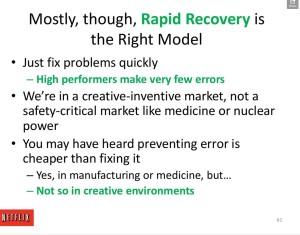
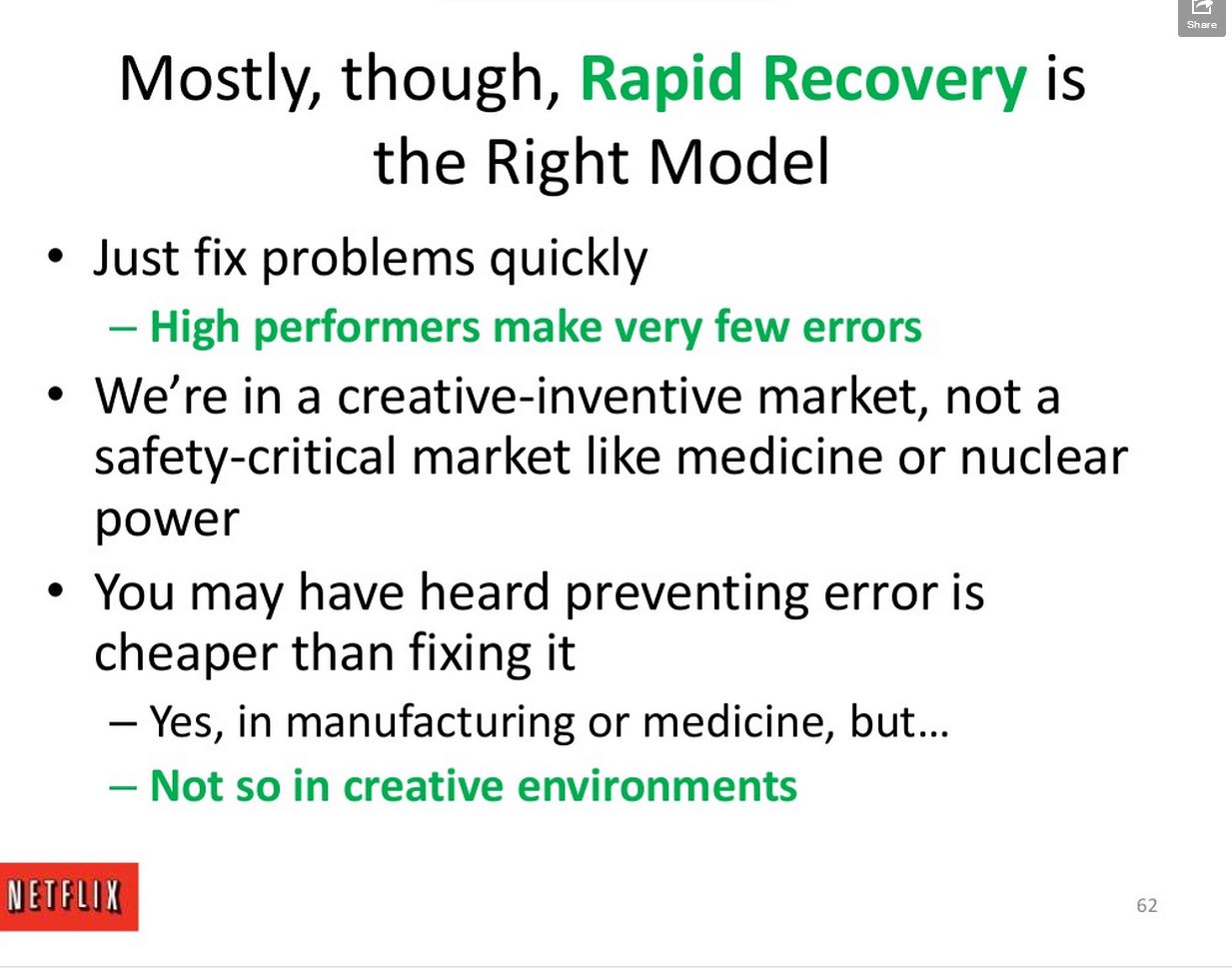
The next slide was the one that intrigued me most:
not so creative


That last line implying it is better to be flexible enough to recover from a problem rather than having rules to prevent them really caught me off guard. And in the slides that follow (63-71) they give examples of good and bad processes and discuss how their famous “take whatever vacation time you want” policy came into being. (Slide 67 is essentially the thesis)

But the idea that it is better for creative environments to take errors in stride and move past them echoes the oft expressed idea that artists and arts organizations shouldn’t fear making mistakes and taking risks because it is integral to self-development.

There are some interesting slides on employee relations, providing context rather than attempting to control (81-87). I don’t want to get into summarizing that because I wanted to tackle their compensation policy.

Their philosophy is that the compensation for each person is individual and they should be paying top market price for that person. And that they shouldn’t wait until an annual review to award an increase in compensation if they realize they are not paying top dollar, they should do so immediately.

Compensation is not dependent on Netflix success.  (96-104) They are against giving raises based on job title (what are all other marketing directors getting? Not all people with that title are of the same quality), or giving across the board percentage raises, or practicing internal parity (everyone in the department/seniority get paid the same).

For Netflix, monetary compensation is everything. I imagine that is because they are hiring people who are both very talented and motivated by the idea monetary compensation is everything.

For arts organizations, it is probably possible with some thought to find non-monetary rewards that motivate employees along the same philosophical lines utilized by Netflix. Perhaps flex time, access to facilities and supplies to exercise their creativity, use of organization owned housing for out of town guests at Christmas, etc.

Given the idea that compensation level is personal to each individual, the opportunities provided to each person may be different. An administrator and a receptionist may end up making the same salary because the administrator values being able to use the ceramic studio to create works they can sell over being paid more.

If you subscribe to their philosophy that A level results for B level effort gains you greater responsibility and compensation that will allow you to grow within the company, then a receptionist who has made great contributions could be promoted to the marketing department.

But then you potentially run into the area that takes the most courage–letting go of a mediocre producer in the marketing department. If there are a couple of stars in the marketing department who have the potential of heading up a new endeavor that will earn more revenue, that’s great, shuffle them off to better things. But you might as easily need to let someone go to get the best talent into marketing.

Netflix philosophy assumes everyone working for them is motivated to advance. I don’t recall if they covered this in the slides or the article, but I suspect if someone declined to be promoted, they might be viewed as too timid for the company’s ambitions and content to invest B effort to generate A work.

This may be just as true for an employee of an arts organization, but much more difficult to discern because the person could value the work/life balance afforded by their position so they can spend time with family or artistic pursuits. You might never find someone who can produce as well as they can working 25 hours a week and they may stick with you for the next 10 years. It can be tougher to discern in the arts and tougher to find the resolve to cut mediocre people loose.

But I suppose allowing for employee work-life balance is why Netflix has the very liberal “no-vacation policy” vacation policy. They probably understand that those needs are just as individual as compensation.

Caring, Rather Than Money, Makes The World Go Round

There was a Slate article today covering research on motivating employees that seemed well-aligned with the non-profit work environment. The research essentially verifies the importance of providing recognition and a sense of meaning to employees.

Researchers found that small gifts, rather than money, motivated people to work harder. They told one group of workers they would receive 7 euros more in pay than they had been promised when they were recruited. Another group was given a gift wrapped water bottle worth 7 euros and the control group was given no bonus. The cash bonus didn’t inspire any improvement, but those receiving the bottle were 25% more productive than those in the other two groups. The article notes that this increase in productivity more than paid for the 7 euro expenditure.

(my emphasis)

It’s not that the workers particularly loved their bottles—in fact, in a separate experiment in which catalogers were offered the choice between a bottle versus 7 euros, 80 percent took the cash (and still worked a lot harder). Rather, it was the thought that counted, and simply handing out a few more euros hardly takes much thought. Even offering the option of a gift showed that the employer cared.

An intriguing final version of the experiment underscored the importance, in the eyes of the employees, of the thought and effort bosses put into their gifts. This time, the cash was delivered as a 5-euro note folded into an origami shirt and a 2-euro coin with a smiley face painted on it. The origami money-gift generated the highest increase in productivity of all…

The study isn’t without its limitations. It’s hard to imagine that the average Wall Street trader would work harder for a pink Cadillac than a six-figure bonus. The motivational effects of cash surely become more important when the stakes get higher, and gifts probably work best when tailored to the particular set of employees. That’s how you really show you care.

And that, more than gifts versus cash, is really the study’s takeaway. Many employees toiling away in stores, factories, and cubicles are desperate for a sense of meaning in their work lives. Even the smallest gesture of kindness that shows they’re part of an organization that actually cares can give them purpose—and that leads to motivation.

It is widely recognized that people who work in non-profits do so because they valued the purpose and meaning they find in their work. Invoking the obvious disclaimer that it shouldn’t be a substitute for paying people a living wage, a boss providing some validation that what motivates that employee is valued and recognized can keep that person energized.

It probably isn’t a coincidence that the gifts that exhibited the most effort on the bosses’ part elicited the strongest effort on the employees’ part. For all the technology that may separate us, the work environment is still a communal experience and each person wants to know that the others are expending effort and thought on their behalf.

In many respects, this goes back to the post I made last week about the early warning signs that things are amiss with your company. When the board, upper management and lower echelons are each convinced the others are invested and working hard to keep the organization viable, that knowledge permeates that whole organization without anyone giving voice to that fact.

And the absence of that unity will begin to manifest itself in some intangible way as well.

What If They Don’t Want To Be An Executive Director?

On the Harvard Business Review blog site, Anne Kreamer asks “What If You Don’t Want to Be a Manager?” (h/t Daniel Pink) where she talks a little about the alienation one might feel moving from being a producer of material to a manager. While she talks about an experience in a corporate environment, it was easy to see the same situation cropping up in the arts when someone moves from creating content to producing revenue reports and reviewing labor laws.

One of the options Kreamer suggests, other than leaving the company and striking out on your own, revolves around changing the existing work environment. It was her last two sentences that resonated with me (thus my emphasis).

This is something more companies need to address. To remain globally competitive, organizations need to devise innovative ways to encourage and reward creativity. The unorthodox titles embraced by start-ups — directors of fun, ministers of information — can seem ridiculous, but the emphasis on improvising new ways of doing business is important. Furthermore, research conducted by Office Team found that 76% of employees did not want their boss’s job. If employees are no longer responding to the old carrots, it’s time for companies to establish new means of rewarding talent.

This reminded me of the Daring to Lead and Ready to Lead reports I had written on in the past that reported young arts leaders were chomping at the bit to gain greater responsibility in their arts organization, but didn’t necessarily want to assume an executive role.

It got me to thinking that while there is a lot of discussion about exploring new business models for arts organizations like the B Corporation and L3C, maybe there needs to be a corresponding discussion about changing arts job descriptions so that people actually want to assume the roles.

Two issues that seem to rise to the top for executive directors is work-life balance and that the position seems 75% about fundraising and increasing. It may be time to institutionalize the idea that marketing and development aren’t the sole province of those departments by spreading the responsibility around in job descriptions.

I have read a lot of criticism of Michael Kaiser’s ideas, but I have never seen anyone say he is wrong when he advocates for paying attention to the interests of potential donors and connecting them with your corresponding needs rather than viewing them as the source of a lot of money to answer the need you have prioritized.

With the proper training and expectations declared at the outset, marketing, education and artistic staff could take a more proactive role in identifying, engaging and meeting with donors than they do at present. Hopefully freeing the executive director to balance their personal and professional lives, improve their job satisfaction, connect back with the parts of the organization that excite them, and perhaps encourage others to crave their position.

The same can obviously be done with marketing where development, education and artistic, etc. are more active in expressing and advancing the organizational message.

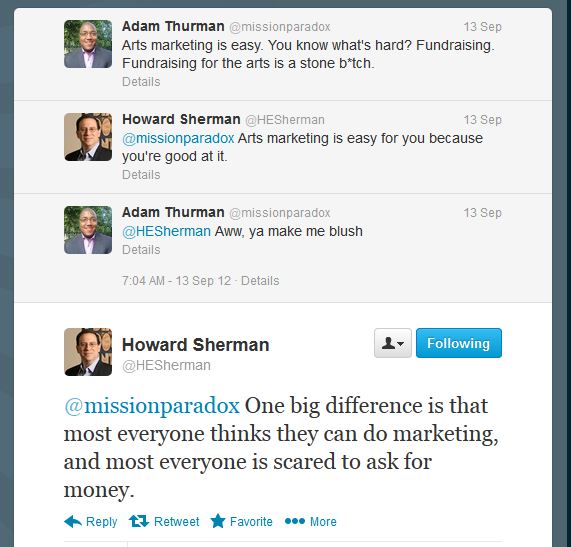
I think people are already cognizant of this interdependent need based on a Twitter exchange between Adam Thurman, Howard Sherman and others this past September.

devmarketing1
devmarketing2

Passion About Your Work Is Hard Work

Apropos of my post a few weeks back about people thinking creativity as a lightning strike gift rather than a process of work over time is a piece on Harvard Business Review blog site in which the author, Cal Newport, makes a similar observation about the idea one should follow their passion when looking for a job.

Newport notes that following ones passion has become common career advice and includes a Google N-Gram charting the explosive rise of the phrase in print use during the 2000s.

“Why is this a problem? This simple phrase, “follow your passion,” turns out to be surprisingly pernicious…The verb “follow” implies that you start by identifying a passion and then match this preexisting calling to a job. Because the passion precedes the job, it stands to reason that you should love your work from the very first day.

It’s this final implication that causes damage. When I studied people who love what they do for a living, I found that in most cases their passion developed slowly, often over unexpected and complicated paths. It’s rare, for example, to find someone who loves their career before they’ve become very good at it — expertise generates many different engaging traits, such as respect, impact, autonomy — and the process of becoming good can be frustrating and take years.

The early stages of a fantastic career might not feel fantastic at all, a reality that clashes with the fantasy world implied by the advice to “follow your passion” — an alternate universe where there’s a perfect job waiting for you, one that you’ll love right away once you discover it. It shouldn’t be surprising that members of Generation Y demand a lot from their working life right away and are frequently disappointed about what they experience instead.”

The arts career path has long had a “paying your dues” period of near slavery labor for low or no pay internship followed by successfully transitioning to a near poverty level pay. I joke, but only because I don’t want to confuse the poor treatment many entry level people are subject to with the genuine need to actually go through an unsatisfying process of improving your abilities.

The dream of being discovered and making it big is what causes many to pursue a career in the arts. The fact that there are some who can make it big with no apparent effort is something of a plague on the arts industry.

Still for many people, this dues paying process gives people a realistic view of what is expected in the arts career path and they choose to leave it.

Pursuing an arts career with its abysmal pay can be something of a blessing in disguise as part of the dues paying process. The fact we have the stereotype of the actor who waits tables shows that many creative types are picking up other skills in the process of pursuing the dream.

Of course, the benefit of this all hinges on heeding the advice of our grandparents to do everything we do well. It is easy to fall into the practice of not taking a job seriously figuring your effort doesn’t matter since you will be gone soon enough. Then when you revise your career plans, you may suddenly find that as a result of your inattentiveness no one will credit you as having paid some dues.

One of my first jobs was doing yard work which involved everything from mowing and weeding to mucking out horse stalls and polishing brass and bronze pots. I don’t think it directly prepared me for a job in the arts, (though I did end up driving a farm tractor a lot the rural arts center I worked at), it probably instilled a work ethic, taught me about a lot uncommon practices like beekeeping and gave me many problem solving abilities. (Like the time I set fire to the…erm, well I have said too much already.)

Cal Newport calls for career advice to reference the inevitable sour period before you feel inspired by your work.

In some respects, I think the arts are blessed with the stereotype of the wait staff who wants to act. Even though no one believes they will ever have to work in a restaurant to support themselves, that waiter is in our collective unconscious and can’t be exorcised. Part of us always knows that possibility exists. Some may even be motivated to pursue excellence to ensure it doesn’t happen to them.

Still more discussion of that metaphorical waiter needs to happen to make people aware that the pursuit of their passion may not come easily or as directly as they imagine.

Many performing artists would acknowledge their awareness that the pursuit doesn’t come easily since many of them start working hard at eight or nine years old. The problem is that “practice hard to be a success” has been used to motivate them for all those years and it is not a foregone conclusion, especially in relation to orchestras these days.

Arts and culture industries needs to emphasize the fact that the path to success may not be as direct as it has been represented to encourage people to think about and be open to alternative routes.

Arts & Job Crafting

Apropos to yesterday’s Labor Day holiday there was a blog post on the Harvard Business Review site back in June about job crafting, basically changing aspects of your daily activity to make your job more enjoyable.

I thought many of the suggestions cited by the author, Amy Gallo, were particularly applicable to arts organizations. Arts employees are apt to feeling burned out and unfulfilled due to wearing many hats and having a large workload.

But compared to many other types of businesses, employees of arts organizations generally have a fair bit of freedom about how they accomplish tasks. Employing a little creativity in the process isn’t likely to be viewed as disruptive and might even be applauded.

One of the first suggestions Gallo mentions is examining oneself to assess whether the problem might be that you are simply prone to being dissatisfied all the time. Another is to think about ways to change your outlook about your job and perhaps form emotional connections with colleagues and co-workers.

Next is to look at restructuring the job itself:

“Spreitzer and Wrzesniewski suggest using a job crafting exercise to redesign your job to better fit your motives, strengths, and passions. “Some people make radical moves; others make small changes” in how they delegate or schedule their day,…For example, if your most enjoyable task is talking with clients, but you feel buried in paperwork, you might decide to always speak with clients in the morning, so you’re energized to get through the drudge work for the rest of the day. Or you might save talking with your clients until the end of the day as a reward.

If it’s not the work you dislike but the people you work with, you may be able to change that too. Wrzesniewski says she has seen people successfully alter who they interact with on a daily basis to increase job satisfaction. Focus on forging relationships that give you energy, rather than sapping it. Seek out people who can help you do your job better”

In some respects, the fact that just about everyone performs multiple functions in an arts organization can be an asset to job crafting efforts. Lacking concrete job boundaries, people can swap some of their duties a little bit. What is mind numbing to one might provide a refreshing respite to someone else. One thing I have appreciated about the arts jobs I have had has been the ability to get up and away from one task to do essentially all of the things Gallo mentions.

I have been able to attend artist outreaches to see the impact of our work on people in the community. I can talk with colleagues and patrons and develop connections with them. I have been able to get up from my desk to stick my nose in on rehearsals and classes to get some inspiration. Walking around to inspect facilities and equipment or setting my hand to some physical task often provides the distraction my mind needs to find a solution that wasn’t coming sitting in front of my computer.

Mutant Business Models Are Coming! (Embrace Them Before They Embrace You)

Apropos to yesterday’s post about non-profit business models is a piece by Saul Kaplan on the Harvard Business Review discussing how every organization that offers some sort of service needs a business model regardless of whether you are a non-profit, NGO, government entity or for profit business.

If you have never thought about your organization’s business model but figure it is about time you did, you may found Kaplan’s comments about the mutability of business models a little disheartening.

“If you ask any ten people in your organization how it creates, delivers, and captures, will the answers even be close?

If not, it’s probably because, in the industrial era when business models seldom changed and everyone played the game by the same set of well-understood industry and sector rules, it wasn’t as important to be explicit about business models. Business models were safely assumed and taken for granted.

That won’t work in the 21st century when all bets are off. Business models don’t last as long as they used to. New players are rapidly emerging, enabled by disruptive technology, refusing to play by industrial era rules. Business model innovators aren’t constrained by existing business models. Business model innovation is becoming the new strategic imperative for all organization leaders.”

He goes on to talk about the need for new, hybrid business models that blur the existing lines. I take some comfort in the fact that business models are currently a hot topic of discussion among various arts administration blogs. It means we are staying current with trends rather than following far behind.

One thing in particular I took away from Kaplan’s post was the importance of keeping involved in the conversation about business models given that existing lines of separation between profit and non profit are likely to become less distinct.

“Perhaps the most important reason for developing common business model language across public, private, non-profit, and for-profit sectors is that transforming our important social systems (including education, health care, energy, and entrepreneurship) will require networked business models that cut across sectors. We need new hybrid models that don’t fit cleanly into today’s convenient sector buckets. We already see for-profit social enterprises, non-profits with for-profit divisions, and for-profit companies with social missions. Traditional sector lines are blurring. We’re going to see every imaginable permutation and will have to get comfortable with more experimentation and ambiguity.”

100% Fundraising Expenses

Some what apropos of my post on mandatory salary caps for executives of non-profits is a post by Dan Pallotta on the Harvard Business Review blog in which he makes suggestions that would likely see government entities really start screaming.

Palotta advocates for salaries of non-profit staffs on par with those of for profit businesses. But the bulk of the post is spent on the premise that low fund raising expenditures are actually inhibiting charities from doing the most good. His argument is that instead of touting 10%-15% expenditures on fund raising and remaining too small to make a big impact on a problem, charities should be spending 50%-100% on fund raising.

“The less an organization invests in fundraising the less it can grow. The less it can grow the more human suffering persists. We have institutionalized a mechanism for insuring the persistence of human suffering and called it “charity.”

[…]

“If we are serious about the value of human life, then we have to start thinking about 50 to 100% fundraising rates for the organizations chartered to save human lives. Those organizations should take no pride in telling donors or anyone else how low their fundraising costs are. Quite the opposite. I want to support the organization that’s going for scale, not the one that’s stuck where it is. Why would I support a cancer organization promoting its low fundraising investment while cancer remains uncured? We have the whole reward system backwards.

(Qualification: I’m not sanctioning inefficiency. That’s a completely different conversation. Everything I’m advocating assumes maximum efficiency.)

What we are doing is not working. A world in which 10 to 15% fundraising ratios are the norm is a world in which our charities are woefully too small to confront social problems on any meaningful scale. It’s a world where growth occurs – if it occurs at all – at the pace of molasses — the pace of death — and where human suffering continues on an unimaginable scale with no end in sight.”

If you are like me and you are thinking if an organization is spending 100% of the money it raises on raising more money then no one is getting cured, then you are absolutely correct. That is exactly what he is proposing. Presumably, you would use all that money to find a new way to convince people to donate since you wouldn’t have any examples of those whom you have helped.

If you read down into the comments section where Pallotta responds to some of the questions, you get a little more detail. Addressing the idea that the fund raiser never gets around to doing anything, Pallota says,

“Think of it this way. Humanitarian organizations regularly engage in certain activities – a direct-mail campaign – designed to acquire new donors. Sometimes those campaigns can go for several years running 100% costs. But then comes the pay-off – huge fundraising databases with no new expense associated with them You turn that engine on and then you start producing revenues for programs and for the cause at volumes many, many times larger than you could have if you never made the investment and never tolerated the 100% cost ratios for a certain period of time. Understand? “

In response to the question posed by a commenter named Shaun, who asks “who wants to be the person who gives money just to solicit more money?” Pollota answers, “Think of it this way: if I told you your dollar could go directly to the needy, or that it could go to an ad campaign that would generate ten dollars for the needy, which would you choose?” To which another commenter, RachelAC, replies, “I might prefer that my $1 go to the needy now, rather than $10 going to the needy in five years.”

I think RachelAC’s response expresses the crux of the matter for me. In an ideal situation, Pallota’s approach works. But my concern is that the fund raising entity gets so enthralled by their success in raising money, that they never stop and fund the solution. As RachelAC implies, in many situations the dollar today can make a difference where the $10 comes too late. Though granted, whenever a solution to a massive problem comes, it arrives just moments too late for some.

My even bigger concern is that the officers will embezzle the money and run off as they have with so many charities in the past. The fact they are apparently not making as much as they could be according to Pallota only means the incentive to do so increases. I would prefer to know the thieves only absconded with the little I gave rather than what they parlayed it in to.

Big problems can require audacious approaches to solve them. I can see where the piecemeal approach isn’t getting people closer to a solution any faster. But will people continue to give if a theft on the same grand scale were to occur? I think the faith you lose in a charity when it betrays your trust cuts a lot deeper than when a company or person you have invested with misappropriates your money. You enter a relationship with the latter knowing there is a chance you will lose your money. With investments, we are told to diversify. Does it make sense to do the same with our philanthropy or are we just short changing an already under capitalized effort?

Why Don’t You Want To Talk To Me?

I often write, as do so many others, about the importance of establishing a relationship with your audience/donors/community. However, according to a blog post on the Harvard Business Review, our customers may not want a relationship with us. Well, not with arts organizations specifically, but rather with businesses in general.

The post, “Why Your Customers Don’t Want to Talk to You” begins by asking,

“Have you ever walked into an airport, seen that there is nobody in line at the check-in counter, but still made a bee-line for the self-service kiosk? Better yet, have you ever waited in line for an ATM machine even though there is nobody in line for the teller inside the bank?

If you answered “yes” to either of these questions, you’re not alone. Most customers these days demonstrate a huge — and increasing — appetite for self-service, yet most companies run their operations as if customers prefer to interact with them live.”

The authors cite data showing that businesses assume their customers prefer live service twice as much as self service, but that customers are “statistically indifferent about this … By and large, this indifference holds regardless of their age, demographic, issue type, or urgency.” The authors aren’t sure why this is, but offer a hypothesis

“…maybe customers are shifting toward self service because they don’t want a relationship with companies. While this secular trend could be explained away as just a change in consumers’ channel preferences, skeptics might argue that customers never wanted the kind of relationship that companies have always hoped for, and that self service now allows customers the “out” they’ve been looking for all along. “

But what was really helpful about the article were the comments about customer expectations and when people may prefer one type of interaction over the other. And if you don’t believe me, scroll down and read the comment left by Matt Dixon, one of the article’s authors who says as much as he enjoyed writing the post, he is enjoying the comments more.

The reasons why people prefer not to deal with a live person run the gamut- not wanting to be upsold, incompetence/poor customer service from staff, wanting to take time with decision making, not feeling pressured to justify choices to a machine and having already done research on line.

The plus side for humans is avoiding the maze of choices on voice mail systems or having a problem that doesn’t seem to fit the options provided. The human better not sound like they are proceeding through a menu of choices! And of course people aren’t entirely convinced technology is dependable. Two of the calls I fielded today were questions about whether orders had gone through.

One comment by a poster named Will Kenny caught my attention.

“Much of the problem is how companies have defined “relationship,” and many of them simply meant “some way to stay in contact with the customer, to sell more stuff.” In other words, a “relationship” is formed, in these companies, when the company has found a way to continue talking to the customer.”

I felt a little guilty because often that is pretty darn close to the subtext of what we mean when we talk about developing a relationship with our community. It is tough to get past that because we are running businesses and have bills to pay after all. We probably have much more sincere relationships with our next door neighbors than we do with our customers because we babysit each other’s kids and make chicken soup when someone is sick. But those same gestures create a positive impression about the organizations we work for in people’s minds too. And those type of sincere gestures on the corporate level –including just plain listening well–can help strengthen organizational relationships, too.

Arts organizations are in a medial position in all this. So much of what we produce can be researched using other sources. You can read scripts, watch videos, listen to recordings and read reviews. People can avoid contact with us if they like. However, because of the intimidation factor involved with the arts, we are also called upon to be experts, and compassionate experts at that, who can explain without alienating. We save money by having technology handle information requests well and replace a real person. But we also save by having knowledgeable and skilled people who answer the questions. I think there is something to be said for small organizations where some times everyone ends up grabbing the phone because it forces everyone to be able to speak confidently about matters outside their immediate area.