If Only These Problems Were Myths Of A Past Age

If you have read Ve Le’s Non-Profit AF blog, you know that he often frames serious topics with a bit of humor, often extolling vegan cuisine and his obsession with the Oxford comma. Frequently though, he will go into full entertainment mode riffing on a theme and applying it to the non-profit world.

A couple weeks ago, he wrote a post recasting Greek myths as if they occurred in world run as a non-profit. With a hurricane recently piling on to the problems which have faced Puerto Rico over the last few years and another heading toward Florida, non-profits are going to be mobilizing to help affected communities recover. It seemed like a good time to point to humorous content before groups had to seriously dive in.

Le addresses a number of stories, but here are some of my favorites. In his retelling of the Trojan horse, the horse doesn’t contain soldiers who spread out to slay the city’s defenders:

The following days, they joined the boards of directors of several organizations in the city. They never read board packets, always stopped much more knowledgeable staff from taking bold actions, caused missed quorum, insisted on golf tournaments, and gradually ruined morale. And that was how the city of Troy fell.

In Le’s retelling of the story of Echo who had been cursed by Hera to repeat only what other people say:

One day, Echo met Narcissus and fell in love with him. “I should start a nonprofit,” he said to her. She repeated, “start a nonprofit.” He ran off and founded a nonprofit that gave used togas to poor people abroad, and Echo was heartbroken. But joke’s on Hera, because eventually, Echo became a nonprofit consultant who mainly repeated what the staff says, and boards thought she was so smart and she got paid a ton of money.

My favorite story was Le’s version of Hercules’ 12 Labors:

Those were: Plan a silent auction, diversify a board, give someone feedback, get everyone to track their expense receipts, conduct a 360 assessment without someone getting hurt, endure an icebreaker that involves making random mouth sounds, fire someone who is really nice but sucks at their job, call out a major donor for being a jerk, translate a budget into a funder’s own budget format, get more than ten likes on a social media post about an upcoming event, get a several people’s schedules to align for a meeting, and save enough for retirement.

There are about six-seven stories in all and Le has promised a part two which hasn’t surfaced yet. What I appreciate about Vu Le’s writing style is that the problems he addresses are obviously sources of frustration and anxiety for folks in the non-profit sector, but he skewers them so satirically you can feel a slight sense of relief at having an ally by your side that understands.
Org Culture More Important Than Artistic Reputation

A couple weeks ago Aubrey Bergauer hosted a LinkedIn conversation with Karen Freeman from Advisory Board for the Arts (ABA) to discuss what mattered most to arts professionals as they sought jobs in the arts. Freeman discussed a survey ABA conducted where they asked people to prioritize between different situations in order to drill down to what really mattered. An example Freeman gives is would you rather have great pay, but so-so benefits or a lower pay rate but with better benefits.

Among the criteria people had to prioritize were things like artistic reputation, work from home, diversity, equity, and inclusion (DEI), shared governance, professional development, etc., They had over 1500 respondents from organizations around the world, though with a slightly larger representation by U.S. based groups.

Freeman shared four findings among the many that she found most interesting. The first one revealed that respondents felt their current organization had medium healthcare benefits, good management, good job security, middle of the road flexibility with work hours, fairly good progress in diversity and equity and selective transparency. Freeman notes that a majority of respondents felt their organizations operated at the highest level of artistic quality which she attributes akin to a Lake Woebegone view that everyone is above average.

The second finding is perhaps the most interesting one because it provides insight into what arts organizations can do to retain employees (~13:30 in the video). In terms of what people valued most, Inclusive Culture was valued most and Other Office, which encompassed office space and technology fell at the lowest end of the range. Inclusive culture encompasses transparency, accountability, inclusive decision-making along with diversity, inclusion and equity.

Second most important was flexibility which includes flexible hours and work from home. Next is advancement, including opportunity to advance and supervise. Next is Manager which involves good manager, professional development and internal recognition. Health care and leave came next. Second to last was artistic reputation and community import.

This raises some interesting questions. There are already surveys that indicate trumpeting artistic excellence, while important, isn’t a top draw for audiences. Now we see it is almost at the bottom in terms of what organizational staff value. So perhaps it is time to examine the amount of emphasis being placed upon it.

I should note though that it isn’t clear how many of the respondents were creators and performers. Those groups may rate artistic reputation much higher than administrative staff.

Skipping to the fourth slide (~19:25) provides a little insight. When broken down by job role, people in the C-suite (aka highest paid person’s opinion) care most about artistic reputation (even more than artistic department) along with job accountability, manager quality and transparency. C-suite place least emphasis on job schedule flexibility, work from home and DEI.

When broken down by generation (~16:40), the starkest differences were that artistic reputation was most important to baby boomers and DEI was most important to Gen Z respondents.

Freeman also mentioned that they ran some simulations to make up for some potential flaws inherent to the surveying methodology they used to get the above results. In those simulations, when choosing between higher pay or artistic reputation, 54% of people would take the job with higher pay at a place with no reputation for artistic quality.

A second simulation they ran provided the choice between a place that had high pay, but hierarchical decision making, low transparency and accountability, and performative DEI against an organization with better culture on all these dimensions, but lower pay. In that case, 63% of people would take a job with the better work culture at the expense of better pay.

This was some new data for me insofar as what I thought were the start of trends are far more deeply held values than I anticipated. If you are similarly surprised, take a look at the video.

Strippers Ask Actors Equity’s Help Securing Safe Work Environment

A couple weeks ago I caught an NPR story about a group of strippers at a bar in LA who were working to unionize under the auspices of Actors’ Equity Association.  The dancers had been dismissed and locked out after complaining and petitioning the bar’s ownership to improve working conditions, both in terms of the physical performance environment and protection from aggressive clients. After months of striking outside the bar’s parking lot, the dancers filed to join Actors’ Equity.

One of the reasons why this story grabbed my attention was that I made a post in 2021 about how Actors’ Equity had decided to significantly lower the barriers to union membership. The union essentially provided automatic membership to members of sister unions like SAG-AFTRA, AGMA and AGVA as well as anyone who was enrolled in the union candidate program. The candidate program, which required accumulating points for performing in specific types of roles in venues operating under a union classification, was scrapped in favor of the new Open Access program which just requires that you have worked professionally as an actor or stage manager in the United States.

In reviewing the program, I noticed Open Access membership is only available until May 2023 so we will have to see how membership is handled after that. However, I initially viewed the union’s willingness to go to bat for these dancers as an extension of the Open Access program. They didn’t nudge the performers toward other unions like AVGA which represents variety/cabaret performers or SEIU which the NPR story says another group of strippers joined about 25 years ago.  I similarly wondered why the dancers approached Equity rather than another union. Was it due to the union’s presence in small performance venues in LA or perhaps Open Access has made the union appear more welcoming.

It will be interesting to see how the efforts of the dancers to unionize ends up. Likewise, I will try to keep an eye for more news on the Open Access program to see if it continues/evolves after May 2023 and if the effort achieves the diversity, equity and inclusion goals Actors’ Equity intends.

I should mention, the NPR story doesn’t just report on the strike but includes four discrete profiles of the dancers for additional perspective.

NPR Series May Help Expand Conversation About Theatre in US

Keep your radio tuned and your ears open to your local NPR station for the next month or so, especially if you are a theatre professional. The network is doing a series over the next five weeks about the 75th anniversary of the regional theatre movement. In a piece that aired this morning, they provide a little bit of a preview of the topics they are going to hit on from the impact of Covid, to economic concerns, regional theatres as a feeder to Broadway and diversity, equity and inclusion efforts.

The short piece mentions many of the conversations and activities which have unfolded over the last few years, from the mass resignations at Victory Gardens Theatre; the “We See You White American Theater” statement; the viability of subscription model and questions about the utility of the non-profit governance structure:

Theaters also started rethinking subscription plans that prioritize well-off people who can purchase a season’s worth of prime seats in advance, while leaving everyone else scrambling for leftovers. And they began reconsidering the current, frustrating governance model at most non-profits, where theater artists must answer to a volunteer board of directors, often with little theater expertise, which has all of the authority and none of the accountability.

It may be useful to have these topics discussed by an outlet outside of the usual theatre channels. Being able to point to NPR stories may end up being like the consultant effect where an outside “expert” repeats everything internal staff has been saying resulting in decisions to mobilize to achieve important goals.

Most board members and patrons don’t read American Theatre and related information sources, but many do listen to NPR and find it a credible information source. The NPR series can provide an entree for conversation or simply raise awareness among the greater community involved with arts and cultural entities around the country.

Next To Pick Up The Reins

Since there is a bit of a cross-readership, many of you may have already seen that Drew McManus announced yesterday that he was going to cease posting regularly on the Adaptistration blog. Drew is one of the few people who has been posting on the topic of arts management longer than I have.  Way back when he reached out to me about moving my blog from the Movable Type platform I was on to the Insidethearts.com site back in the early days of WordPress.

In his post, Drew noted that even after posting for 18 years, potential topics of discussion have not been exhausted.

Having said that, it still feels very odd to reach the realization that it’s time to stop while simultaneously having no shortage of ideas and topics that deserve attention…but it’s also clear that now is the time to let new voices step in and pick up that conversation. The emerging practice of audition fees, virtual audition practices, underpaid/overworked staff, the post-pandemic compensation reports, and so much more are all issues that need the sunlight of public examination in a non-partisan environment.

I will readily admit that the blog format has gradually fallen out of favor. My active readership has gradually decreased over the years. But I am also pretty clear that I am writing as much to help myself work through thoughts about arts policy and practice as informing a readership. Just as many people have a daily discipline of writing in a personal journal, I am mulling things over publicly.

My intent is to continue writing this blog, but as Drew says I equally hope new voices step up and address topics of concern for the arts and culture field.

Whos And Hows Of TikTok For Arts Orgs

By some fortuitous coincidence, I was digging into my news feed backlog and read Seema Rao’s Museum 2.0 post on guidelines for museum Tiktok accounts on the same day Ceci Dadisman put out an appeal to crowdsource a list of good non profit arts organization Tiktok accounts.

Many of Rao’s tips are basic guidelines for all communications employed by non-profits, regardless of medium or platform. They include avoiding insider terminology and only focusing on concepts that appeal to insider interests.

  • Learn their language rather than making them learn ours. My whole challenge is finding analogies between other Tiktok videos and art. If you’re not familiar with Tiktok, you might not know about duets. People reshare other peoples videos with that commentary. I used that popular format but to share ideas about art. Sure, I could have done short traditional videos about artworks. But that is less popular on Tiktok. Why try to get people to my ideas in a way they are less likely to like?

  • Remember people want to learn about art for fun. They are not doing it because it’s good for them. So don’t make it a chore for them. It might be our job, but it’s their time off.

  • Even if people like art, they don’t have much scaffolding. I have a core group of art lovers who know about art. The vast majority of commenters have basic questions or thank me for discussing basic elements. Schools teach less art, and so our visitors have taken less. It makes them no less interested. But it does mean we need to remember that when communicating about art.

  • People don’t care about museums, just the stuff inside them. Museum people, particularly boards, think visitors are excited by museums themselves. Sure, storage, art theft, removing varnish are interesting, but that’s because they look cool. Very few people are jazzed at hearing about the history of your museum.

The one that really caught my eye advised using personal, rather than institutional accounts with the idea that the former was viewed as more credible and personal:

People trust people to tell them about art. While I only recently put my real name, I’ve often had people say they like my approach to talking about art. I’d previously done Tiktoks for a museum account, and I never had as much pick up on videos. I think people want to hear from an authentic human voice rather than a brand.

While all of the accounts on Ceci Dadisman’s list were institutional accounts, the ones that seemed most appealing were those that didn’t seem to be directed by the marketing department. For example, The Royal Opera House and Met Museum pages featured video of artists performing and artworks in a gallery setting.

The Warhol Museum account seems to be entirely curated by their youth creative team and comes at the artist and work from a number of perspectives like how David Bowie and Ozzy Osborne viewed Andy Warhol and the canvas which Warhol had his friends urinate on.

Likewise, the Carnegie Museum of Natural History has field researchers talk about collecting ants by sucking them into a tube and the hazards of having them in your mouth if you aren’t careful. (Also, making bad jokes)

And of course, the Children’s Museum in Indianapolis collection lends itself to all sorts of opportunities by itself, but the Tiktok account lets folks know the organization isn’t just for kids.

So check out Seema’s post for more thoughts on how to do Tiktoks well and Ceci’s post to add accounts you know of to a Google doc so others can see what people are doing well.

Yours Isn’t The Only Camera Recording Your Selfie

Perhaps it is just the availability of social media feeds and news aggregators to bring information to my attention, but it seems that art projects have been effective in bringing about social change. Certainly that the work is often magnifying an large shift in sentiment can certainly be a contributing factor.

For example, in my city an art project around a Confederate statue has resulted in it being moved. But just a year before the same group of county commissioners unanimously voted to reject a proposal to move it. A couple months ago, I wrote about a project by a Pittsburgh area artist which has lead to an investigation of discrimination in housing appraisals.

Now I have read an article about an artist’s projects about the prevalence of surveillance. While the work hasn’t resulted in any policy changes yet, the disquieting nature of this or similar work may lead to action in the near future.

As covered by Bloomberg, Belgian artist Dries Depoorter used publicly accessible livestream footage of cities around the world to place Instagram selfies into context. He used facial recognition software to find when the photos were being taken during the footage he recorded and then placed the image in a split screen with video of the people employing all sorts of techniques and artifice to get their shot.

For many viewers, the video — which comes from just 10 days of footage — says something more about the decay of online privacy than it does about social media superficiality.

“​​If this person can do this as an art piece, imagine what someone being paid by a big company can do with the same data, at scale, for purposes of making money, that won’t make a public tweet about it,” wrote software developer Juan Alvarado on Twitter.

Depoorter has done similar projects before, tapping into red light cameras to show people jaywalking. In another he grabbed and displayed the publicly available Facebook photos of everyone visiting museum exhibitions.

“I show the dangers of technology with my work,” he said over WhatsApp.

The artist declined to elaborate on those dangers, however, saying his main goal is to create art that speaks clearly for itself.

Podcasting Surge Benefits Somewhat Mixed

So it appears that podcasts have turned into public radio’s competitive advantage. According to a recent study, nearly 4 in 10 public radio listeners also listen to a podcast weekly with those that listen to the talk-radio format more likely to listen than those that listen to public radio adult alternative or classical music formats.  Younger listeners are more likely to consume podcasts than older listeners.

“… 72% of Millennial public radio listeners also consume podcasts compared to 57% of Gen X and 35% of Baby Boomers.”

This said, podcast listenership has been cooling in recent years and while podcasts are a entree to listening to terrestrial broadcasts for many, in some cases it is drawing listeners from brick and mortar stations.

While nearly two-thirds (63%) say it has no impact on the “real time” they spend with AM/FM, the survey also points to a third of weekly podcast users spending fewer hours with the broadcast station. That is even more true among listeners of news-talk stations, where 39% said they are spending less time with AM/FM in favor of podcasts.

What I found most interesting was that the cooling attitudes toward podcasts seemed to be rooted in advertising. I assumed then that the survey included podcasts created through both commercial and public radio channels because public radio usually just has a brief underwriting message rather than a longer ad that people can potentially skip. The credibility of the ads is seen as super low. I would be interested to see a deeper dive into which company’s ads were seen as more credible than others.

The Public Radio Techsurvey data shows 61% of public radio’s weekly podcast listeners are getting tired of hearing the same ads in the podcasts they listen to, including a quarter (26%) who strongly agree. Just four percent disagreed, while 29% were neutral.

[..]

It also shows that host-read ads are preferred to produced spots, particularly among younger listeners. The survey shows 43% would rather hear a host-read ad. But among Millennials that number jumps to 59%.

“The data on advertising in podcasts is an eye-opener. While podcasters like to think their ads are more engaging, our respondents suggest otherwise,” Jacobs says. “While live reads from hosts are perceived as preferable to produced spots, podcast ads overall are no more credible than commercials heard on the radio.” Their data shows just 14% of public radio listeners think the ads they hear on podcasts are more credible than what they hear from their radio.

This last bit got me wondering about the relative credibility of sponsors and advertisers listed in program books, posters, digital signage around arts and cultural entities. I am thinking about this both from the point of view of wanting to provide a bit of a valuable benefit for sponsors and from the perspective of “charity washing” conversations where it appears corporations are trying to burnish their image through charitable giving. If sponsorship placement doesn’t lend credibility to generally sincere companies, it is something of a pity. But on the other hand, if people aren’t fooled by charity washing efforts, that is a relatively positive outcome.

Welcoming and Belonging For All

Last week I received an email from Arts Midwest noting that September 9-18 is Welcoming Week, an international effort to provide a welcoming experience at all levels. This includes government and social policy and action to make communities more welcoming to organizational efforts to provide a sense of belonging in workplaces and other social interactions.

The concept of creating more metaphorical doors through which people can engage with arts and cultural organizations is a frequent topic here so I wanted to call attention to the effort and some of the resources that are available. In addition to the Welcoming America website, Arts Midwest created a page of resources focuses on how arts organizations can create that sense of belonging for employees and community members with whom they interact.

Arts Midwest is also hosting a webinar on Wednesday, September 14 4 pm EDT/3 pm CDT/1 pm PDT on the topic with a focus on “how arts can transform, deepen, and enrich immigrant inclusion work. ”   Sign up if you would like to learn more.


“We Have A Culture of Paying Artists”

Always happy to draw attention to the good work of arts organizations, I was pleased to get a comment on yesterday’s post about creating contests and engagement events which expect artists to work on spec.

In her comment, Eva Buttacavoli, Executive Director of The Contemporary Dayton in Ohio writes about her organization’s efforts to create the expectation that artists should be paid for their work.

In EVERYTHING we do, we have and will continue to, pay artists for their work. We actually also pay for all RFP finalists’ specs – and, as the city’s art center, we use requests for art (for festivals, lobbies, walls in blighted areas), to teach community leaders (and the folks who ultimately write the checks) that we have a culture of and expectation to pay artists – and we actually will not help promote or support any project that does not. Our artists have learned to champion themselves and their work – and have passed that expectation along to most projects for which they are invited.

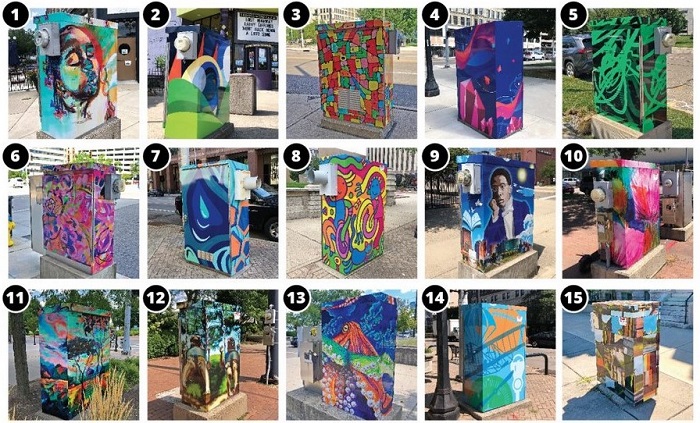
She includes a link to a recent effort where artists designs were used on vinyl wraps placed on electric boxes around downtown which seems like a fun idea for other communities to pick up on – https://www.downtowndayton.org/artwraps/

Design Ain’t Free

Last week Hyperallergic ran a piece asking why the New York Department of Sanitation (DSNY) with a budget of $1.9 billion was asking artists to submit proposals to decorate their trucks for free.

While the artists will supposedly retain all rights to their work,

…artists will receive no compensation, and that they will grant both DSNY and partner organization the Sanitation Foundation the “royalty-free, non-exclusive right to use and/or reproduce the designs for non-commercial and/or educational purposes.”

Artists will have three, seven hour work days to execute their design on a truck at the end of September.

NYC based artists, who face the city’s high cost of living are concerned about the lack of compensation in return for helping DSNY realize their goals.

A few weeks earlier I saw a similar conversation occur in response to a call by an arts advocacy group for submissions of images to be used in a national ad campaign. The winning designer would be compensated for their work. The issue was that artists were being asked to design for a major project on spec without any compensation.

If a designer is doing a logo for a local company, there is a significant amount of work they invest in research, multiple design iterations, etc,. If they are working on spec, that is a lot of time and energy invested that could be spent on other projects with guaranteed payment. For something that would be used nationally in a promotional/awareness campaign, they would likely invest that multiples more effort into research and design with the goal of making it as perfect as possible.

This is something to keep in mind when running poster contents or similar projects in relation to your arts organization. The goal of raising awareness and engagement with your organization is often a worthy one, but evaluate whether it is being done with full consideration of the time and effort that will be required to complete the task to the apparent standard. It is probably best to consult with someone who does similar work before soliciting submissions because what you imagine is a 20 minute effort may actually require two days at minimum.