No Subscription Model Should Last Forever

I was listening to an episode of How I Built This where Guy Raz interviews ClassPass founder Payal Kadakia.

At first I was just drawn to listen because Kadakia presented a familiar story of someone who loved dance and continued dancing even as she was studying Operations Research and Economics at MIT. As I got into the story, I realized it held some lessons about discounting and subscriptions for arts and culture non-profits.

It was the desire to dance that lead her to found the earliest iteration of ClassPass. She was looking to take a class in NYC and couldn’t figure out time, place, price and transportation. She struck on the idea of making a search engine that would unify this information and allow you to find and make reservations for classes in the way OpenTable allows you to make restaurant reservations.

The idea was so compelling to people that when her boss at Warner Music called in her to ask why she was quitting, she walked out with a $10,000 check from him as an investment in her unformed company. While the company was feted with great fanfare, it took 10 days before they had their first reservation. Kadakia says that is when they approached the dance & exercise studios to get a sense of customer behavior and realized that unlike plane and restaurant reservations where people have already made a decision they are going to fly or go out to eat, people looking for classes  (this is ~2012) hadn’t decided to take a class.

This is where the lessons about human nature, discounts and subscriptions starts to kick in (about 34 minutes into the show.) As Guy Raz observes, in the course of about 5 years, Kadakia ends up running 5 different companies because the business model changes so drastically. (It may not seem drastic on a small scale, but when you realize she goes from raising around $40 million in her second round of funding to a recent $1 billion valuation, each change has big implications.) Kadakia says each time they changed the model, human behavior changed on them.

One of the first things they did was offer 30 day passes to a range of different classes. They promised studios around 70% of people would convert to more permanent students. It ended up about only 10% did which Kadakia admits was unfair to the studios. What they discovered was that people were continuing to take classes by signing up with a new email address. Now, my first instinct was to accuse them of gaming the system and curse them under my breath.

Kadakia and her team may have done that, but what she said they realized was that people enjoyed being able to attend a variety of classes. Instead of $45 for a 30 day product, they moved to a subscription model for $99 where you could take up to 10 classes a month, but no more than three at the same studio. Eventually they moved to an unlimited class model.

As the company grew, the fitness industry of spin, barre, bootcamp, etc classes was growing as well and they began doing business with bigger, more marquee names. This raised the average per-class rate they had to pay to studios. Kadakia says they reached a place where they were faced with adopting the business model most gyms use where they are counting on you not exercising in order to make their money. As someone who both continued to dance and took classes every day, she felt the idea of betting against their customers was anti-ethical to their founding principles of getting people to exercise.

Faced with the prospect of having a lot of people angry at them for drastically raising the price of the unlimited pass, they moved away from that as their core product and now package classes differently.

As referenced earlier, one of the main things I took away from this was that sales and subscription models not only need to be structured differently for different communities, but potentially changed up across the lifespan of your organization because audience dynamics and expectations are likely to evolve. I fully expect most venues will find the ticketing model and policies they had in place pre-Covid won’t as fit well for audiences now.
 

Innovation Results From Hard Work And Funding

In the Washington Post, Jon Gertner reviews a book about innovation by Matt Ridley.  One aspect of the book Gertner emphasizes is Ridley’s view that innovation is 90% perspiration and 10% inspiration:

Ridley’s most important chapters, and his book’s most interesting, are where he calls attention to “surprisingly consistent patterns” that describe the process of making new things. Innovation, he tells us, is usually gradual, even though we tend to subscribe to the breakthrough myth….He also illustrates how innovation can be a matter of the right people solving the right problem at the right time — and that it often involves exhaustive trial-and-error work, rather than egg-headed theoretical applications. This was typically the case with Thomas Edison, who, as Ridley notes, tried 6,000 different organic materials in the search for a filament for his electric light.

Gertner’s criticism of the book is it underappreciates the contributions of government funding in that long process of trial-and-error exploration.

Thus, you won’t find a lot here about the development of the atomic bomb, which depended almost entirely on state largesse, or about the subsidization of renewable energy. Nor will you read much on the transistor, many early lasers or the photovoltaic solar cell, which were created under the auspices of Bell Labs, part of a government-authorized monopoly…. And in Ridley’s story about the origins of Google, you will not see any indication that its founders were helped in their earliest days by a grant from the National Science Foundation.

Indeed, his book consistently plays down the influence of public funding in medicine, public health, personal technology, transportation and communications; it likewise minimizes — quite strenuously, and erroneously — the role of federal assistance in the development of natural gas fracking, which was kept alive by research investments from the Energy Department in the 1970s.

Reading this review, I realized in the 16+ years I have been writing this blog, I don’t think I have ever made a post that tied the lengthy process of creativity together with the importance of funding.

I have dealt with the topics separately. I have had a number of posts about how even creators often attribute their first big successes to some inherent stroke of genius or talent rather than to the 7 years of trial and error that lead to it.

I have also made posts about the importance of government and foundation funding to creative industries. I think the closest I may have come to directly tying both together are some posts I made about how people who have a support and expectations of relatively affluent families/friends are more able to participate in low paying internships/apprenticeships which can be highly important to networking and career development.

In any case, obviously innovation is a long term process which requires funding support and there aren’t a lot of entities willing to make that investment when it comes to creative arts.

By that same token, it shouldn’t be forgotten that businesses in general have benefited from government support of the basic research which constitutes the backbone of many of their products.

Perhaps all those calls for the arts to be run like a business should be answered by noting that contrary to all the garage origin stories of many famous companies, artists are often left to subsidize their own development. Additionally, the history of innovation of all types is one of government support.


It’s A Good Time To Broaden Board Composition Too

Tyler Green’s tweet today about art museums acting like corporations rather than charities got me to look at the full series of tweets on the subject.  He is angered by the fact that instead of stepping up to support museums in a time of crisis, the billionaire members of boards are voting for mass lay-offs of staffs.

In brief, his argument seems to be that while museum boards are comprised of people who make the largest individual donations to museums, they are not the largest sources of support for those museums.

He notes that many charities have board members who represent the membership or community the organization serves, but institutions like San Francisco Museum of Modern Art (SFMOMA) don’t have any.

All this is worth serious consideration as our organizations seek to move on to the next normal. Those who have supported our organizations in the past with their participation may no longer feel safe engaging with the general public. There is an opportunity to start working toward oft expressed ideals of engaging a broader audience with whom you haven’t had the time and resources to initiate a conversation. Because they are increasingly likely to be your new audience.

Their numbers may not be as large as your old audience, but social distancing rules have reduced your top capacity so you have some cover to explain the smaller crowds.

I wrote about Nina Simon’s talk on this effort earlier this month.

But perhaps most importantly in the context of Tyler Green’s posts, it is probably time to broaden the membership of the board. This is likely to necessitate a shift in corporate/board culture. Even if your board isn’t comprised of billionaires, it is highly likely that the group dynamics of the board are going to feel alienating to any new members chosen to represent the core demographics served by your organization.

Psychology of Re-Opening

Artsjournal.com linked to a Washington Post story about all the psychological considerations some movie theater operators are factoring into re-opening their spaces for screenings. To paraphrase one of those interviewed, there may be a whole series of conditions that have to be met to admit audiences, but you don’t want people to feel like they are undergoing an airport screening just to see a movie.

An owner of a movie chain in Omaha has decided to rely on a mix of subtle imagery and social proof:

One conclusion: Leaning in to safety messaging is a surefire way to turn off customers.

“If you’re leading off the pitch with ‘It’s so clean you’re not going to get sick’ then you’ve already lost the argument,” said Barstow, whose company is about to open a new Omaha location. Instead of talking about disinfectant and distancing, he says, he believes it more effective to roll out traditional marketing that slips in the requisite information — an image of a shiny lobby with an employee in the background who just happens to be wearing a mask, for instance.

“You let people know you’re taking care of them, but very subtly,” he said.

Barstow said he and his daughter, who runs the company’s marketing operation, have discovered that the best weapon for luring customers might be not what the theater is doing at all — it’s the sight of other customers.

[…]

“Seeing someone like a mom bring her three kids to a matinee is I think going to be the best tool to make people feel comfortable about coming themselves.” Of course, he acknowledges, such events need to happen organically, captured instead of contrived on social media.

At my venue, we had already been planning to start showing movies in late July before our governor added live performance venues alongside movie theaters as places that are allowed to hold events. One of the major points of concern for employees was whether customers would wear masks. We weren’t sure how forceful we could be, but the recent decision by the AMC movie theater chain to make masks mandatory gives us a little more support, regardless of how insistent we decide to be.

One interesting observation from the Washington Post article I hadn’t really considered was the importance of having mask wearing staff communicate reassurance with their eyes and posture since the rest of the face won’t be visible. In this, perhaps the performing arts have a competitive advantage.

“You have to train staff how to reassure customers with their eyes, because no one will be able to see their mouths,” said Barstow, who is mandating employees wear masks.

“Maybe,” he mused, “we should hire local drama students.”

Customer Desires: Always Complicated

The news JC Penney is closing a number of their stores and liquidating the inventory reminded me of a post I made eight years ago about the company’s efforts to deal more fairly with customers. Instead of having all sorts of sales and discounts that lead consumers to suspect something had been marked up last week in order to put it on sale this week, among other bits of trickery, JC Penny’s new CEO at the time pledged to offer completely transparent, low everyday pricing.

The move backfired on them leading a number of business reporters to observe that perhaps people liked to be cheated. That CEO was out, a new one was ushered in who restored the sales and coupons.

It was all a bit revelatory about consumer psychology and how you can’t always take what people say they want at face value.

As I pointed out in my post at the time, it also illustrates that money does not build relationships and loyalty.  I would suggest that most non-profit arts organizations are in the relationship building/facilitation business. If we weren’t, would people be donating the value of their tickets on cancelled events and increasing the amount they typically donate in a year? I say facilitation because participation in an activity with friends and family contributes to the development of relationships.

As much as your organization is struggling, those donations and other expressions of concern are what distinguish your identity and role in the community from larger corporations, even if you suspect you may be soon accompanying JC Penny on the road to dissolution. In that 2012 post, I also linked to a post I made about the expiration date of arts organizations. At the time I was speaking theoretically. Sorry to say it may be emerging into reality.

Back in 2012 when I first wrote my post, I quoted Collen Dilenschneider. She has since come out with much better research and advice for arts organizations use of discounts, but the basics still remain the same.

One thing of course, I need to point out is that price does not develop loyalty. You can not develop a relationship with your community if interactions with your organization are based on price. I stated that in the early days of this blog and as Dilenschneider notes this is true even in these days of social media:

“It is far better for your brand and bottom line to have 100 fans who share and interact with your content to create a meaningful relationship, than to have 1,000 fans who never share your message and liked you just for the discount.”

Dilenschneider also points to some data that there are diminishing returns from social media discounts. This may illustrate be where arts organizations and retailers differ. Retailers can offer myriad discounts annually and not suffer, but arts and cultural organizations offer a product valued entirely differently from that of retailers

You Don’t Know You Are In Water

Seth Godin made a post today that addresses the current climate of Black Lives Matter, policing, statues, etc without directly naming any of these things.  (A week ago he mentioned he generally tries to write posts that were evergreen rather than specific to the times in which they were penned, but felt he had to unequivocally state Black Lives Matter.)

Today he points out that when you are part of the dominant culture, you don’t see it around you like the proverbial fish that aren’t aware they are in water. It isn’t until you go to another country that you recognize every small assumption comprising your daily routine needs to be examined closely just to cross the street to get breakfast.

This experience can be part of what is fun and engaging about your visit. But part of what makes it fun is that you know you can return to a familiar environment later where you will have many stories to tell. The prospect of living in that foreign place for a longer time can be more daunting.

When media images, policies and corporate standards tell someone that they are an outsider who needs to fit in in non-relevant ways, we’re establishing patterns of inequity and stress. We need to be clear about the job that needs to be done, the utility we’re seeking to create, but not erect irrelevant barriers, especially ones we can’t see without effort.

Good systems are resilient and designed to benefit the people who use them.

If the dominant culture makes it harder for people who don’t match the prevailing irrelevant metrics to contribute and thrive, it’s painful and wasteful and wrong.

If you think about the above quote from Godin a bit, you might see that there are a good many times when the dominant culture shows little regard about alienating its own members. We have seen it happen often in recent years in both large and small ways. Currently we are in a period where many people are realizing their membership isn’t as secure as they thought or that they are no longer in synch with the terms of membership. The result is, they are finding greater common cause with those who have felt themselves outsiders.

But also, lest it get lost in the macro level big societal questions being wrestled with on the national and international stage, Godin’s admonishment about good systems being resilient and designed to benefit the users is just as applicable on the micro level of your organizational business hours and admission practices.

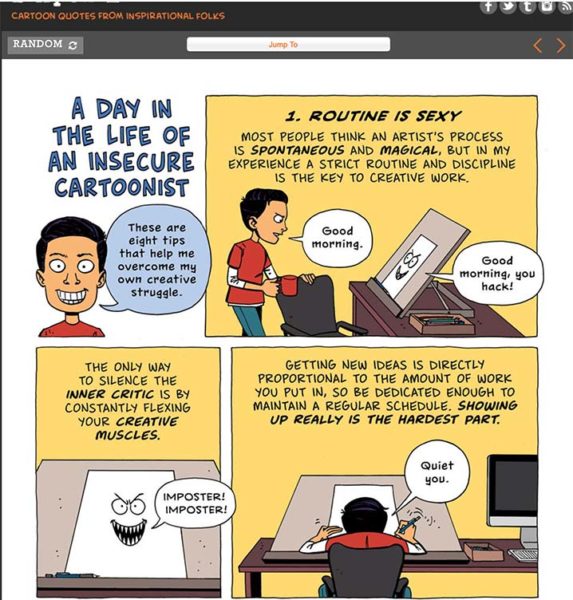
Making Time For Your Creativity Can Be The Hardest Part

While people still haven’t returned to the daily routines they may have had before Covid-19 brought a halt to so much of our lives, it might be worth encouraging people to continue cultivating whatever creative practices they may have engaged in during these times. Reinforce the value of whatever they became interested in as part of their lives. Chances are people are reconsidering what things they found fulfilling before and whether those things still hold value for them.

That said, there is always an investment of time and a learning curve involved with starting anything new. That can be a disincentive to continuing for people who are seeking the comfort of their earlier familiar lives.

It has been awhile since I linked to a cartoon from the Zen Pencils site. This one is excerpted from a page the cartoonist wrote about his own practice.

Long time readers know before I moved to my current position in Georgia, I lived in Ohio where I tried to infiltrate a Creative Cult, a group of people who provided the community with various hands-on creative experiences at different places around town. They are still up to their shenanigans and currently have people on a hunt around the community trying to find “eggs” that were stolen out of museum paintings.

Nick Sherman, a young gentleman who may or may not be the mysterious, yet dashing cult leader has a weekly newsletter which includes missives to him from the Creative Underground explaining all the ways in which the Man will try to convince him he isn’t creative or that he should be prioritizing other things over his creative pursuits.

For example, on May 1 the Creative Underground wrote:

This is what we mean. THE MAN starts by whispering in your ear something very obvious; that there is a time for art-making, and there is a time not for art-making. A harmless statement right? Wrong! THE MAN never stops where he should. He then goes on to cleverly suggest that, “If you are doing your art, you must be neglecting something else.” Do you see his trap?

Then because you want to be a responsible, upstanding, person you think, “Of course! I do not see my little old grandmother nearly enough.” You go see her. And in this way, THE MAN keeps bringing up distraction after distraction (even legitimate ones!) that keep you from your art. Something always comes up. Soon, your brain makes a very dangerous and direct comparison. It flashes like a bright-red neon sign against the darkest corner of your brain. “ART = SELFISH”

In this way, Nick anthropomorphizes all those insecurities and doubts everyone has about their creative practice. Granted, sometimes there are actually people in our lives who are more than happy to give voice to these sentiments and there is no need to provide them with a metaphoric form.

You can subscribe to Nick’s newsletter here if you have an interest.

Putting Some O’ That Theory Into Practice

I arrived in my office last Friday to find a heck of a lot more emails in my Inbox than I am used to. It turned out the evening before the governor had announced a change of guidelines that would allow performing arts organizations to open after July 1 and people immediately started scrambling trying to ascertain what it all meant.  Ultimately, nothing the new order contained deviated from our expectations by much at all in terms of how it would impact seating capacity or operational practices. We were on a Zoom call with the county attorney today and he had nothing surprising to say in his reading of the order, but it was good to have our understanding confirmed.

Like me, you may have heard that Texas’ governor had issued guidance on performing arts centers last week.  However, I was surprised to learn that Ruth Eckerd Hall in Clearwater, FL was having concerts last week. I hadn’t heard that things had opened that far in any other state.

The performances in Clearwater were in their lobby in a cabaret type setting  with attendance capped at 80 people. It looks like the three shows on June 11 sold out quickly and the added shows on June 14,  19 & 25 sold out as well. I was wondering if there are any readers in Florida who may have attended who could talk about the show and what their experience was. I see from an article on the show there were some screening procedures and people were seated at a social distance.

Fans were offered face masks at the gate, temperature-checked upon entry, and delivered drinks and snacks by servers in gloves and black masks. They sat in groups of four or fewer, and for the most part, only got up to hit the head.

The venue is also communicating their safety policies in the events scheduled this month which include the following.

– Venue staff will be wearing face masks; we encourage patrons to do the same. Face masks are available at the door upon request.
– Hand sanitizer stations are readily available. If you are in need of an attendant with cleaning supplies, please ask the wait staff.
– Table selection is on a first-come/first-served basis. We ask that you not change tables once you are seated.
– We encourage remaining at your table during the show. If you wish to stand, you will be asked to move behind the seated area and maintain social distancing.
– All food and beverage service will be table-side. There will be no walk-up service available.
– If you suspect you are ill or reside with someone who is ill with flu-like symptoms, we ask you to exchange for a future show.
– While we are committed to providing a clean and safe environment, it is impossible to eliminate all health risk in any location so please use discretion.

This seems a good example upon which to base your own venue communications as you start to open so that you don’t have to invent it all from scratch.

How Do Arts Administrator Practice To Get Better?

Sometimes a good headline is all it takes. When I saw a link to a New Yorker piece about “Bassoonfluencers,” I knew I had to at least take a look.

It turned out to be an article about a woman who posts her daily bassoon practice sessions on Instagram. She was inspired by violinist Hillary Hahn’s online posting of 100 days of her own practice regimen. The bassoonist, Morgan Davison, feels that being accountable to her followers to make a daily posting helps keep her motivated and evaluating the quality of her recordings has kept her on a path to improvement.

Readers may recall I made a post back in January about Hillary Hahn’s use of daydreaming as part of her practice routine.

I have long been interested in the process of practice and improvement so the article about Davison and other musicians using social media as part of their practice intrigues me.

On the other hand, it isn’t exactly a new idea for me. I have long felt writing this blog and having an accountability to my readers aids my effort to be a better arts administrator. The need to seek out new material to write about keeps me abreast of all sorts of developments in policy, theory, and practice. Additionally, it helps me perceive connections that wouldn’t seemingly intersect with arts and culture.

I would be interested to know if anyone else has a practice they feel improves their proficiency as an arts administrator.  Performers have long used recordings as a way to reflect upon and improve themselves. Posting those sessions on social media is only the newest manifestation of that.

Except for reading, going to conferences and networking, I am not sure if arts administration has had a similar tool to use. These things don’t provide for easy reflective assessment. Keeping a journal might be the best method.  It might be that there hasn’t been a perceived need for self-improvement in arts administration, but the challenges and speed of change over the last 20 years or so have revealed a need for it.

Teamwork? We Got Tons

I read stories celebrating the fact that Covid-19 is finally making businesses recognize the benefits of telecommuting, confident that there will be this great revolution that will see people working from home in the future. To me it seems like it will be a terrible situation which will create greater class divides and income inequality.

I don’t think it takes a great deal of imagination to see how telecommuting will enable companies to more easily classify workers as independent contractors and not provide any health benefits. Because employees won’t be seeing and interacting with each other on a regular basis where they can compare notes about wages, work loads and other expectations, it will make it easier to underpay employees and prevent them from organizing to demand better pay.

Already employees are subsidizing the companies they work for by bearing the cost of electricity and internet connections. I know at least one person who is paying for her own mobile hotspot in order to do her job because the internet speed in her location is not fast enough.

Yes, it may provide greater work opportunities to people living in rural areas and may even improve the economies of some rural places as people move there, but again those places will need to have good technology infrastructure in place to support those workers. And not everyone will have the resources to move to places with a lower cost of living, nor will the potential pay for the work they are qualified to do justify the move.

Which is not to say the current work environment is any more beneficial. I just feel that except for people with higher status jobs, a move to telecommuting is potentially a worse situation unless accompanied by some strong worker protections, especially in regard to health insurance.

But the intent of this blog post isn’t really to get into a debate about socio-political-economic policy as much as it is to provide a context for potentially the biggest drawback of telecommuting — a degradation of creative interaction and teamwork.

Steve Jobs famously designed Pixar’s offices so all the restrooms and mailboxes were in a central location so that people working in disparate departments and projects would engage in casual “what are you working on?” conversations they wouldn’t otherwise have. His hope was that this would drive innovation and result in creative leaps.

Today on the CNN site there was an article titled “Minneapolis theater community uses stagecraft skills to support businesses of color in the aftermath of protests” One of the people interviewed made what is probably a very familiar comment to many of you:

“For anyone who has arts training, they are taught early on how to collaborate with people. And that collaboration comes with the ability to quickly organize and problem-solve,” said University Rebuild organizer Daisuke Kawachi, who pointed out the valuable stagecraft skills volunteers are now applying to their community.

And as with Pixar, physical proximity makes others more aware of resources than they might have normally been:

Kawachi estimated University Rebuild has supported more than 200 businesses. He said the number could be higher, because some requests have come on the spot while volunteers are in the field.
“We’ll go to a business and then their neighbor will say ‘come over.'”

Because we are steeped in the culture, a lot of us take a collaborative team environment for granted. As much as businesses have been saying that creativity is one of the top things they look for in employees, if telecommuting becomes widespread, collaboration and teamwork may become a greater competitive advantage as well.

Do We Need Hysterical Strength To Bring About Required Change?

It appears Indiana University’s Center for Cultural Affairs was having some sort of virtual convening around the topic of New. Not Normal: Artists, the Creative Sector, and Innovation after the Pandemic. I only became aware of it because I was starting to see the videos recorded by some of the featured speakers appear in my Twitter feed today.

I watched the videos by economist Tyler Cowen and self-described philanthropy wonk Lucy Bernholz, both of whom had some thoughts about what the post-Covid future held for the arts. However, the person who envisioned the greatest necessity for transformational change was artist/activity Marc Bamuthi Joseph.

His suggestion was that instead of paying artists to create new works, they should be contracted to lead organizational leadership and stakeholders through a process of envisioning the role the organization should play in the community. In his words, rethinking theater as a site for creative wellness. This is based on the assumption that performing arts organizations can no longer exist with the goal of filling every seat. Even absent restrictions by governments, people will be reticent to return.

As an aside, something that has occurred to me that one has mentioned. If there is any group that turns out to attend performances in sufficient numbers to make an event financially viable, assuming they don’t become severely ill, their influence on what happens in arts and cultural may be cemented for decades to come. Depending on who constitutes that group of attendees, it could either be productive or detrimental in the long term.

Joseph says the smart performing arts entities will be those that embrace

“…social practice artistry, public health, fiscal health, brand expansion, digital production, embodied creative commons…how could currently empty theatres and music halls be utilized in service of social health, used as food service platforms, or testing sites or polling places or spill over waiting rooms for hospitals.”

Near the end of his video, citing the superhuman feats people are capable of when faced with a situation of alarming urgency, he suggests that the pandemic provides both the motivation and “hysterical strength” to rescue the collective arts and culture community from the threat being faced. Though he likens the strength of courage to that of survival so he may not be suggesting we are experiencing a type of disaster that gives rise to instinctive terror.


Many Stages Of Covid Coping

I don’t know about everyone else, but not having a slate of performances on my schedule has kept me just as occupied as actually having events. While I am definitely grateful to still have a job, albeit warily eyeing its status, I have never not had enough to keep me occupied on an Monday-Friday, 8 am-5 pm+ basis.

It almost seems like we are going through the many stages of coronavirus coping analogous to the stages of grief. I am not sure how many stages we will go through for coronavirus, but this how I have partitioned my experience thus far:

First came the frenetic activity of crisis management, review of force majeure clauses, cancellations, communications and processing of refunds.

Then came the scrutinizing of governor’s orders and generation of seat maps, processes and shopping lists of sanitizing product in order to comply with what we anticipate the rules will be once we are permitted to re-open, whenever that may be.

Now things seem to be in the phase when organizations facing the prospect of cancelling their signature events try to formulate alternative plans. Their primary intent is to have something in place so that when they say they are cancelling their big event, they can simultaneously announce what smaller endeavors they will engaged in instead. The underlying goal being to create a situation where they retain relevance in the minds of community members in the absence of their big event.

I stayed late at work today to participate in my third Zoom meeting of the day to brainstorm contingency plans with a community organization. When I asked one of my staff if she would be on the meeting, she said she couldn’t because she was participating in the same conversation with another organization.

At the same time, it surprises me that some organizations are adamantly sticking to their traditional practices and ticketing policies–or at the very least, are doing a poor job communicating with their audiences. This week we had a spate of angry phone calls mistaking us for an organization in another part of the country that has a similar name. My guess is either something happened recently or some information was released that made 3-4 people so angry they didn’t realize the phone number they googled was at a place 800 miles away.

Though my understanding is that some ticketing services’ policies have exacerbated the refunding process so the blame may not lay entirely with venues.

In any case, I think it is clear to most everyone that you can’t take it for granted that you will retain the goodwill and reputation you may have built up. Those with poor reputations may find that a shift in personal priorities means there is no longer a begrudging tolerance of poor practices accorded them due to their stature and influence.


Your Zoom Meeting Is Really Just An Early Performance Experience

At the end of last month, Nina Simon did the lead presentation for Opera America’s virtual conference. (Or perhaps it was just the lead presentation for the topic of “Creating Real Belonging.” I just saw there was a panel discussion on the topic that followed.)

She only specifically referenced opera for about 3 minutes of her 30 minute talk and some of her best ideas of the talk were in those three minutes so the whole thing is definitely applicable to any cultural discipline.

As you may or may not know Simon left her job at the Santa Cruz Museum of Art and History to devote herself full time to Of/By/For All, an entity whose goal is “to help civic and cultural organizations matter more to more people.”

If you have read my previous posts about her, you know she espouses efforts to be more inclusive and welcoming by creating new doors both in a physical and metaphorical sense through which more members of the community can enter and participate with the organization.

Lest people worry about carving up their physical spaces to literally install more doors, what that really means is that the context of space can be very important to how welcome people feel. For a show they had on surfing, people gathered at the beach. For a Día de los Muertos program her museum had hosted annually, people asked why the heck it was happening there rather than the historic cemetery the museum managed.

Perhaps the most immediately relevant issue tackled was what our audiences might look like post-Covid-19. She mentioned that there was an immense opportunity right now to shift who in the community felt included and welcomed at your organization.

She also astutely pointed out that regardless of what you do, in all likelihood your organization will have no choice in who feels welcome at your organization post-Covid-19. There are going to be people who no longer feel secure entering the public sphere to the degree they had before.

She notes that a lot of organizations are using social media to keep their March 2020 core audience engaged during a time they can’t physically be present. She says now is the time to use social media to begin building relationships with the new groups whom you want to feel welcome rather than just doubling down on retaining those who already like you.

And social media provides a two way street — because people can’t be out and about, they are talking about what matters to them and what they are looking forward to doing on social media at a volume they hadn’t before. Organizations can learn quite a lot about those groups with a little resourcefulness and effort.

Simon encourages organizations to be very specific about who they are targeting. She says it shouldn’t just be “teenagers,” but rather “teens who love to sing,” “teens who love fashion,” or “creative misfits seeking an outlet for expression.” Being curious about people on social media is a good place to start to figure out what makes them feel welcome in a place like yours.

The one suggestion she had in regard to opera made me laugh because it ran contrary to all current performance and Zoom etiquette. As many people have noted, historically attending a performance was a pretty raucous affair. Citing some similar commentary about an early performance at La Scala, she suggested holding a virtual opera performance on Zoom where all the attendees were unmuted.

As always, she said interesting stuff I haven’t covered so watch the video.


Guides For Reopening Planning

Last week I had a post on Arts Hacker featuring the Event Safety Alliance’s (ESA)  Reopening Guide for live event venues. You may have already seen the guide being passed around by a lot of people. Given the times, I feel like distribution hasn’t reached the point of over-saturation. When I start seeing it more frequently than ads for the presidential campaign, I’ll know it is time to stop.

In my Arts Hacker post, I focused on the idea of legal duty of care. I had been on a webinar with Steven Adleman, a lawyer who serves as Vice President of ESA, and he addressed the concerns many people had regarding their liability if people were exposed to Covid-19 while at their event.

In addressing that, he said firstly, that if someone is social enough to attend a live event, they probably interacted with others so much that it would be difficult to prove your event was the source of their illness.

None of which excuses you from sanitizing the hell out of everything in sight and implementing diligent operating practices.

Which bring us to the ESA Reopening Guide’s statement about a duty of care. I suspect Adleman wrote it because much the same content appeared in the webinar he conducted. I quoted it in my ArtsHacker post, but feel it is significant enough to repeat here:

“As a matter of common law, everyone has a duty to behave reasonably under their own circumstances.  Consequently, there is no such thing as ‘best’ practices.  There are only practices that are reasonable for this venue, this event, this crowd, this time and place, during this pandemic.  Because few operational bright lines would make sense, The Event Safety Alliance Reopening Guide is designed to help event professionals think through their own circumstances.  In the order than one plans an event, the Reopening Guide looks closely at the health and safety risks involved in reopening public spaces, then proposes risk mitigation measures that are likely to be reasonable under the circumstances of the smaller events and venues that will reopen first.”

Even though it just appeared last week, I wrote and submitted my Arts Hacker post around May 15. In the interim, the Performing Arts Center Consortium (PACC) released their own reopening guide. It is a little nicer than the ESA guide, especially in regard to the color coded charts outlining what should be done in different phases of reopening.

I am not going to even pretend to hide my annoyance at the existence of these two guidebooks released around the same time.

It would really have been great if the ESA and PACC guides had been combined. Lest you think they were separate efforts developed independently of each other, the PACC board of advisors is listed as contributors to the ESA guide, together, in the exact same order as they appear in the PACC guide. There is no excuse that they were unaware of the separate efforts.

In the past, I would just shrug at similar duplicative efforts by competing groups. But during these times when half the day is spent trying to figure out how our organizations and/or individual practices might manifest in the next normals and the other half of the day is spent trying to understand how to keep employees/co-workers/family/friends safe in the face of uncertainty about the threat the virus poses, the need to be aware of and expend effort to track down two sources of advice contributes to the problem, not the solution.


Meeting Your Legal Duty Of Care In Post-Covid Reopening