A Heartbeat Left In The Old Girl Yet

Though they haven’t played since October 2009 and the symphony filed for Chapter 7 liquidation in December 2010, the Honolulu Symphony musicians saw a new opportunity to perform together emerge today as tickets went on sale for the first performances of the Hawaii Symphony Orchestra.

The new organization has embraced an ambitious plan with their first masterworks concert occurring barely a month from now on March 4. A Pops season will be announced soon.

I spoke to Jonathan Parrish who headed the previous symphony’s musicians’ union orchestra committee at a meeting on Monday and he told me there was some scurrying going on to offer all the tenured musicians their places back. Many had moved away and might not return. Fewer had than I thought and some of those who did, have returned to town to play for the opera.

JoAnn Falletta, Music Director of the Buffalo Philharmonic Orchestra and the Virginia Symphony had been assisting the revival efforts as artistic adviser and programmed this first abbreviated season.

Steven Monder, former president of the Cincinnati Symphony Orchestra, had also been active in trying to see the orchestra revived. Though it doesn’t say on the website or explicitly in the press release, an article printed this last November reported he “had already signed on as president.”

Obviously, there will be a “Wait and See” period since there had been a number of years where the former organization was constantly teetering on the brink.

It may have been purely by necessity, but I thought it shrewd to announce the revival during the opera season and have the opera ticket office handle their sales. Even if there isn’t a large overlap in the audiences, the opera patrons are watching the symphony musicians play and the opportunity to purchase tickets to the symphony is close at hand.

Talk About Your Org Before Someone Else Does

Last week Americans for the Arts held a Private Sector salon on ARTSblog where they discussed where the interests of the arts and business intersected. Much of the discussion was very interesting, but one entry by Margy Waller stuck with me for a few days. Part of it was the timeliness of her subject. She cited the recent controversy at the National Portrait Gallery (NPG) about a video that included ants crawling on a crucifix. She quoted a commenter on the NPR story about the controversy calling art the leisure pursuit of the elite.

It immediately made me wonder if the commenter was aware that admission at the NPG, like most of the Smithsonian museums, is free and that the gallery contains very accessible works of historical significance from portraits of Presidents, First Ladies, Founding Fathers and Cornwallis’ surrender to Washington at the end of the Revolutionary War to Stephen Colbert. I am not sure what more someone needs to feel that museum has something to offer them rather than deciding it is only in the purview of others. Even with the exposure provided by people like Stephen Colbert and millions of people wandering through the NPG for free every year, people are unaware of the experience the museum offers. The museums really only get national attention when there is controversy and at that point, no one is interviewing the person talking about the benefits of the arts or the thousands of other works hanging in the galleries.

This weekend when the Honolulu Symphony decided to ask a judge to allow them to dissolve rather than undergo Chapter 11 reorganization, (a request which as of this writing, the judge has granted), the 140+ comments people made on the initial newspaper article revealed just how uninformed and unaware about the symphony’s operations people were. I am not referring to people making spiteful comments about how elitist classical music is who weren’t making any effort to learn. There were plenty of them. But there were others conducting conversations in which people were learning about the business aspects of the symphony for the first time.

A commenter with the handle 1SWBP wrote:

“Shamonu–mahalo for the explanation. That makes more sense now. I appreciate your taking the time. My empathy now runs much more deeper and the union stuff makes perfect sense. I guess I never realized how ‘large’ our symphony was. I do regret not being able to get out more and enjoy them more often.”

What made Margy Waller’s post most inspiring however was a video of Cincinnati mayor Mark Mallory talking about the economic benefits the arts have brought to his city in his State of the City address last year. It reinforces the idea that you have to talk about what you bring to the table, and talk about it, talk about it some more and then get others to talk about it when people get sick of hearing you. A little depressing though that there are only 113 views so pass it on if you like it.

Measuring Sports With Arts’ Yardstick

For a long time there has been a sort antagonistic undercurrent between the arts and sports, more on the part of the arts than sports. Personally, I think it can be traced back to high school where artistic and athletic pursuits both competed for after school program funding, but that is just my theory. (Borne out by those humiliating wedgies and locker stuffings the jocks carried out on the drama kids. Not me, mind you. Just something I have heard.)

But you see signs of it all the time. Arts organizations will pull out stats that show more people spent more money on their events than on sports. Folks in the arts bemoan the loss of reviewers in newspapers while the sport section expands.

Things seem to be shifting a little bit though. There was the Minnesota law that combines arts support with funding for outdoor sport hunting and fishing.

I came across a less beneficial pairing of art and sport today in an editorial about increasing student activities fees to support college sports.

“On the revenue side, even the most popular sports are perennial money losers, weighed down by staggering travel costs and erratic attendance. Just like the Honolulu Symphony, everybody loves the idea of a collegiate men’s basketball team, but not enough people turn out to support it.”

It is tough to know where to begin. The paper does the symphony no favors by reminding people of it’s woes. There is also the idea that only things that make money are worth having around. That is an argument the whole non-profit funding system exists to refute in some degree. In this case, the situation is not the same because the core purpose of the not for profit university is theoretically to educate, not necessarily to support ancillary athletic programs. I will leave it at that so as not to become embroiled in debates about the value of athletics to learning and the monies collegiate programs bring to schools.

There has always been a bit of an assumption that sports were getting all the funding to the detriment of the arts, especially in high schools where the arts are cut but sports often aren’t. But it is starting to look like colleges and universities are no longer willing to support sports teams any longer. In the last year, both Hofstra and Northeastern Universities shutdown their football teams (though 13 new football programs were announced as being in development) because the schools were no longer willing to make their funding a priority.

My first impulse was to follow this observation with a “there but for the grace of God…” statement noting that if the arts’ traditional opposite is threatened, wither stands the future of the arts? But that plays back into the whole concept that the arts are of lesser value than sports. Honestly, I can’t see that arts programs at schools are in any more danger of being cut than they usually are.

If anything, I would say the standards long applied to the arts are being applied in other areas. It isn’t just sports. In education as a whole, the intrinsic value of learning is being displaced by the what degree pursuits are of practical use and financial value upon graduation. This isn’t a matter of what majors student are choosing to pursue, it is also a discussion educational institutions and government officials are having over what degrees are worth offering.

Goin’ Mobile With The Orchestra

I was driving home a week ago when I heard an interview on the radio with a couple talking about founding the Orchestra of the Hawaiian Islands. (MP3 download) Now given that the Honolulu Symphony has just declared bankruptcy after years of financial struggles, this elicited a “say what?” moment for me.

It turns out this is a program of American Music Festivals, a once Chicago and now I guess Hawaii based organization. The organization was founded in Chicago and created project based ensembles to perform cultural exchange concerts in Russia and Eastern Europe in addition to the Chicago area. Apparently this was accomplished by contracting freelance Chicago Symphony Orchestra musicians.

American Music Festivals is run by a husband and wife, artistic director and executive director team. When she was offered a job at a school on the Big Island of Hawaii, they moved their operations to that state. Their intention is to utilize Honolulu Symphony musicians to increase the size of their projects from their current 12 piece string ensemble up to full symphony size.

They aren’t looking to replace the Honolulu Symphony at all. If the symphony is revitalized, they envision themselves complementing its outreach efforts. Much of their interest is in local and international outreach. Their plan is to institute cultural exchanges with Japan and perhaps other Asian countries. They hope to bring Hawaiian music to Japan and add the music to their existing exchanges in Eastern Europe.

What interested me about the interview was the concept of how technology, transportation and communications allows endeavors like this to be so mobile. Where they live seems to have little bearing on whether they can accomplish their goals.

Of course, part of this is due to the fact their organization has no fixed orchestra. When asked whether he might one day want to establish an orchestra with regular salaried members, Artistic Director Philip Simmons said, “Why would I want to do that though? Why would I want to create all those problems for myself?” The organization focuses on project driven events which provides them with the flexibility to do different things with a variety of groups locally and worldwide.

Simmons suggests that maybe the old models and formulas for a concert experience aren’t working anymore. He doesn’t say his structure is necessarily the new way, but offers it as an alternative.

Given that the Honolulu Symphony has talked about operating with a much reduced ensemble, perhaps a collaboration between them and the Orchestra of the Hawaiian Islands (OHI) can bring enough funding together to assemble the numbers the Honolulu Symphony had performing for them in the past. They wouldn’t necessarily be competing for the same funding pot. The OHI is serving an area of the state the Honolulu Symphony once did but really hasn’t had the funding to do so in recent past. OHI may be able to gain funding from people interested in supporting local performances.

Honolulu Symphony No Longer Stands Apart

There is an oft expressed sentiment in Hawaii that the state is about 10 years behind the current trends. The Honolulu Symphony administration, however, seems to be right in step with the current approach symphony management nationwide takes while in negotiations with their musicians.

In an interview that aired last Friday on Hawaii Public Radio, Honolulu Symphony Executive Director Majken Mechling echos the usual arguments about musicians only working part time, being overpaid for their services and being obstructionist. My heart sunk when I heard this during my morning drive to work last Friday. These arguments sound so similar to those espoused by other symphony organizations across the nation, I wondered if Mechling, who was recently executive director at the local chapter American Diabetes Association, had researched those symphony negotiations in preparation for the symphony job. Intentional or just coincidence, I believe it was a mistake to follow this approach in terms of public and musicians relations.

The symphony administration has gone from the exemplar of civil relations with musicians I cited about a year and a half ago and Ron Spigelman praised about a year ago, to just like most every other symphony.

The Honolulu Symphony musicians’ pay was about 12 weeks behind by the time a large donation late last year caught them up. They had been continuing to play for about a year even though the gap in how far behind their pay was continually increased.

Last April I had observed that the moral victory the musicians achieved by their dedication to their organization in spite of not having been paid didn’t put food on their table or pay their mortgages. I will likewise acknowledge that dedication, commendable as it might be, doesn’t pay off the symphony’s debts today.

But I can’t imagine that the decision to donate $2.13 million to the symphony last September wasn’t in part influenced by the dogged loyalty the musicians showed to the organization. I am sure the musicians’ gesture impressed a number of people enough to make less publicly recognized donations.

Now about three months after the symphony filed for bankruptcy protection, to hear the musicians disparaged as if they hadn’t provided such a significant sign of their investment disturbs me. Frankly, even if they are being obstructionist, it is hard to blame them after enduring such a long period of uncertainty and making concessions only to have things fall apart on them anyway. Even if the musicians aren’t as cordial in private as they were before, where is the benefit in employing antagonistic language?

I certainly don’t condone any threats Mechling may have received from musicians or their supporters. But after a long period where the relations between the administration and the orchestra were at least publicly polite, there doesn’t seem to be anything to gain by being critical of the musicians. The organization still retains a halo of goodwill. What is the cost of being complimentary of the musicians or saying nothing? The situation may unavoidably end with the number of musicians being severely cut. It would be better that the narrative continually be that the orchestra has always valued its musicians, always honored their loyalty and is heartsick to have reduced their numbers. That would be the sort of thing that convinces donors the orchestra is still worth supporting, even in it’s diminishes capacity.

The thing I disliked the most was Mechling’s comparison of the dealings with the musicians union to that of the state and its union employees. I believe she was trying to tap into the popular sentiment expressed on online comment forums that was recently running against the state employees while they were making obligatory noises resisting pay cuts and furloughs. (Disclosure: I am represented by one of the union bargaining units which did settle and take pay cuts and furloughs.) I believe her attempts were misplaced and unnecessary. For one thing, the state employees would have been striking and making all sorts of noise if their pay was just a couple weeks in arrears. The musicians barely made the slightest critical statement publicly against the symphony. Even now Steven Dinion’s comments in the interview that they have been frustrated by the process and don’t understand the administration’s agenda are about the strongest public statements that have been made by the musicians on the situation.

I understand and empathize with the frustration Mechling may be feeling having taken the helm of an organization that seemed to have cause for hope only to have bankruptcy declared a short time later. The time she was provided to feel any sort of elation was quickly curtailed and now she is faced with overseeing the (hopefully) partial dismantling of a long storied institution. This includes being faced with making decisions about the futures of 80 some individuals. That can’t be easy. Artists, administrators and technicians grousing about each other in turn is a national past time in the performing arts. Limiting the timing and the forum in which these are done, however, is critical.

Next Time, Ravel On Tabla

I went to see Bela Fleck, Zakir Hussain and Edgar Meyer perform with the Honolulu Symphony this weekend. I had heard an interview with Zakir Hussain about the project on PRI’s The World a week or so earlier and was intrigued by the description of the project. (There is another interview and video here. Scroll down a little.) When I saw they were coming to a concert hall near me, I hopped on the computer to order tickets.

It was really a wonderful performance and a lot of fun. There were some encounters I had and some comments I overheard that were illuminating to me. Most of them weren’t really about the Honolulu Symphony in particular. From what I have heard they are pretty much industry wide practices.

Actually, the first incident I never expected and I don’t think had any reflection on the symphony or industry at all. The first half of the program was Mendelssohn’s Symphony No. 4 in A, Op. 90. Apparently there was more than just coughing going on during the piece because as soon as I exited the door into the side hall, I walked into two guys arguing. One suggested they take it outside and the other moved outside. The first guy’s girlfriend restrained him from going outside. I don’t know how that developed so quickly except the second guy said something about having a skin condition so maybe he was scratching a lot during the performance.

Maybe Mendelssohn just inspires violence. That final movement was played a little more energetically than I anticipated.

Anyway, having avoided a scuffle, I made my way to the Italian ice line. A group near me was talking about the performance and one person wondered where Messrs. Fleck, Hussain and Meyer were. He was a Fleck fan and came specifically to see him perform. From the way he spoke, he thought he was coming to a Bela Fleck concert where the symphony was contracted to back him rather than Fleck being the symphony’s invited performer.

Had you visited the website, you might get the impression the guest artists were performing first from the way the information was ordered. (see below)
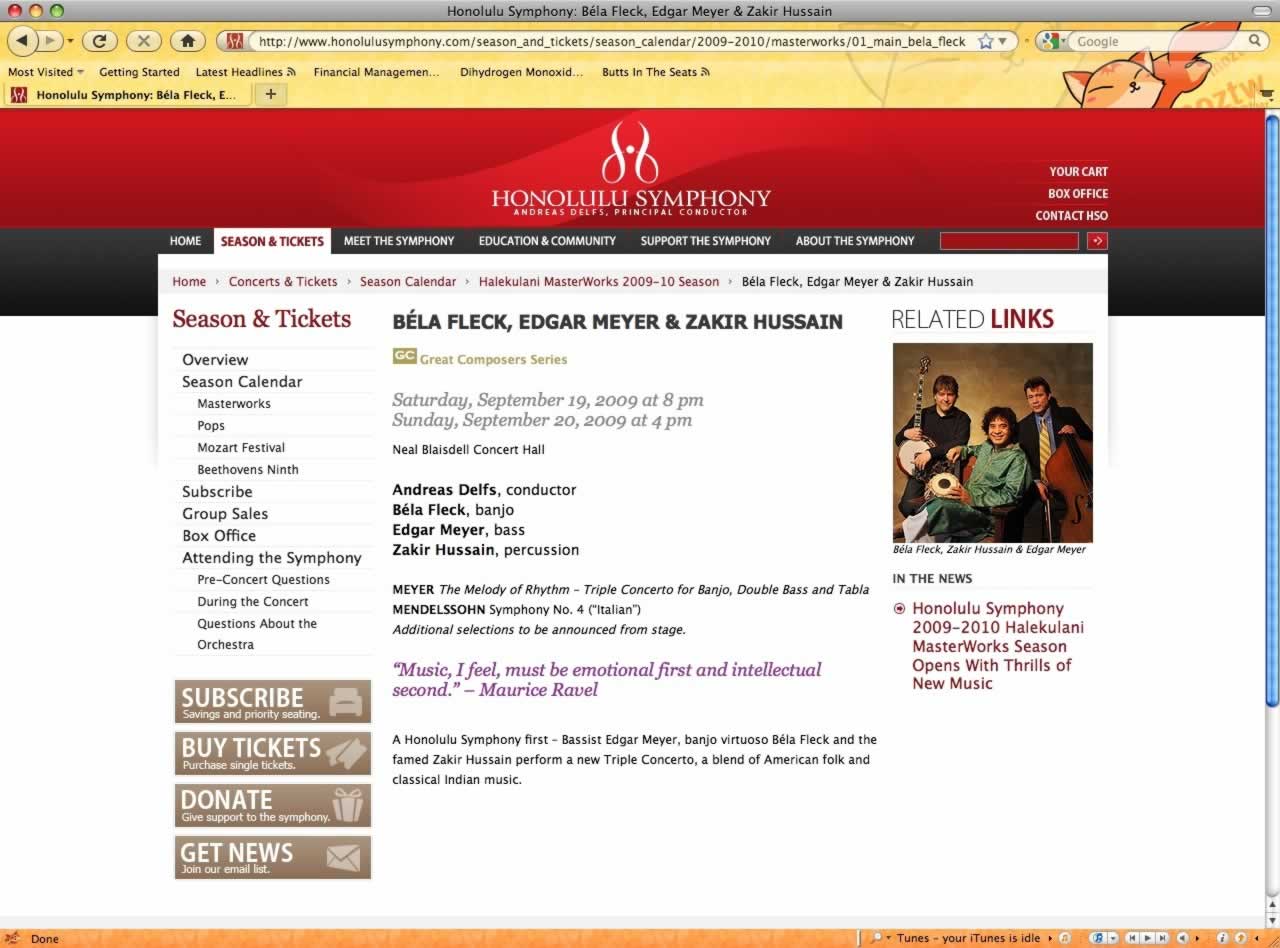
fleck screen grab

A woman in the party noted the program listed the Mendelssohn first but she thought the trio would be participating in that piece.

I have to confess made similar assumptions. Even though the order in the program was reversed from the website, the trio’s names were listed so prominently, for a moment I thought maybe they were playing in the Mendelssohn. Then I began to wonder if there had been enough time for them to rehearse with the symphony to do a credible job. (Well, if I am really being truthful, I thought they were going to be playing Ravel. If you notice there is a Ravel quote on the screen capture above I had it in my head I might get to hear Bolero interpreted on the tabla, banjo and double base. You gotta admit that could be cool. )

Then I remembered something I had read on a blog this past spring/summer. I thought it was either an entry or a comment on one of my Inside the Arts compadres blogs, but I couldn’t find it. (Happily link to it if someone points it out.) In any case, someone wrote something to the effect that the common practice of Pops concerts was to make you sit through classical to get to the featured pops artist.

In any case, the people I was standing near didn’t sound as if they felt they had been hoodwinked, but did sound a little mystified about the experience. I am sure their concerns were forgotten in the second half of the evening. I am hardly an expert on the music, but I found the piece Meyer wrote for their three instruments very engaging. They played a couple more pieces, did their bows and then came back for four encores.

It was a conversation I overheard walking out to the parking lot that I hoped was not widely held. The people behind me pondered if the orchestra musicians might be angry about the recent financial difficulties because they were so stiff and emotionless compared to the guest artists which one woman described as looking as if they were having fun. One of her companions suggested the orchestra musicians were probably required to maintain a discipline like soldiers.

I imagine that isn’t too far from the truth. Bela Fleck nodded his head and mouthed the tabla beats as Hussain played and exchanged a look with Meyer that seemed to say “he is kicking butt.” Hussain grooved out while Fleck was playing. (Meyer was profile to me so I couldn’t see what he was doing as well.) Having an entire orchestra exhibiting their individual reactions to a performance is likely to get distracting if the focus is supposed to be on the music.

During the performance, I had some interesting conversations with the woman next to me. I think she thought I had some sort of expertise in classical music or at least the attendance experience because I correctly guessed that the people lined awkwardly along the edge of the stage and the walls of the seating area were there to perform “The Star Spangled Banner.”

She told me the best place to sleep was in the orchestra hall. I suggested that it was an expensive undertaking to spend so much only to sleep and it might be better to buy music. She told me she could never experience the quality she was that night because she didn’t have an expensive stereo system.

I don’t know that she actually slept, but she did spend the first half with her eyes closed and her hand across them. I can’t imagine she comprises a significant untapped niche for orchestras. For me the encounter just proved that we can never entirely understand the nuances that provide people with enjoyment while attending events.

Near the end of the performance, everyone rose to give Messrs. Fleck, Hussain and Meyer a standing ovation. I didn’t stand because I was pretty sure they weren’t done yet and had held some great stuff in reserve. My new friend turned and asked, “Wasn’t that good enough for you to stand?” When they were done, and don’t get me wrong they did confirm my suspicions, I felt a little obligated by her earlier question to stand and make a comment that now I was ready to stand.

I felt a little insincere doing it. I generally have no problem keeping my seat and clapping enthusiastically while the world rises around me. But I have never had anyone looking to me for leadership and confirmation. In retrospect, I am not sure if they deserved it or I just succumbed to the pressure.

Art and Crime Bonus Entry

Speaking of the intersection of crime and the arts, Pacific Business News reports that the already cash strapped Honolulu Symphony suffered a break in this weekend. Fortunately, there wasn’t a lot of damage and very little was stolen.

Jackson said Honolulu Police Department officers described the break-in as a typical “cash grab.”

“There was a ransacking of papers and that kind of thing, but only an undisclosed small amount of money was taken — no equipment or computers,” she said.

Okay guys, do you read the newspapers? You go in to business that hasn’t paid it’s employees in nearly 12 weeks trying to find money?

Heading To Other Shores

I was pleased when Ron Spigelman over at Sticks and Drones chose to start Take A Friend to the Orchestra Month by acknowledging the poise with which the Honolulu Symphony Orchestra musicians and administration were conducting business in tough economic times in contrast with the tensions other classical music organizations were facing. Granted with their pay six weeks in arrears, the moral victory didn’t go very far in putting food on the Honolulu musician’s tables or paying their mortgages, but at least they had the consolation that someone noticed and appreciated their approach to the situation.

Unfortunately, things may be getting a little tougher for the symphony. The Honolulu Symphony announced yesterday that Executive Director Tom Gulick will step down when his three year contract expires on June 30. (Seems like it was just last year I was heralding his arrival.) Gulick has been credited with doing much to increase the financial support and income of the symphony. Whether he is leaving of his own accord or because the board decided he hasn’t done enough is unknown to me at this time. In any case, this leaves the symphony without executive leadership for a time and requires the expenditure of time and dwindling resources to search for another.

Though if you think about it, Honolulu’s composure might work to its benefit. If you are a potential executive director, you know just about any organization you join in this financial climate is likely to be in tenuous financial shape. Wouldn’t you be more inclined to interview with an organization which has proved it can resist the general trend toward acrimonious relations between administration/board and musicians? (Not that living in Hawaii doesn’t have its appeal as well.)