What Do You Know About Your Emails?

If you are like me, you may be taking time this summer to re-evaluate some of your practices like email marketing. Last year, I came across an interesting set of email marketing myths.

Now I know, these sort of articles are pretty common so I did a search for similar stories and actually found this list popped up fairly frequently. That must mean this list of myths is true…or that they have a really good email mailing list. In either case, they must know what they are talking about, right?

Two of the “truths” that caught my eye were for myths 2 & 3 – 85% of opens happen within two days of receiving an email, but only 21% of purchases happen during that period. 32% happen two weeks after. And “20% of your annual openers do so after being inactive for 6 months.”

First, let me say for the record I can’t believe any company is actually ceasing to send me emails after I fail to respond or take action for 6 months. It is hard for me to believe any company thinks they should give up after 6 months and actually does it.

That said, the basic idea that people are engaged by your communication and your organization long after you might assume they are hearkens back to the research presented by Andrew McIntyre a few years back that indicated people often felt a close association with a company/arts organization even after 2-3 years of inactivity.

This is just another bit of evidence from a different quarter that reinforces the concept of not giving up hope that a person will continue their participation in your activities.

The facts for myths 4, 5 and 6 were interesting to me. The fact that fewer than 1 subscriber in 2000 will tag an email as spam was interesting me. I don’t think I ever tagged a non-Viagra related email as spam myself, but I always worry that recipients might be liberal with the spam button. I am less concerned now.

I was also surprised to learn “sending four emails a month instead of one doubles the number of consumers opening one or more emails..” Post author Mark Brownlow explains,

“Don’t get misled by changes to rates. All things being equal, if you double your frequency and average click rates drop 20% that’s a win.

1000 mails/month at 10% CTR = 100 clicks

2000 mails/month at 8% CTR = 160 clicks

The converse is also true. If you remove 60% of your list and see click rates double, you’re actually losing.

1000 mails at 10% CTR = 100 clicks

400 mails at 20% CTR = 80 clicks”

In responding to myth 6 about shorter subject lines being better, Brownlow encourages people focus on being efficient with subject lines, but give yourself permission to use whatever words are necessary to make your impact. The infographic presents some interesting data about subject lines – less than 60 characters increase opens, but those over 70 characters increase clicks.

Of course, as they say, your mileage may differ and you really need to pay attention to the characteristics of those you are reaching. Brownlow cautions in the comments section, “…Many recommendations are based on scenarios or averages that may not fit your particular situation. As you say, testing is important…”

If you are apt to dismiss the data in the infographic as not matching your experience, then you can’t cleave to the myths as being true in turn because they aren’t likely to be true for your situation either.

Even after decades of using email, it is extremely difficult to calibrate its use as a marketing tool because the way people use the technology is constantly evolving.

I am keeping one eye turned toward Adam Thurman over at Mission Paradox blog. Last month, he was looking for guinea pigs to test and provide feedback on his email marketing class. I am interested to see what he may have developed.
If You Love Your Brand, Set It Free

Last week I reflected on Adam Thurman’s recent post about wrestling corporation WWE reinventing itself three times to adapt to changing audiences.

He followed up with a post about how the visible manifestation of rebranding has to reflect an internalized change that has already started within the company, or else the rebranding fails.

He suggests organizations commit to rebranding themselves every 7 years or so.

His post reminded me that Japanese anime series change their opening sequence and music every time the season changes, which can happen multiple times a year. As an example, here is the opening of D.Grayman season 1 versus season 3.

There is continuity of characters and basic artistic look to let fans identify their favorite anime series when a new season comes out. However, other than the Drew Carey Show whose changes in opening sequences didn’t necessarily synch up with changes in seasons, I can’t think of too many American shows that make a regular change. (Granted, apples to oranges comparison.)

In any case, while most arts organizations may put out a different brochure every season, they may not change the look of their website as regularly. That might be something to consider, especially if you can feature the work of a local visual artist to draw attention to them as a resource.

It could be especially effective to change the header of a monthly newsletter since that can take less effort than revamping an entire website. Doing A/B testing with different art can help identify an effective look and identity for the organization.

You can probably get a high open rate on your emails if you tell people you want their feedback. This month half are getting one piece of art and the other half another, next month the art with switch for both groups. That way people not only are engaged by the request for feedback, but there is a sense of competition with another group about who got to see the better artwork first.

Wrestling With Your Audience Composition

I am rather busy wrapping things up here at work and preparing to move, but I wanted to make a nod in The Mission Paradox blog’s direction for a post he made about reinventing one’s organization.

Adam Thurman had been tweeting in advance of his post about how many times he attended Wrestlemania and how wrestling held lessons for arts and cultural organizations so I was curious to see what he had to say.

I had watched wrestling once upon a time, but drifted away for various reasons, including the fact the basic plot was pretty repetitive.

Yes, you could say that about arts organizations which revive the classics. Romeo and Juliet aren’t ever gonna get any less dead (though you never know…) But these days, there are probably more people for whom the classics are brand new than repeats.

But you have to admit, while the basic formula does repeat itself, there is a heck of a lot of drama that goes on before anyone ever enters the ring. Much of it harkens back to some basic archetypes with which people can identify: heroic journeys, villains, anti-heroes, talismans of power, ethical quandaries.

Thurman addresses some interesting facts I wasn’t aware of about how wrestling giant WWE reinvented itself twice in order to appeal to changing demographics and tastes.

What If They Don’t Want To Be An Executive Director?

On the Harvard Business Review blog site, Anne Kreamer asks “What If You Don’t Want to Be a Manager?” (h/t Daniel Pink) where she talks a little about the alienation one might feel moving from being a producer of material to a manager. While she talks about an experience in a corporate environment, it was easy to see the same situation cropping up in the arts when someone moves from creating content to producing revenue reports and reviewing labor laws.

One of the options Kreamer suggests, other than leaving the company and striking out on your own, revolves around changing the existing work environment. It was her last two sentences that resonated with me (thus my emphasis).

This is something more companies need to address. To remain globally competitive, organizations need to devise innovative ways to encourage and reward creativity. The unorthodox titles embraced by start-ups — directors of fun, ministers of information — can seem ridiculous, but the emphasis on improvising new ways of doing business is important. Furthermore, research conducted by Office Team found that 76% of employees did not want their boss’s job. If employees are no longer responding to the old carrots, it’s time for companies to establish new means of rewarding talent.

This reminded me of the Daring to Lead and Ready to Lead reports I had written on in the past that reported young arts leaders were chomping at the bit to gain greater responsibility in their arts organization, but didn’t necessarily want to assume an executive role.

It got me to thinking that while there is a lot of discussion about exploring new business models for arts organizations like the B Corporation and L3C, maybe there needs to be a corresponding discussion about changing arts job descriptions so that people actually want to assume the roles.

Two issues that seem to rise to the top for executive directors is work-life balance and that the position seems 75% about fundraising and increasing. It may be time to institutionalize the idea that marketing and development aren’t the sole province of those departments by spreading the responsibility around in job descriptions.

I have read a lot of criticism of Michael Kaiser’s ideas, but I have never seen anyone say he is wrong when he advocates for paying attention to the interests of potential donors and connecting them with your corresponding needs rather than viewing them as the source of a lot of money to answer the need you have prioritized.

With the proper training and expectations declared at the outset, marketing, education and artistic staff could take a more proactive role in identifying, engaging and meeting with donors than they do at present. Hopefully freeing the executive director to balance their personal and professional lives, improve their job satisfaction, connect back with the parts of the organization that excite them, and perhaps encourage others to crave their position.

The same can obviously be done with marketing where development, education and artistic, etc. are more active in expressing and advancing the organizational message.

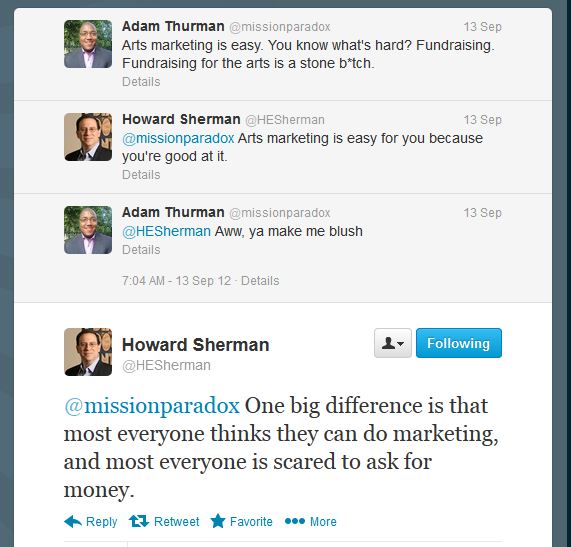
I think people are already cognizant of this interdependent need based on a Twitter exchange between Adam Thurman, Howard Sherman and others this past September.

devmarketing1
devmarketing2

What Would Happen To Wine If Everyone Wanted Free Grape Juice

Hat tip to Adam Thurman for distributing the link to an interesting piece about devaluing artistic content by Todd Henry. Henry wonders about the fate of artists when increasingly the view seems to be that content should be free.

“This means that artists have to shift their business models to give away (or make available for cheap) their main art, and instead focus on selling scarce peripherals. Authors sell lectures. No longer able to make a living from recording, bands sell tickets to concerts and survive off of merchandise sales. Content creators give away their content in order to gain eyeballs and ears,…

The problem is…some people are just great at being artists. They aren’t great at business models, distribution or line extensions. They just want to make great, valuable art and sell it at a fair price. What do these people do?
[…]

Would we have had The Beatles if they’d been told, “Never mind spending years in the studio crafting your records. Those things are just promotional fodder to sell these snazzy Sgt. Pepper t-shirts and posters. You should focus instead on how you’re going to monetize.”

I am currently exploring bringing a show, which heretofore has only existed on YouTube, to our stage. The creative team is actually excited that they might not have to cover most of their expenses out of pocket for once.

Until Todd Henry pointed out that increasingly it is ancillary products rather than the artistic product supporting the creation, it never occurred to me what a bizarre situation it is. These guys from the YouTube show I am talking to mentioned the same thing–T shirt sales helped defray some of their expenses.

But there are a million stories in the naked cit.. -erm, YouTube and not everyone is going to be paid for them. We already know that places like YouTube are eroding the concept that you should have to pay for content. People will clearly continue to create content and try to support it however they can. I don’t think an effort to inspire a shift in attitude is going to gain much traction.

Though who knows, I hear Comcast cable is trying to get people used to the idea of paying for bandwidth consumption. As much as I am resistant to the idea, it could change attitudes about paying for content as well.

To extend the question Todd asks about killing the golden goose, I wonder how many creatives will persist until their abilities mature if few are willing to pay for the content. That might be the real long term threat.

The guys I am trying to present are young and their show is fun. But what happens in a few years when they settle down and look to raise a family and they decide they don’t have time to create content alongside their regular job and family? The fact artists have never been paid well has always been a problem, but if even the possibility of a pittance wanes then unremunerated recognition becomes the only motivator to create.

Artists and other creative types need time to allow their skills to develop. Ira Glass said as much in the speech I linked to last week. As a country, we need creatives to mature into their abilities rather than quit early on.

Recognizing Your Customers

There has been a post on The Drucker Exchange that has been nagging at the edge of my unconscious for a couple weeks now. Actually, it was one line from a news piece about how the Massachusetts Department of Transportation has been able to replace bridges in days rather than years.

“The highway department didn’t use to see the drivers as customers,” Frank DePaola, administrator of the highway division for the department, told the Times. “For a while there, the highway department was so focused on construction and road projects, it’s almost as if the contractors became their customers.”

There is obviously a lesson here for all businesses, including arts organizations about taking a step back and re-evaluating who your customer is. Often times it is multiple people.

Adam Thurman illustrated this in a post he made yesterday about buying a suit.

“He told me that he understood that no one really needs a suit…
[…]
He understood that people aren’t really paying for a suit, they are paying to work with a person that truly gives a damn about how they look. They are paying for the feeling they get when they look good.

It takes a certain humility to embrace that thought. It takes a humble artist to understand that it isn’t all about her or her art, it’s about the audience and the feeling they get from the experience.”

I actually took the time to follow a link in the Drucker Exchange post to one of Peter Drucker’s books, Management: Tasks, Responsibilities, Practices where he talks about the fact that there are often many customers that have to be pleased. For example, in some cases, it might be both the consumer and a government regulator, each of which have vastly different definitions of what they value.

Another example Drucker gives addresses how people’s priorities change over time–a teenage girl wants the most stylish shoes with price being a lesser concern and durability being of no concern. Her older sister (or the same girl in a few years) will have these same priorities in different proportions.

Arts organizations have seen this effect. When people reach a certain age, they tend to gravitate toward the arts more frequently than when they were younger because their priorities change. The challenge being faced now is that overall social priorities have gradually shifted over time as well so while people’s priorities still mature over time, the way they choose to express those priorities are manifesting in a different manner.

So in the context of all this, one of the challenges I constantly face in serving my customers is the perception that our theatre is hard to find and get to. Even though I recognize this is a need to be served, it really confounds me and is therefore somewhat akin to my not recognizing who my customers are.

There are standard department of transportation road signs directing people to us from 2-3 miles out. To get to the theatre from the highway, you make a right, go three lights, make left, go to the bottom of the hill, make a right, make a left and you are pretty much delivered to the campus. It is generally straight drives and right angles. There are no confusing one way streets to navigate. Everything is well lit and on major thoroughfares with regular signs. Parking is free and plentiful.

I understand that people might overlook the signs, obvious though they are. We offer directions and maps for download off our website that include reverse directions so that you can get back home. We have copies of those directions available in the lobby as well as people depart.

We have a dedicated directions line you can direct dial to, which from the feedback we have gotten, I suspect people are listening to on their cellphones as they drive.

My suspicion is that “hard to find” really means they are unfamiliar with the location because they don’t drive by the neighborhood on a regular basis. We are separated from the local retail area by an interstate and there is no reason to drive across unless you attend school or live in the neighborhood.

The other problem is that most people probably use GPS or Google Maps instead of checking our website for directions. Unfortunately, the shortest distance route actually makes you get off the highway three miles early and takes you through a zillion stop lights. At certain times of the day, that route can easily add an hour travel time due to traffic.

These aren’t things I can solve, though I am always looking for options. One thing I will try to do is communicate the sources of reliable information more frequently via various channels before people embark on a trip to the theatre.

If anyone has suggestions or stories of how you solved this sort of problem, I would love to hear about them.

Yeah, Sometimes It IS Boring

I wasn’t quite sure what I was going to post about today, but Adam Thurman at Mission Paradox decided me with his post today about reducing the opportunities for audiences to be anxious about their attendance experience.

He starts his post:

When I picture someone entering a live performance venue I imagine a thought bubble above their head. Here’s the thought inside that bubble:

“Man, I hope this doesn’t suck.”

Interestingly enough, that is what I was thinking when I was driving to see a dance show this Saturday. I didn’t have too much basis for real concern since I knew the curators who put the show together and had worked with close to half the groups who would be performing. On the other hand, the event was billed as cross cultural and you never really know how successfully performers will execute their vision of what that means.

I think most of you with any experience in the arts know what I mean. Like me, I am sure you have seen some pretty awful stuff performed right after some pretty good stuff and are uncertain how the night will turn out.

Question is, do most people in our audience members know we have the same concerns abut enjoying the as they do? Do they know we can be worried about not liking the performance or being bored?

I suspect they don’t. I suspect they feel our disappointment with a performance will be expressed in terms of the failure of its attempt to illuminate the futility of the post-modern vision against the fin-de-siecle fatalism of the last decade.

Andrew Taylor once wrote he felt it was counter productive for arts organizations to never admit any program supported by a grant did not perform as planned or better.

“It’s an insight as old as theater — conflict, flaw, and tension are what make narratives compelling. And yet, read through most arts marketing materials or grant applications and what will you find? Perfection, triumph, success, and positive spin. Their performances are always exceptional. Their audiences are always ecstatic. Their reviews are always resounding (or mysteriously missing from the packet). Their communities are always connected and enthralled. In short, they are superhuman, disconnected, and insincere.”

I would say the same is true with audiences. We advertise everything we do as the most exciting and seminal work they will ever see but never concede audiences may not be in ecstasy every moment they are in the theatre. As a result, audiences expect to be in ecstasy and may either decide there is something wrong with them for not feeling amazed or decide they have been had by a bunch of B.S.

One of my favorite episodes in Drew McManus’ “Take A Friend To The Orchestra” program came about 6 years ago when Drew took the brother of WNYC Sound Check host, John Schaefer, to a concert by the Chicago Symphony Orchestra. Jerry Schaefer had never been to an orchestral concert before. One of the parts that impressed me the most was that Drew admitted that he often gets bored at times during a concert and that it was okay to be bored at times.

I am not suggesting a full confessional after every performance outlining everything that went wrong. One common theme on this blog has been the idea that we need to speak about the arts experience in everyday life –when we are waiting online in the supermarket, at parties and picnics, in elevators and on buses. I am not talking about announcing your boosterism aloud in public places, but rather getting people to talk about their experiences, fears, anxieties, passions, etc., in relation to the arts. Part of that conversation needs to be acknowledging that, yeah sometimes it is boring; sometimes is it bad; sometimes it is confusing, even for those of us with a lot of experience.

The benefit people in the performing arts have as audience members when it comes to artists who are not household names is that we may often know more about the artist’s reputation than most. We can enter a performance space or gallery with a higher degree of confidence about the experience than others might.

This isn’t a peculiar characteristic of the arts, it just comes with exposure and experience. Sports fans will know what match ups are likely to be most exciting than will a new attendee to a game. Sports fans will recognize when a high stakes situation is developing while a novice allows their attention to wander.

While there are entire cable channels and sections of newspapers dedicated to educating people about why certain sports match ups will be exciting, the Arts and Entertainment channel shifted its focus in other directions and newspapers are dropping their culture reporting. The arts have to mostly rely on word of mouth and those with the most knowledge aren’t really speaking often or in a compelling manner that acknowledges the beauty and the flaws that make the beauty all the more remarkable.

And believe me, I include myself among those not communicating in a basic, honest manner devoid of marketing spin.

Wait, What Is This Guy Actually Talking About?

In the morning when I look at all the Twitter streams I follow, I often click interesting looking links and then come back to the web pages when I am done with all the new tweets. The result is often a long series of tabs on the Firefox browser and often I don’t quite know who suggested what story when I get around to reading it.

Since most of those I follow have an association with arts and culture, you might understand why I initially thought the blog post I was reading was on that subject. It wasn’t until I got to the sixth point that I had any inkling it was on another industry altogether and the eleventh before I was sure.

RULES FOR BUSINESS MODELS

* Tradition is not a business model. The past is no longer a reliable guide to future success.

* “Should” is not a business model. You can say that people “should” pay for your product but they will only if they find value in it.

* “I want to” is not a business model. My entrepreneurial students often start with what they want to do. I tell them, no one — except possibly their mothers — gives a damn what they *want* to do.

* Virtue is not a business model. Just because you do good does not mean you deserve to be paid for it.

* Business models are not made of entitlements and emotions. They are made of hard economics. Money has no heart.

* Begging is not a business model. It’s lazy to think that foundations and contributions can solve news’ problems. There isn’t enough money there. (Foundation friend to provide figures here.)

* There is no free lunch. Government money comes with strings.

* No one cares what you spent. Arguing that news costs a lot is irrelevant to the market.

* The only thing that matters to the market is value. What is your service worth to the public?

* Value is determined by need. What problem do you solve?

These sentiments are actually about news delivery and found on Jeff Jarvis’ BuzzMachine blog. For awhile there I thought an arts blogger was replicating Adam Thurman’s posting style on Mission Paradox. I had to go back to my Twitter account to try to figure out where the heck I got this link, finally discovering it was the Artful Manager, Andrew Taylor.

Honestly now, if I hadn’t alluded to the fact it wasn’t about non-profit arts and cultural organizations, would you have known it wasn’t? Every point made is a topic of conversation that has come up regarding the arts. Hopefully, they are conversations you have had at least with yourself, if not the staff and board of your organization.

The fact that news organizations are facing these same questions is of some comfort–at least we know the arts are not alone in the challenges being faced.

At the same time, the fact these questions can be asked of the news industry only serves to confirm their wider relevance. These are questions any business must ask. The arts are not special in this regard.

As much as I feel my practical side provides a good balance to my idealism, it is tough to think about the arts not being the exception. Every time I scroll up to re-read these points and see “Virtue is not a business model,” and “Business models are not made of entitlements and emotions,” there is a part of me that says, “Yes, but the arts are different.” In many respects this is true, but the arts in the U.S. operate in an environment where what is written above is also true to a great degree and must be acknowledged.

Rather than try to talk all of us out of our belief in the sublime experience the arts can bring to every day existence, I will merely stress the need to be mindful of the aforementioned truths and not allow our aforementioned belief in the power of the arts to dismiss the stark reality they represent.

Presumed Disappointing

Adam Thurman at The Mission Paradox made a great blog post yesterday pointing out that, unfortunately, when it comes to the question of whether they will enjoy an opportunity to interact with the arts, the default assumption many audience members hold is “no” until convinced otherwise.

“Most people, when given the option to attend a performing arts event, are more scared that the performance is going to be disappointing then they are excited that the performance is going to be good.”

He goes on to say:

“This is the thing we have to remember:

We are in the trust business.

Not the theatre business.

Not the museum business.

The trust business.

When you are dealing with a risk averse public the only way to get them to do a risky thing is by earning their trust.

How do you earn their trust?

By building a relationship with them.

My observation is that most of us in the arts are very good at putting up programming, but we aren’t good at building relationships.”

It put me in mind of an entry I did about three years ago where I cited an entry on Neill Roan’s old blog (oh why, oh why did you shut down that blog!), titled “How Audiences Use Information to Reduce Risk.”

In the entry I talked about the efforts I was going to inform people about performances since they often commented they hadn’t seen anything about the show. Reviewing the entry, I realize now that the problem we likely face is that people’s primary expectation is to receive notice in the newspaper or radio because that is where they traditionally have gotten the information. The problem is, people aren’t using those media in the same way they used to. Their expectations don’t align with their practice any longer.

In that entry I spoke of using electronic notifications, word of mouth and opinion leaders to help disseminate information about performances. One thing I missed that Adam speaks about is relationship building. It is true that people need to view the information you provide as credible, but they also need to believe that you will provide an enjoyable experience even if they end up less than thrilled about the performance.

Just last week Drew McManus cited a situation where the non-artistic elements of an evening combined with a partially disappointing/partially sublime artistic experience with the net effect being negative. Some of the non-artistic elements were entirely out of the arts organization’s control, others could have been ameliorated to some degree.

Certainly people aren’t coming for the parking and an easy ticket office experience. You gotta deliver the goods artistically. The relationship building comes when people know your artistic quality is pretty dependable and can trust that you will make an effort meet their needs and expectations and reduce problems that arise.

“Don’t Let Them Use Your Passion Against You”

I always enjoy reading Adam Thurman’s work on Mission Paradox. Recently he posted “An Open Letter to Arts Administrators.” As an arts administrator, I felt obligated to disseminate it a bit. It contains advice that, even if you have heard it before, bears hearing again to remind you of a few things. (It’s also mirrored on Arts Blog. You may find the comments there worth reading.)

The section that particularly resonated with me was:

3. Don’t let them use your passion against you. Consider this:

Imagine you were a lawyer. What if I told you that there were some law firms (not all, but absolutely some) that didn’t get a damn about their employees? What if I told you that some firms were designed to bring in people and get as much out of them as possible before they burned out?

Would you believe me?

Of course you would. Hell, because it’s the legal profession you would expect such behavior.

Here’s da rub:

Some arts organizations are the exact same way.

Just because the end product is art and not a legal brief doesn’t mean the place automatically values their employees. Just because the place is a non-profit doesn’t automatically make it a nice place to work.

But here’s the really messed up part. At some of those arts orgs, if you complain that the hours are unreasonable, or the pay is low, or your input isn’t valued . . . they imply that your commitment to the “cause” is low. They convince you that if you really were passionate about your work, you would put up with the sub par conditions.

Don’t fall for it. It’s a trap. Remember point 1, it doesn’t have to be like that . . . you deserve better.

Been there and done that. I am ashamed to say that I am pretty sure I tacitly supported the “your commitment to the ’cause’ is low” message against other people in at least one place I worked even as I resented working under those conditions. I imagine I enjoyed the approval of my willingness to suffer for the cause and in the absence of any real remuneration, sought more praise by pressuring other people to toe the line. Though I have also declined contract renewals in places with poor work environments, too.

I was encouraged by the memory of two studies I read and blogged on last year, one by Building Movement and another commissioned by the Myer Foundation which showed that the new generation of leaders seek a greater balance between work and personal life and aren’t buying the idea that suffering is proportional to commitment.

What may be the downside for many non-profit organizations is that the leadership, recalling that they sacrificed and brought the company into being by force of will, are reluctant to groom these new leaders because of a perceived lack of commitment on the would-be protege’s part. One desirable benefit can be that the replacement won’t perpetuate a stressful environment. A board expecting the miracles of the last executive director might not make that easy.